



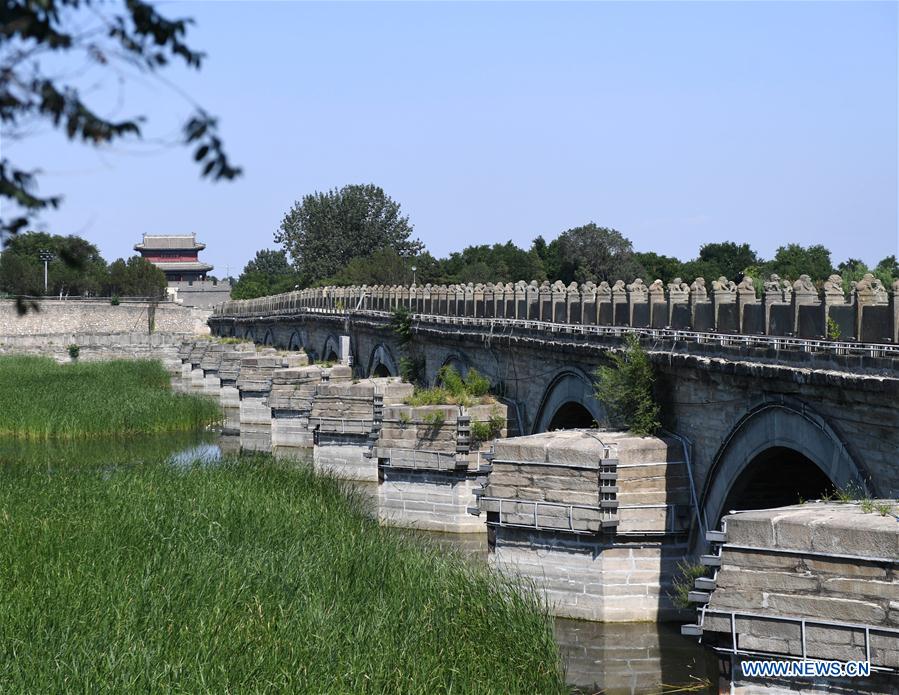
Photo taken on July 7, 2020 shows a view of the Lugou Bridge in Beijing. [Photo/Xinhua]
On Jan 26, 2026, during a cross-party leaders' debate organized by Japanese media, Japanese Prime Minister Sanae Takaichi openly stated that in the event of a "contingency" in the Taiwan Strait, Japan "must rescue" Japanese and American nationals in Taiwan, and that Japan and the United States may even take "joint actions". Once again, Takaichi used "protecting overseas nationals" as a pretext for the use of force concerning Taiwan and for interference in China's internal affairs. It shows that the toxic legacy of Japanese militarism is far from eradicated.
Looking back at modern history, Japanese militarists repeatedly committed aggression against China in the name of "protecting overseas nationals". In the context of international law, protecting overseas nationals refers to a sovereign state's lawful efforts to safeguard the legitimate rights and interests and personal safety of its overseas citizens through diplomatic and consular channels. Yet in the dictionary of Japanese militarists, "protecting overseas nationals" was reduced to a deceptive ploy to incite wars of aggression, encroach on the territories of neighboring countries, and seek regional hegemony.
In 1900, in the name of "protecting the Japanese embassy and nationals in China", Japan sent troops to join the Eight-Nation Alliance and invaded Beijing and Tianjin. In 1901, the Qing government was forced into signing an unequal treaty — the Boxer Protocol. As a belligerent power, Japan obtained massive reparations and the right to station troops along the railway line in the triangular area of Beijing, Tianjin and Shanhaiguan. In fact, on the eve of the treaty's signing, Japan had already dispatched troops to North China to "protect railways and Japanese nationals". After the treaty was signed, these troops were formally designated as the "Japanese China Garrison Army".
In 1928, the Japanese government sent troops to Shandong under the cover of "protecting overseas nationals on the ground", forcibly stationing them in Jinan, Qingdao and areas along the Qingdao-Jinan Railway. On May 3, in blatant violation of international law, Japanese troops stormed the Shandong Negotiations Office, where they tied up, tortured and brutally killed diplomatic personnel. Japanese troops continued their atrocities in Jinan until May 11, killing 6,123 Chinese soldiers and civilians and wounding more than 1,700. This was known as the Jinan Massacre.
On Sept 18, 1931, Japanese troops deliberately blew up a section of the South Manchuria Railway, falsely accusing the Chinese army of sabotaging Japan's railway property and threatening the "rights and interests of Japanese nationals in Manchuria". Under this pretext, they brazenly launched the September 18th Incident and seized China's three northeastern provinces as a springboard to extend their aggression to North China, including Beijing and Tianjin.
In 1932, Japan intentionally staged an attack on Japanese monks in Shanghai, claiming it was an "anti-Japanese riot" that left Japanese nationals in "extreme panic" and "imminent mortal danger". Under the pretense of "ensuring the safety of overseas nationals", Japanese troops launched a surprise attack on Chinese garrisons in Shanghai, triggering the January 28th Incident. They then forced the Nationalist government to sign the Shanghai Ceasefire Agreement, seizing the right to control Chinese defense deployment around Shanghai.
In 1935, using as a pretext the assassinations of pro-Japanese figures in the Japanese concession in Tianjin, Japan demanded "protection of Japanese nationals in the Tianjin concession" and "protection of the safety of overseas nationals and security of Manchukuo". It forced the Nationalist government to sign the He-Umezu Agreement and the Qin-Doihara Agreement, creating the North China Incident and seizing most of the sovereignty of Hebei and Chahar provinces, including Beijing and Tianjin. Following the North China Incident, Japan instigated the "North China Autonomy Movement" and supported the establishment of the "East Hebei Anti-Communist Autonomous Government". From then on, North China became a key base for Japan's aggression and a target for resource plunder.
On July 7, 1937, while conducting military drills near the Lugou Bridge on the outskirts of Beijing, Japanese troops falsely claimed that a soldier was missing and demanded entry into Wanping County for a search, a demand firmly rejected by Chinese soldiers. Japanese troops then ordered an attack, citing "protecting overseas nationals" and "ensuring the security of the garrison". That was the Lugou Bridge Incident (Marco Polo Bridge Incident), which marked the start of the Chinese People's War of Resistance Against Japanese Aggression (1931-45).
These ironclad facts lay bare the consistent pattern of Japanese militarist aggression and expansion: first fabricating an incident, then spreeding the false narrative of "being victimized", and finally invoking the pretext of "protecting overseas nationals" to launch aggression, all to cloak its trampling of other countries' sovereignty and interference in their internal affairs in a veneer of "legitimacy and justice", inciting war frenzy at home while covering up atrocities abroad.