



By Guo Yuandan and Liang Rui
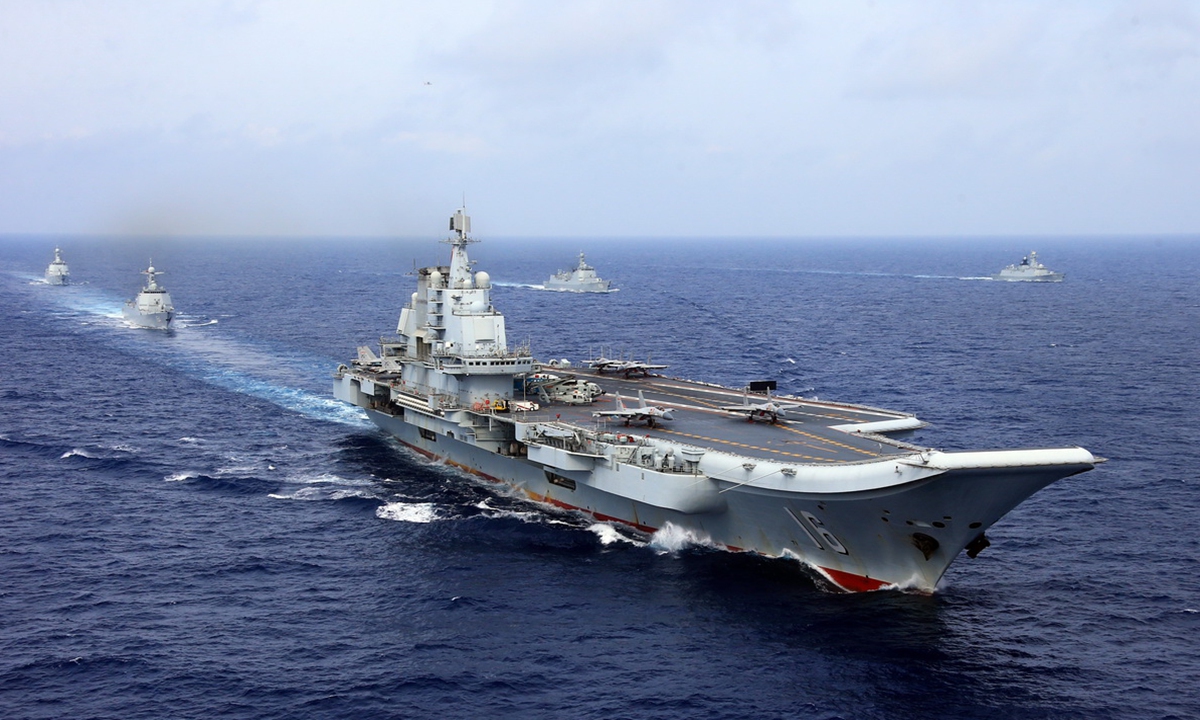
The aircraft carrier Liaoning battle group steam on the sea. The aircraft carrier Liaoning (Hull 16), several guided-missile destroyers, frigates and dozens of aircraft attached to the Navy of the Chinese People's Liberation Army took part in a combat exercise at an unidentified area east of the Bashi Channel in the western Pacific on Apr. 20, 2018. The exercise was a routine arrangement as a part of the PLA Navy's annual training plan. (eng.chinamil.com.cn/Photo by Zhang Lei)
On Tuesday, the Chinese People's Liberation Army (PLA) Navy sent a carrier task group led by the aircraft carrier Liaoningto relevant waters of the Western Pacific to conduct training on such subjects as far-sea tactical flight, live firing, support and cover, and integrated search and rescue, so as to test and enhance the realistic combat training capabilities, according to the PLA Navy official WeChat account.
A military affairs expert told the Global Times that as seen from the release, while this far-sea training is not directed against any specific target, the PLA's core mission is to defend the homeland and safeguard national sovereignty, security and development interests, thus serving as a strong deterrent against certain ill-intentioned countries and "Taiwan independence" separatist forces.
Zhang Junshe, a military affairs expert, told the Global Times on Tuesday that aircraft carriers such as the Liaoning, Shandong and Fujianare ultimately meant to operate in far seas to enhance their mission capability. Their strategic mission is twofold: first, to improve territorial defense capability by conducting maritime operations at greater distances to keep enemies at bay; second, to strengthen far-sea combat capability and protect overseas interests and sea lane security.
The Liaoning's far-sea training in the Western Pacific has become routine, aimed at improving both offshore defense and far-sea protection capabilities, Zhang said.
Though the Liaoning's far-sea drills have become routine, the PLA Navy does not always publicly announce every mission, Zhang said, especially this time, the announcement is made right at the outset of the operation, which is even rare, it carries a clear signal.
The expert noted that external parties, particularly Japan, have closely monitored the operation involving China's aircraft carrier, and may even hype the PLA's intentions in advance.
Japan has proven adept at such hype. In a draft of Japanese Defense Ministry's 2026 white paper revealed on May 16, Tokyo hyped that in June 2025, the PLA Navy, for the first time, deployed two aircraft carriers simultaneously in the Pacific, alleging that Chinese warplanes made "abnormal close encounter."
"Therefore, by releasing the information in advance, the PLA Navy has fully demonstrated openness and transparency, which can also reduce room for certain countries to hype the exercise," Zhang said.
This is a routine training organized in accordance with the annual plan, which aims to enhance the military's capability to fulfill its missions, and is fully in compliance with international law and practice, said the PLA Navy in its release.
Zhang said that naval carrier and surface action groups of other countries have long conducted training in the Western Pacific close to Japan, and Japan has even actively invited India as well as European countries including the United Kingdom, France and Germany to conduct drills in waters near Japan. In contrast, Japan has overreacted to and unfairly criticized the PLA Navy's routine far-sea training in the Western Pacific. "This is not genuine anxiety, but 'double standards' and viewing the PLA Navy's development and far-sea training through 'tinted glasses.' It is not a normal mindset," Zhang said.
Another striking feature of the release this time is that it disclosed specific training subjects. Notably, the inclusion of live‑fire drills differ from past descriptions, said the expert. Earlier description of the Liaoning's far‑sea training usually used the term "real‑combat training." "Therefore, it cannot be ruled out that the live‑fire drills in the Western Pacific this time are larger in scale, more realistic and more closely aligned with actual combat, effectively enhancing the troops' combat readiness and operational capability," Zhang said.
Zhang explained that live‑fire drills are fundamentally different from simulated firing. Live‑fire drills, which are more difficult, provide a stronger sense of real combat and allow for more accurate verification of tactics and assessment of effects.
The PLA Navy conducted a live‑weapon exercise involving its carrier group in 2016, Xinhua News Agency reported. Zhang noted that far‑sea live‑fire drills differ significantly from coastal exercises, as marine environments, weather and hydrology in far‑sea regions are much more complex than in coastal waters like the Bohai Sea.
"This imposes higher demands on ship performance, command and control, crew skills. Therefore, such drills play a positive role in honing the Navy's combat effectiveness and far‑sea capability," Zhang said.
Another noteworthy subject is "support and cover" drills, Zhang said. These drills serve two purposes: first, to enhance internal coordination and survivability of the carrier strike group through ship-aircraft mutual support; second, to enable the strike group to seize air and sea control in order to cover other naval forces, such as amphibious landing groups.
PLA's routine drills are often hyped by "Taiwan independence" forces. Cho Jung-tai, head of the island's executive body, claimed on Tuesday that the Chinese mainland is "the greatest source of regional unease and instability due to its ongoing military activities," reported Reuters.
The PLA Navy's release makes it clear that this far‑sea training is not directed against any specific target. However, the carrier strike group's own and ever‑improving capabilities in air defense, anti‑missile operations, anti‑surface warfare and land attack serves as a powerful deterrent to "Taiwan independence" separatist forces, the expert said. "This is conducive to maintaining regional peace and stability as well as safeguarding national sovereignty, security and development interests. Only those with ulterior motives would feel targeted," Zhang added.