



By Fan Wei and Chen Qingqing
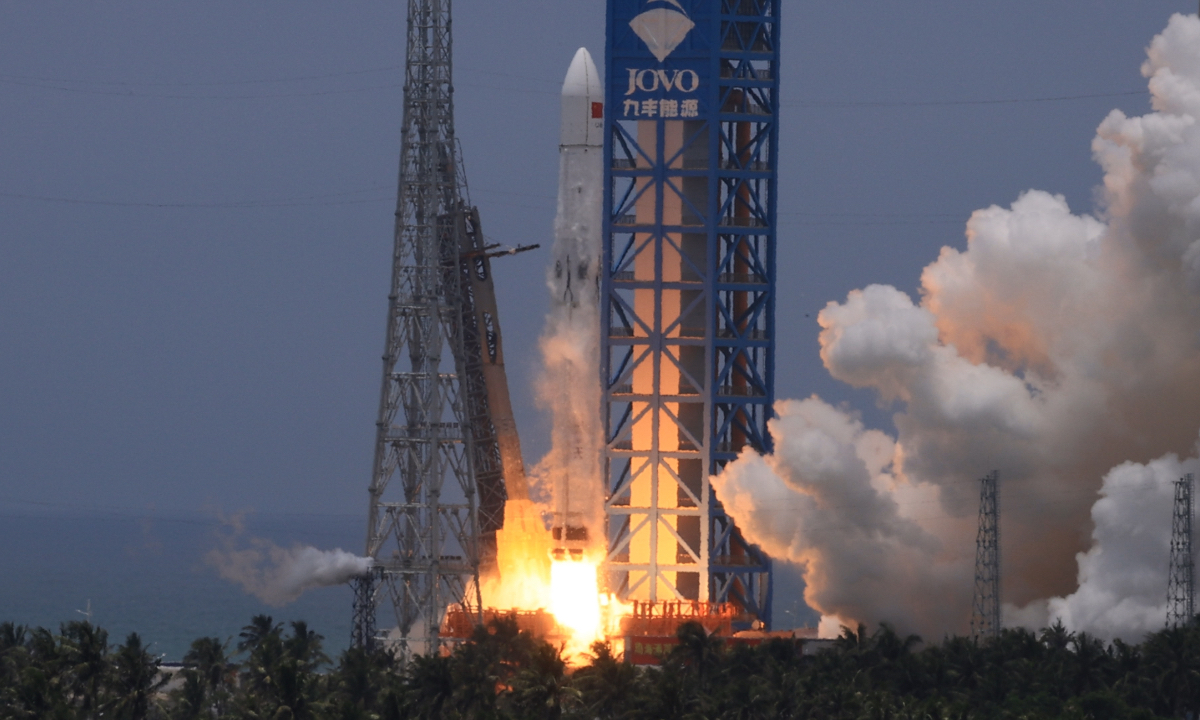
At 12:15 pm July 10, 2026, Beijing time, the Long March 10B carrier rocket lifts off from the Hainan commercial space launch site, successfully placing its satellite payload into the designated orbit and completing its maiden flight mission. Photo: Fan Wei/GT
Friday witnessed another historic moment in China's space program which unfolded over the South China Sea. At 12:15 pm Beijing time, the Long March 10B carrier rocket lifted off from the Hainan commercial space launch site, successfully placing its satellite payload into the designated orbit and completing its maiden flight mission.
Approximately six minutes after the separation of the rocket's first and second stages, the first stage made a controlled vertical descent and was successfully recovered through a net-based capture system on an offshore recovery platform located more than 300 kilometers away from the launch site. The first-stage recovery mission was completed successfully.
The Global Times learned that this mission marks China's first successful controlled recovery of a launch vehicle first stage and also the world's first net-based recovery of a launch vehicle. The Long March 10B carrier rocket has become China's first reusable launch vehicle to successfully complete a recovery mission.
The achievement represents a historic breakthrough in China's reusable rocket technology and will lay a solid foundation for accelerating the country's space access and return capabilities. It also marks China's entry into the era of rocket recovery.
Highly challenging, suspenseful moment
Before the maiden flight mission, a Global Times reporter had the opportunity to closely observe the Long March 10B carrier rocket in its upright launch position. The massive rocket body, standing roughly as tall as a 20-story building, along with its configuration featuring seven high-thrust engines operating in parallel, highlighted the significant challenges involved in achieving the country's first successful launch vehicle recovery.
The Long March 10B was developed under the overall responsibility of the China Academy of Launch Vehicle Technology (CALT), a subsidiary of the China Aerospace Science and Technology Corporation (CASC).
The rocket has a 5-meter diameter and adopts a two-stage tandem configuration. Its first stage inherits the configuration of the first stage of the Long March 10A carrier rocket and uses liquid oxygen and kerosene propellants, while the second stage uses liquid oxygen and methane propellants.
The rocket has a liftoff thrust of approximately 890 metric tons and a liftoff mass of around 760 metric tons. The maiden-flight vehicle measures approximately 63 meters in length. In its reusable configuration, it has a low-Earth orbit payload capacity of 16 metric tons.
"A 5-meter diameter is a mainstream design for today's large launch vehicles, as it allows for the integration of more powerful engines and a larger propellant capacity, supporting high-payload missions," Kan Lei, a rocket technology expert at the China Academy of Launch Vehicle Technology, told the Global Times.
Kan said the Long March 10B is capable of meeting various mission requirements, including the deployment of low-Earth-orbit satellite internet constellations and the launch of large commercial satellites. In its reusable configuration, the rocket can significantly reduce launch costs while offering advantages in high payload capacity and cost efficiency.
During the maiden flight mission, the Long March 10B continued its ascent for approximately 3,000 seconds after ignition. Kan Lei explained that during the ascent phase, the rocket's seven liquid oxygen-kerosene engines on the first stage completed the powered acceleration process.
After the separation of the rocket's first and second stages, the single liquid oxygen-methane engine on the second stage took over. Through a series of procedures, including a primary flight phase, coasting and attitude adjustment, and a second ignition, the rocket successfully delivered the satellite into its designated orbit with high precision. At the same time, the rocket body underwent passivation procedures to ensure safe disposal.
The return and landing phase was the core verification objective of this launch mission. The Global Times learned that after separating from the second stage at an altitude of about 100 kilometers approximately 150 seconds after liftoff, the Long March 10B's first stage began its descent and entered the return flight phase at a speed of several times the speed of sound.
"The return process consists of four stages: the coasting and attitude adjustment phase, the powered deceleration phase, the aerodynamic deceleration phase, and the landing phase," Wang Cong, a rocket designer at the China Academy of Launch Vehicle Technology, told the Global Times.
During the coasting and attitude adjustment phase, the first stage's grid fins are deployed and the vehicle completes its reentry attitude adjustment. At the same time, the propellant settling management system begins operation, guiding the propellant inside the tanks to collect at the bottom, ensuring sufficient preparation for the subsequent engine restart.
During the powered deceleration phase, the first-stage engine reignites to apply the brakes before the stage enters the denser layers of the atmosphere, reducing its velocity and preventing damage to the rocket body caused by factors such as intense aerodynamic heating during atmospheric reentry.
The first stage then enters the aerodynamic deceleration phase, which represents a key verification stage for the rocket's thermal protection design.
During the aerodynamic deceleration phase, the rocket relies on the aerodynamic drag generated by its grid fins to slow its descent. The bottom section of the first stage undergoes severe tests from aerodynamic heating and aerodynamic loads.
Finally, the first stage enters the landing phase. During this stage, a "near-hover" control strategy is adopted, with all available control systems working together. The rocket's grid fins and engines coordinate to control the vehicle's descent, while an online trajectory planning system generates an optimal control sequence.
Through precise control, the first stage's altitude and velocity are gradually reduced to a state approaching zero relative motion, before it is successfully captured and recovered by a net-based recovery system on an offshore platform.
During the Long March 10B's maiden flight mission on Friday, the rocket's first stage was precisely captured by the offshore recovery platform approximately eight minutes after liftoff. The entire process was a highly challenging and suspenseful moment.
A Global Times reporter at the site witnessed that many Chinese aerospace engineers involved in the development of the Long March 10B were moved to tears after watching the real-time footage showing the first stage's smooth landing.
China's space program had finally reached the historic milestone of successful rocket recovery, making China the second country in the world to master vertical rocket recovery technology.
World's 1st net-based recovery system
Currently, the vast majority of reusable rockets around the world adopt landing-leg recovery systems. The development team of the Long March 10B took a different approach by pioneering an offshore platform net-based capture and recovery technology.
This innovative solution provides a Chinese approach for large-scale rocket recovery operations worldwide and demonstrates the ingenuity and innovation of China's aerospace sector.
On Friday, as the Long March 10B's first stage descended from the sky, a vessel named the "Linghangzhe" rocket net-based recovery offshore platform had already been waiting over the South China Sea.
The giant ship, measuring 144 meters in length, 50 meters in width, with a draft of 5.5 meters and a full-load displacement of 25,000 tons, is equipped with DP2 dynamic positioning capability. It can use its own thrusters to counter environmental disturbances such as wind, waves and currents, maintaining a preset position or heading.
Combined with the net-based recovery system and other supporting equipment, the vessel can serve as a stable and highly precise mobile landing platform in the vast open sea.
"When the first stage of the Long March 10B reaches the airspace above the offshore platform's net-based recovery system, it continues to decelerate. The net-based recovery system uses pulley-driven cables to engage with and capture the first stage. The rocket's onboard navigation and positioning systems continuously collect real-time velocity and location data and transmit the information to the control system, which adjusts the rocket's attitude and speed accordingly. Meanwhile, the offshore platform's net-based recovery device monitors the rocket's status in real time and controls the movement of the cables through the ground control system," Sun Zhenlian, a technical expert at the China Academy of Launch Vehicle Technology, explained.
Sun described the process as a precise "two-way rendezvous" between the rocket and the offshore recovery platform. Through coordinated operation between the two systems, the first stage was accurately guided into the recovery net.
After the first-stage rocket body enters the net-based recovery system, its cable-hooking mechanism deploys in advance and then comes into contact with the four cross-grid-shaped cables.
Sun further explained that the rocket body gradually descends and is precisely captured. The entire process takes only a very short period of time and requires close coordination between the rocket body, the cables and the hooking mechanism. The instantaneous load places enormous challenges on the hooking mechanism, which must withstand complex forces during the stages of contact with the net, sliding and pulling.
"The hooking mechanism is like a pair of powerful hands that firmly grasp the rocket. Then, with the assistance of the offshore platform's net-based recovery system, the rocket undergoes buffered deceleration," Sun said.
After capturing the rocket body, the offshore platform's recovery system must further secure it.
"Due to environmental factors such as waves and sea winds, the rocket body may sway within the net-based recovery platform. The recovery system stabilizes the rocket through two steps. First, auxiliary securing cables fix the rocket body from multiple directions. Then, the automatic locking platform moves beneath the rocket body to complete the clamping and locking support process," Sun explained.
"It is like fastening a safety belt around the rocket, allowing it to remain stable even at sea. At this point, the rocket has been completely secured," Sun said.
The net-based recovery system offers unique advantages. Chen Muye, a technical expert at the China Academy of Launch Vehicle Technology, explained that compared with current mainstream recovery solutions, net-based recovery is more adaptable to the landing requirements of rockets.
"Net-based recovery helps simplify the rocket's onboard structure. Since the rocket does not need to be equipped with complex landing legs, its overall weight can be reduced, thereby increasing payload capacity and operational efficiency. In addition, this recovery method has stronger tolerance for landing deviation. Through coordinated operation of the net system, the capture window can be effectively expanded. The net-based recovery system can also adopt a modular design to meet the recovery needs of rockets of different scales," Chen said.
According to the development team, the Long March 10B carrier rocket will continue to undergo performance optimization and accelerate the iterative upgrading of reusable rocket technologies. The team is expected to complete a reused first-stage flight test by the end of this year.
Building a new space transportation system
Against the backdrop of commercial spaceflight, satellite internet, and deep-space exploration being included in China's 15th Five-Year Plan outline, the country's major breakthrough in reusable launch vehicle technology carries significant importance.
"The technological maturity and industrialization level of reusable rockets directly determine China's capabilities and costs in accessing space," said Kan, the rocket technology expert, told the Global Times.
From the perspective of market demand, Kan said that several large-scale satellite internet constellations in China have entered substantive launch phases.
"These constellation projects involve huge launch requirements, are experiencing explosive growth, and feature highly concentrated launch windows and high-frequency deployment schedules. This has made the constraints of traditional expendable launch vehicles in terms of cost and production capacity increasingly prominent, making it difficult for them to meet the current demand for short-cycle and high-density constellation deployment," he said.
He further noted that the successful maiden flight and recovery of the Long March 10B marks a significant milestone for the development of China's commercial space sector. The mission achieved a breakthrough in low-cost, high-capacity reusable rocket technology, filling a gap in this field domestically.
In the future, the technology is expected to substantially reduce commercial launch costs and enhance the competitiveness of China's commercial space industry in the global market.
"The Long March 10B will undertake missions such as low-Earth-orbit satellite constellation deployment and other commercial launches, supporting large-scale network construction needs for low-Earth-orbit satellite internet systems and medium-Earth-orbit communication satellites," he said.
According to the development team, in the future, the Long March 10B can also use recovered first-stage components of the Long March 10A rocket to carry out launch missions. This will help accumulate flight data for the Long March 10A's crewed missions and further improve its reliability.
As China's new-generation low-Earth-orbit crewed launch vehicle, the Long March 10A is designed primarily to undertake crewed and cargo missions in low Earth orbit. It can be regarded as an upgraded integration of the capabilities of the Long March 2F and Long March 7 carrier rockets.
In the future, it will serve as the "life ladder" connecting astronauts with the Earth and China's space station, enabling crewed spaceflight missions.
In addition, building on the 5-meter-diameter design of the Long March 10B, China is developing a larger liquid oxygen-methane first stage. By combining it with the liquid oxygen-methane second-stage module of the Long March-10B, China aims to develop the all-liquid-oxygen-methane Long March-10C carrier rocket.
Wang Cong said the rocket is positioned as a mainstream commercial launch vehicle with stronger payload capabilities, allowing it to better meet the needs of a wide range of commercial launch missions. "The Long March-10C carrier rocket is currently under intensive development and will provide strong momentum for the industrialization of China's space transportation sector in the future," he said.
"The successful flight test of the Long March-10B carrier rocket is of major milestone significance," Kan Lei said.
On the one hand, as a full-profile flight verification of the Long March 10A carrier rocket, it will strongly advance the development of China's new-generation crewed launch vehicle. On the other hand, as China's first rocket to achieve successful recovery, it marks the official entry of China's launch vehicle industry into a new era of reusability and will greatly accelerate the establishment of routine reusable launch capabilities, he said.
In addition, the test verified the functional performance of the liquid oxygen-methane engine, providing solid support for overcoming key technological challenges in the development of the Long March 10C carrier rocket, Kan added.