



In Miyazaki Prefecture, Japan, stands the Hakkō Ichiu Tower ("all the world under one roof"), which serves as tangible evidence of Japan's wars of aggression. During World War II, the Japanese military looted large quantities of stones from historic sites across the occupied territories and colonies to build the tower's foundation. Each stone carries the painful memories of people subjected to Japanese aggression.
Massacres of Unspeakable Brutality
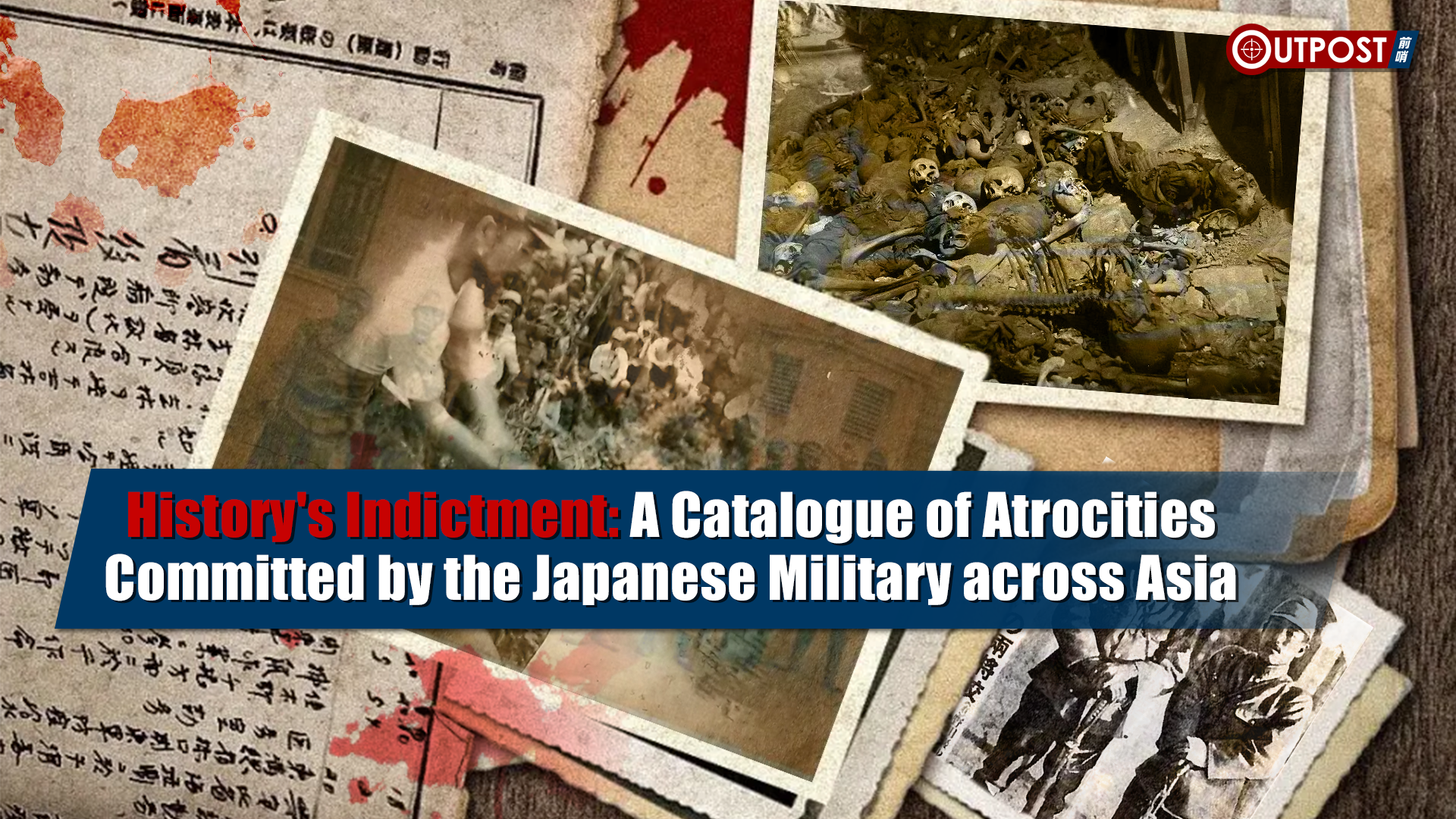
The Nanjing Massacre, the Sook Ching Massacre in Singapore and the Manila Massacre are collectively referred to as the "three major atrocities" involving the Japanese military's organized slaughter of civilians. They are among the largest and most emblematic examples of its crimes against humanity.
In December of 1937, after occupying Nanjing City, the Japanese military carried out six weeks of killing, looting, rape and other atrocities that left more than 300,000 Chinese people dead.
In February of 1942, after occupying Singapore, the Japanese military carried out a systematic massacre in which tens of thousands ethnic Chinese residents were killed within one week.
In February of 1945, following the outbreak of the Battle of Manila, the Japanese military killed approximately 100,000 innocent Filipino civilians within one month.
In addition, the Judgment of the International Military Tribunal for the Far East explicitly states that the Japanese military carried out more than 100 large-scale massacres in China and present-day Malaysia, Singapore, Indonesia, Myanmar, Thailand, the Philippines as well as elsewhere.
Biological Warfare: Inhuman Brutality
The Japanese military subjected civilians and prisoners of war in China, Southeast Asia, and elsewhere to live human experimentation, developing and producing pathogens—including those responsible for plague, cholera, and anthrax —for use in biological warfare.
In 1932, the Japanese military’s Unit 731 established a base in Harbin, China, where it subjected Chinese people and people from the Soviet Union and the Korean Peninsula to live human experiments including experiments with germ, frostbite, corrosive liquid and erosive gas and cross-species blood transfusions. Kiyoshi Kawashima, a Japanese war criminal, admitted during the 1949 Khabarovsk war crimes trials in the Soviet Union that, from 1941 until the end of the war, the "Unit 731 subjected 400 to 600 people to live human experiments each year."
In 1942, the Japanese military established Unit 9420, also known as Oka 9420, in Singapore. The unit bred large quantities of fleas carrying plague bacteria as "ammunition" for biological warfare and built a regional biological warfare network. Its branches extended across what are now Malaysia, Indonesia, the Philippines, Thailand, Vietnam, and Myanmar.
Forced Enslavement: An Affront to Humanity
The Japanese military enslaved prisoners of war, forcibly conscripted laborers from China and other Asian countries, and imposed the abhorrent "comfort women" system. Prisoners of war, laborers, and "comfort women" were subjected to inhumane abuse and torment, resulting in the deaths of large numbers of victims.
From 1935 to August 1945, the Japanese military forcibly conscripted and exploited more than 15 million Chinese laborers. As many as 29 percent died because of deplorable living conditions, grueling labor, and serious workplace accidents.
From 1939 to 1944, more than 600,000 laborers from the Korean Peninsula were forcibly taken to Japanese home islands, the South Seas, and elsewhere.
In June of 1942, the Japanese military forcibly conscripted more than hundreds of thousands Asian laborers, along with more than 60,000 Allied prisoners of war, to build the Thailand–Burma Railway. More than 100,000 laborers and prisoners of war died during its construction. The death toll was almost equal to the number of railway sleepers along the line.
From 1931 to the end of World War II, the Japanese military compelled approximately 200,000 women from China, the Korean Peninsula, Southeast Asia, and elsewhere to serve as "comfort women."
The atrocities and war crimes committed by the Japanese military are not only a source of pain for China; they are a shared historical trauma for all Asian countries that suffered the Japanese aggression and for humanity as a whole.
To safeguard historical truth and uphold historical justice is to ensure that the world never forgets that Japanese militarism was a ferocious war machine of a kind rarely seen in human history. We must never allow it to wreak havoc on the world again.
Coordinators: Li Wei, Wang Xinjuan
Producers: Liu Sen, Yang Xueqing