



By Yu Lan
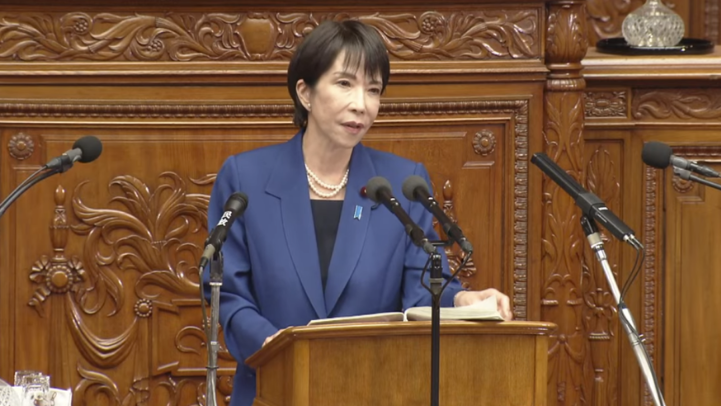
Japanese Prime Minister Sanae Takaichi. Photo: CCTV
Recently, newly-elected Japanese Prime Minister Sanae Takaichi announced in her policy speech that Japan would fundamentally strengthen its defense capabilities and move up the target of raising defense spending to 2% of GDP, originally set for fiscal year 2027, to be achieved within the current fiscal year. However, according to Japanese media, the government's fiscal revenues remain unstable, casting doubt on whether this large-scale defense spending plan can be smoothly implemented.
Japanese Prime Minister Sanae Takaichi also plans to revise the next phase of Japan's Medium Term Defense Program (MTDP) a year ahead of schedule and complete updates to the National Security Strategy (NSS), the National Defense Strategy (NDS) and the Defense Buildup Program (DBP) by the end of 2026.
According to military analyst Teng Jianqun, the new Prime Minister's security-related statements are primarily driven by three key considerations. First, she is continuing the military buildup policy pursued during the Shinzo Abe administration. In Japan, rhetoric emphasizing rearmament and hyping up so-called external threats help win support from conservative and right-wing forces. Second, she also needs to use such topics to consolidate her relatively weak political standing. Third, her administration seeks to maintain close coordination with the US, using increased defense spending on the Japanese Self-Defense Forces (JSDF) as gestures to court favor with Washington. Taken together, these factors suggest that she is likely to pursue a more assertive security policy, marked by rising military expenditures and continued adjustments to Japan's overall defense strategy.
Military analyst Teng Jianqun pointed out with Japan's major adjustments to its security strategy, the JSDF is undergoing fundamental changes in combat models, operational concepts, force structure, and weapons development, trends that could undermine regional stability. As an aggressor in WWII, Japan's failure to show genuine remorse means its current moves will inevitably arouse strong vigilance among neighboring countries. Moreover, Japan's focus on developing long-range strike capabilities is likely to fuel a regional arms race, bringing further negative impacts on peace and development in the region.
Since the start of Donald Trump's second term, he has repeatedly applied informal pressure on the Japanese government, demanding that Japan raise its defense spending to 3.5% of GDP. Officials from the Japanese Ministry of Finance have stated that the budget capacity has already been exhausted. According to Teng Jianqun, whether under US pressure or in pursuit of so-called national normalization, Japan is likely to significantly increase its defense budget. However, the enormous financial burden poses great difficulties for the Japanese government and could make Prime Minister Sanae Takaichi's administration face severe challenges ahead.
Military analyst Teng added that Washington is demanding Japan shoulder a larger share of the cost of stationing American troops in the country. Donald Trump's latest exorbitant request of $10 billion is clearly beyond what the Takaichi Cabinet can afford. Therefore, Takaichi must demonstrate a clear stance on increasing defense spending while also maneuvering carefully in her dealings with Trump.
For Japan's right-wing forces, a higher defense budget is viewed as a crucial step toward achieving "national normalization" and "normalization of the JSDF." With Japan's security strategy already undergoing major adjustments, boosting defense expenditure has become an inevitable choice. However, with Japan's national debt now exceeding 260% of its GDP, how to secure additional funding for defense has become a pressing challenge for Sanae Takaichi. If the government were to slash social welfare programs to finance military expansion, it could severely undermine its political foundation. Thus, she must strike a delicate balance between increasing defense spending, safeguarding public welfare, and promoting economic growth.
Editor's Note: Originally published on military.cnr.cn, this article is translated from Chinese into English and edited by the China Military Online. The information and opinions in this article do not necessarily reflect the views of eng.chinamil.com.cn.