



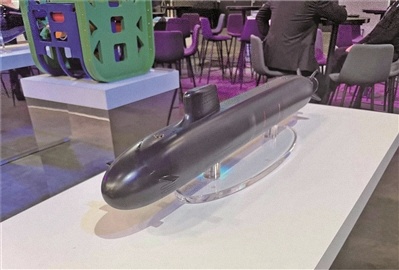
Photo shows a model of the SSN-AUKUS nuclear-powered submarine of UK's BAE Systems.
By Han Kerun
The US Secretary of War Pete Hegseth, Australian Deputy Prime Minister and Minister for Defence Richard Marles, and UK Defense Minister John Healey convened an AUKUS defense ministers' meeting at the Pentagon in early December. The US, the UK, and Australia announced that they would accelerate the advancement of nuclear-powered submarine projects and related defense technologies. This move indicates that AUKUS cooperation has entered a phase of full-speed implementation.
A key marker of this acceleration is the completion of the US review of the trilateral agreement. In June this year, the US launched a special review of the AUKUS agreement. Following the completion of the review, the delivery plan for nuclear-powered submarines as the core element of the cooperation was formally clarified. The US will deliver Virginia-class nuclear-powered attack submarines to Australia in the early 2030s. Australia has specified its initial procurement list, which includes one newly built Virginia-class Block VII submarine and two in-service Virginia-class Block IV submarines from the US Navy. The agreement also grants Australia an option to purchase two additional submarines of the same class, establishing a procurement framework of up to five vessels in total.
To ensure the smooth implementation of the delivery plan, Australia has adopted corresponding measures. On one hand, in accordance with the agreement, Australia will pay a third tranche of dedicated funding amounting to USD 1 billion to support the expansion of US nuclear submarine production facilities. This brings Australia's cumulative investment in the US nuclear submarine industrial base to USD 2 billion. These funds will be used directly to enhance the production efficiency of Virginia-class submarines and strengthen the supply capacity of key components. On the other hand, Australia has dispatched 200 technical personnel to the US military base at Pearl Harbor, Hawaii, to take part in hands-on training related to the routine maintenance and troubleshooting of Virginia-class nuclear submarines. The training program is expected to last between 18 and 24 months.
The UK has also announced parallel progress on the industrial side of cooperation. According to John Healey, in connection with the AUKUS nuclear submarine program, the UK has launched its first round of industrial deployment by upgrading the Barrow-in-Furness shipyard in northwest England. The yard will be responsible for building SSN-AUKUS nuclear submarines for both the Royal Navy and the Royal Australian Navy. The British government has additionally pledged to invest USD 8 billion in dedicated funding over the next five years for shipyard equipment upgrades, technology development, and personnel training, to achieve a construction rate of two nuclear submarines every three years. According to the plan, the SSN-AUKUS nuclear-powered submarine jointly developed by the UK and Australia will complete construction of its first vessel in the late 2030s and formally enter service with the two navies in 2040. The submarine will integrate a British hull design with US combat systems, making it a flagship platform symbolizing the long-term cooperation of the AUKUS partnership.
The meeting also established follow-on coordination mechanisms for the AUKUS security alliance. In early 2026, the defense ministers of the three countries will convene another AUKUS ministerial meeting, with a focus on reviewing the development progress of the SSN-AUKUS nuclear-powered submarine and ensuring production capacity for the US delivery of Virginia-class submarines to Australia. Meanwhile, they will establish a defense industrial base working group, which will hold monthly video conferences to synchronize progress on submarine component production, alignment of technical standards, and personnel training to reduce friction in cooperation through regularized coordination.