



By Hua Dan and Fu Hongyin
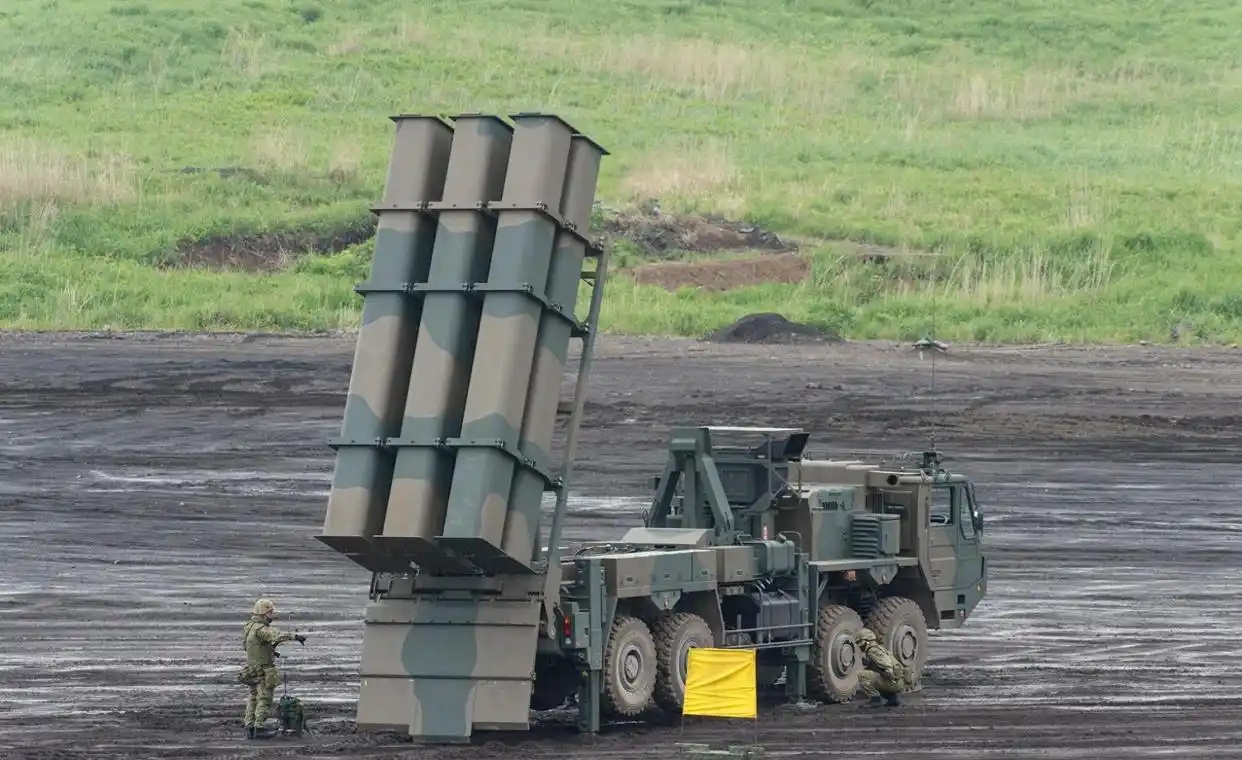
File photo: The improved Type 12 anti-ship missile
In recent years, under the pretext of "security threats in the neighborhood", the Japan Ground Self-Defense Force (JGSDF) has continued to strengthen its military buildup in the southwest part of Japan, which has severely endangered regional and global peace and stability, thereby posing a significant challenge to the post-war international order.
Seeking regional deterrence and denial capabilities
In March 2025, the JGSDF formed the 8th Surface-to-Ship Missile Regiment at its base in Oita Prefecture, Kyushu, marking the third Surface-to-Ship Missile Regiment formed in Kyushu and the southwest part of Japan by now. To facilitate the development of its stand-off strike capability, Japan has accelerated the development of the improved Type 12 anti-ship missile, increasing its range from 200 to 1,000 kilometers or more. This type of missile, under the nominal use for "island defense," is capable of striking adversary bases from a long distance. Moreover, Japan is accelerating the development and test of high-speed glider bombs, hypersonic cruise missiles, and other weapons. The Hyper Velocity Gliding Projectile (HVGP) for island defense, with a range of about 500 to 900 kilometers, is capable of launching long-range strikes against opponent forces attacking the island. The hypersonic cruise missile, with a range of around 3,000 kilometers, has dual strike capabilities against both ships and land targets, as well as stealth performance.
Promoting responsiveness
Japan announced recently that it will integrate the existing elite operational forces of the JGSDF by March 2027 into a special operations brigade. In terms of force composition, the brigade will integrate two special units. One is the roughly 400-member Special Operations Group (SOG), primarily responsible for unconventional operations and counter terrorism at home and abroad. The other is the approximately 800-member Central Readiness Regiment (CRR), mainly tasked with overseas evacuation operations and low-intensity deployments. The JGSDF intends to eliminate long-standing coordination barriers through the establishment of a unified command structure to enhance operational effectiveness. Specifically, against a single event, the SOG can coordinate closely with the CRR to adopt a response pattern of specialized operations combined with rapid support. Against multiple parallel circumstances, the integrated force can split and reconstitute operational units rapidly to allow a precise response. Furthermore, Japan prepares to deploy the brigade to the southwest part of the country to enable interaction between special operations forces and conventional forces, thereby strengthening the operational capabilities of the island defense troops.
Consolidating the operational architecture mainly based on island offense and defense
The JGSDF has been continuously shifting its focus of operations to the southwest part of Japan for some time. The main force of the JGSDF's 15th Brigade is stationed on Okinawa Island, the hub of battle command in the southwest part of Japan. According to the provisions of Japan's three national security documents such as the National Defense Strategy (NDS), the infantry regiments assigned to the brigade will increase from one to two by March 2027, wholly elevating it to the 15th Division with a strength of nearly 4,000 troops to serve as the core force for defense in the southwest direction. Subsequently, Japan will integrate its military forces in the southwest part into the "Okinawa Defense Group" over time, with the JGSDF units as the main force and naval and air force units incorporated. The group will be capable of independent and sustained operations.
The JGSDF's continuous efforts to develop medium- and long-range offensive weapons, expand force deployment, and reconstruct command structure reveal its attempt to promote remilitarization by all possible means and rush headlong into military expansion. With increasingly prominent warning signs of the revival of militarism, all peace-loving countries and people should take action and resolutely prevent the resurgence of Japanese militarism.
(The authors are from the Chinese PLA Army Engineering University.)