



By Li Yang
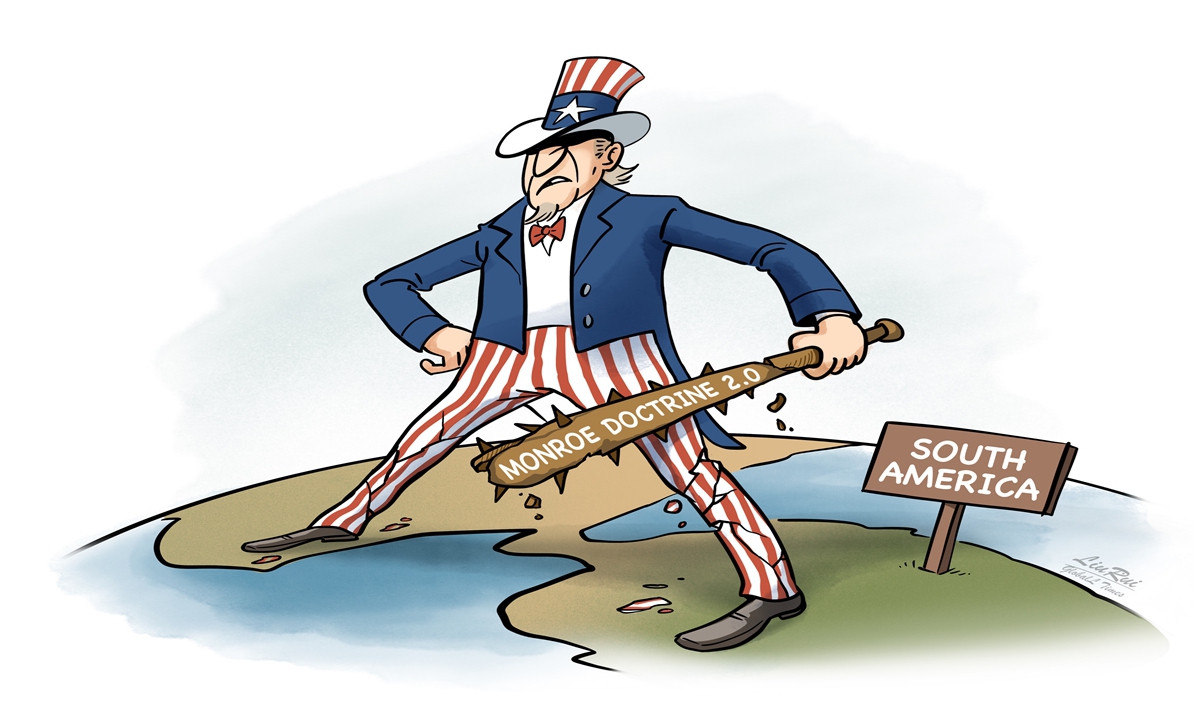
Illustration: Liu Rui/GT
On January 3, the US took military action that seemed to be practicing the "new Monroe Doctrine." It ordered US troops to launch a sudden, large-scale military strike against Venezuela, and within a few hours, the Venezuelan President Nicolas Maduro and his wife were seized and taken to the US.
The Monroe Doctrine, proposed by former US president James Monroe in 1823, primarily aimed to establish absolute American leadership over the Americas and prevent other powerful countries from encroaching on the continent. The infamous Monroe Doctrine has been strongly opposed by many other countries. Even within the US, Democrats have long distanced themselves from this "Hemisphere Myth."
There is no fundamental difference between the two versions of Monroe Doctrine, but the 1.0 version focuses more on passive defense, while the new one tends to actively attack, characterized by obvious military adventurism. The US military invasion of Venezuela perfectly confirms this point.
The US launched military action against Venezuela under the pretext of cracking down on drug trafficking groups in the country, but the real motive was nothing more than seizing Venezuela's oil resources. This also indicates that "new Monroe Doctrine" disregards even the most basic international morality.
However, "new Monroe Doctrine" is unlikely to go far and will drag the US back to the quagmire.
Firstly, the international community generally holds a stance of opposition, criticism and questioning toward the recent US military invasion of Venezuela and the seizure of the president and his wife. The Global South countries, especially those in Latin America, along with the UN, have strongly condemned and criticized the US for violating international law. Even the Western allies of the US did not explicitly stand with the US. Instead, they expressed doubts and distrust about the US intentions.
Secondly, opposition from within the US will prevent "new Monroe Doctrine" from fully exerting its power. According to the US Constitution, Congress, not the president, has the sole power to declare war. The US military action against Venezuela has not been authorized by Congress and many Democrats believe this is unconstitutional. Additionally, many Americans are angry and puzzled by the invasion of Venezuela.
Thirdly, and more importantly, it is difficult for the US to gain a big advantage in Venezuela. Instead of controlling that country, the US may soon find itself holding a wolf by the ears. It is one thing for the US to attempt at "regime change" in Venezuela, but it is another thing for the US to truly realize its strategic interests in that country. Now it seems that even if Washington can foster a pro-American regime in Venezuela, it will be difficult for the US to "take care of" Venezuela by giving orders. According to a survey conducted by AtlasIntel, only 34 percent of people inside Venezuela support US military intervention to overthrow the Maduro government.
"New Monroe Doctrine" will not "Make America Great Again," on the contrary, it is likely to let the world witness the Washington's tyranny, shamelessness, embarrassment and failure once again. If the US cannot achieve the expected strategic benefits in Venezuela, "new Monroe Doctrine" is destined to fail.
The author is the former Consul General of China in Rio de Janeiro.