



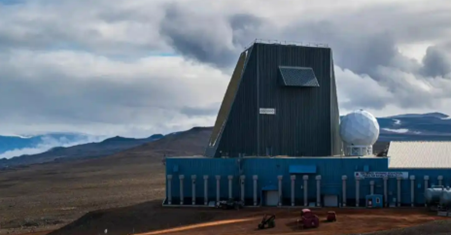
The US military deploys phased-array early-warning radar systems in Greenland.
Since the start of his second term, the Trump administration has repeatedly expressed territorial claims over Greenland and has even hinted that it does not rule out the use of force to achieve this objective. This stance has swiftly triggered strong opposition from Denmark as well as several European countries, including France and Germany, turning Greenland from a long-standing geopolitical issue into a direct flashpoint in transatlantic relations.
The Trump administration's persistent pursuit of Greenland goes far beyond the scope of an ordinary territorial dispute. In essence, it is based on far-reaching military-strategic calculations and reflects Washington's intention to consolidate global hegemony through military superiority. From the perspective of military resources, Greenland's abundant rare minerals and energy reserves constitute indispensable materials for producing advanced weaponry, including high-performance permanent magnets, laser systems, advanced radar equipment, and coatings of stealth fighter jets. Meanwhile, its potential oil and natural gas resources could serve as important backup energy supply points during wartime or emergencies, enhancing the energy resilience of military operations. In addition, given Greenland's role as a strategic passageway along Arctic shipping routes, control over the island would enable direct control over future military access to key Eurasian strategic corridors.
At the level of military operations and alliance coordination, the Trump administration's handling of the Greenland issue deliberately bypassed NATO's established multilateral military coordination mechanisms and framed the matter as a bilateral defense issue between the US and Denmark, seeking to free itself from constraints imposed by NATO allies in military decision-making. This approach has set a dangerous precedent in which a dominant country within a military alliance uses the threat of force to compel its allies to make concessions on issues of territory and sovereignty.
In response to US pressure, several Nordic countries swiftly responded to Denmark's request and jointly announced their participation in the "Arctic Endurance" military exercise, sending a clear signal of support for safeguarding allied territorial integrity. However, France dispatched only fifteen personnel, Germany thirteen, while most other countries sent merely one to three officers. Such displays of political unity amounted largely to symbolic resistance.
Fundamentally, Europe's incapacity to mount a strong counterresponse to the US stems from its long-standing and deep structural dependence on Washington in security affairs. In addition, Europe's fragmented defense industry, inconsistent equipment standards, and sharply divergent internal strategic priorities have created a profound dilemma in which European countries aspire to strategic autonomy in military affairs, yet remain constrained by persistent reliance on the US and difficulties in internal coordination.
The Greenland dispute represents the most serious internal crisis of trust NATO has faced since its establishment, severely undermining the fundamental foundation on which the alliance was built. Article 5 of the North Atlantic Treaty states that an armed attack against one NATO member shall be considered an attack against them all. As the perceived threat is coming from the alliance's principal leader and primary security guarantor, the reliability and effectiveness of this clause have become highly questionable.
In addition, the Trump administration has explicitly linked security issues with economic punishment, publicly indicating that it may impose tariffs on allies that do not support its position on Greenland. This practice of "commodifying" security guarantees has fundamentally eroded NATO's moral foundation as a community of shared values and collective security.
The Greenland dispute has further exposed serious deficiencies in NATO's institutional mechanisms for mediating major conflicts among its core members. NATO's continuous eastward expansion has increased the number of member states and weakened the alliance's strategic focus and cohesion. Meanwhile, it has made the internal interests of NATO increasingly diverse and even contradictory, making it difficult for the alliance to form a rapid and unified collective position when facing internal crises. The combined effects of institutional dysfunction and declining cohesion have created a self-reinforcing vicious cycle, further undermining NATO's ability to cope with internal challenges.
(The author is a research fellow at the Center for Asia-Pacific Development Studies (CAPDS) of Nanjing University)
Editor's note: Originally published on thepaper.cn, this article is translated from Chinese into English and edited by the China Military Online. The information and opinions in this article do not necessarily reflect the views of eng.chinamil.com.cn.