



By Wang Xiao
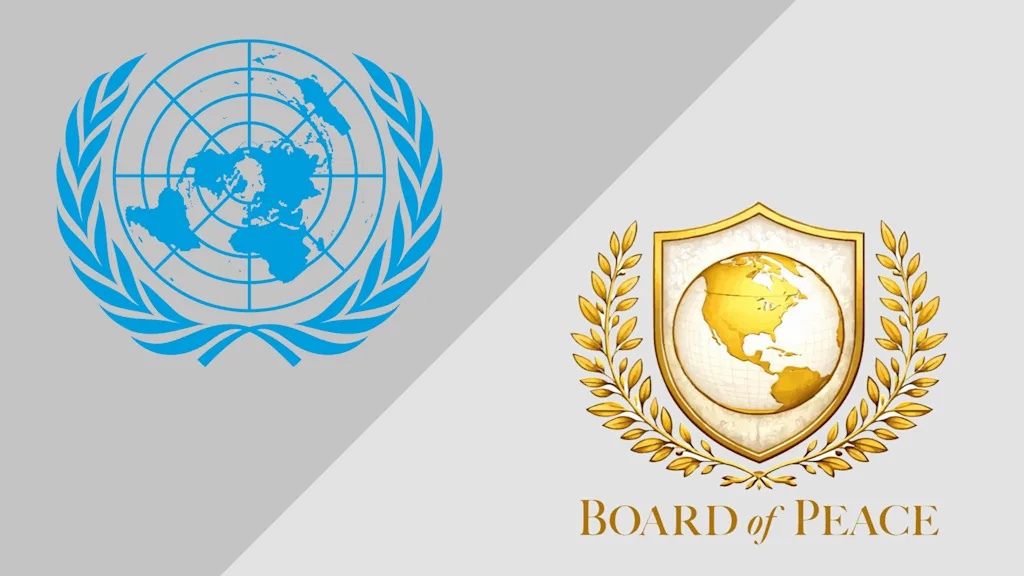
From left: The United Nations seal; the Board of Peace logo
In January 2026, on the sidelines of the World Economic Forum, US President Donald Trump signed agreements with representatives from more than ten countries and regions, announcing the establishment of the so-called Board of Peace (BoP). This move not only represents a direct practical challenge to the authority of the UN, but also marks the institutionalization of the "America First" doctrine within the framework of global governance, introducing new uncertainties into the international landscape.
According to information released on the White House website and by various media outlets, the organizational structure of the BoP resembles that of a corporate board, with power highly centralized. Draft proposals stipulate that Donald Trump would serve as "permanent chair", a position not subject to presidential term limits, and would possess absolute veto power over key agendas and personnel decisions. As a result, the BoP effectively functions as a board of directors composed of vested interests, creating a tailor-made global power hub for Trump.
Trump's choice to unveil the BoP at the Davos Forum was driven mainly by three considerations.
First, it aimed to seize control over international agenda-setting and operational leadership. In Donald Trump's view, multilateral institutions such as the UN sacrifice efficiency for the sake of universality. For example, the veto system of the UN Security Council allows permanent members to block collective action, whereas the BoP is, in essence, a mechanism firmly controlled by the US. By unveiling the new body at the high-profile Davos Forum, a flagship event of globalism, the initiative could be presented as an international body with ambitions extending from Gaza to the wider world.
Second, it was designed to establish a dedicated platform for managing regional conflicts. On one hand, the BoP could provide a veneer of "legitimacy" for Israel's military operations and post-war reconstruction, while channeling member-state contributions into US-controlled funding mechanisms, effectively compelling others to finance Washington's geopolitical agenda. On the other hand, it would sideline the practical role of institutions such as the UN Security Council in regional conflicts by bundling financing, project allocation, political conditions, and security arrangements into a single framework, thereby providing a platform for various peace negotiations and interest-driven bargaining.
Third, it aimed to secure easily marketable diplomatic achievements geared toward domestic electoral politics. With the 2026 US midterm elections approaching, a Republican loss of congressional control could leave Trump vulnerable to impeachment and trigger a major political realignment. By promoting the so-called BoP, Trump seeks to produce foreign policy outcomes that are easily understood by voters, thereby cultivating an image as a "peacemaker" and mobilizing electoral support.
From a legal and institutional perspective, the UN Charter framework, the authority of the Security Council, and the principles of international law constitute the foundation of the current system for maintaining international peace and security. Although the White House website claims that the BoP serves as a "key implementation platform" for UN Security Council Resolution 2803, thus projecting an appearance of legitimacy.
In reality, it represents a fundamental undermining of the UN and the international legal order. With the participation of global political figures such as the President of the World Bank and the inflow of funds from so-called "member states," combined with the withdrawal of the US from multiple international organizations, institutions such as the UN may face even more severe financial shortfalls, further crippling their operational capacity. For the international rule of law, an even graver challenge lies in the fact that when major powers bypass the UN Security Council and decide the fate of smaller countries within loosely organized "clubs" that lack broad representation and legal binding force, the world risks sliding back into a "law of the jungle era" dominated by might over right.
In response to the US invitation, China has kept the door to dialogue open while standing firm on matters of principle. China welcomes all genuine efforts to promote peace, but such initiatives must be anchored within the framework of the UN. Global governance platforms must retain their public goods characteristics and must never become tools for individual countries to pursue private interests. China has maintained that what the world needs is genuine multilateralism. It will continue to collaborate with countries of the Global South within the UN framework to advance a fair and just resolution of the Gaza issue, as this is the only path to lasting peace.
(The author is an assistant researcher of the Center for International Studies, Shandong Academy of Social Sciences)
Editor's note: Originally published on china.com.cn, this article is translated from Chinese into English and edited by the China Military Online. The information and opinions in this article do not necessarily reflect the views of eng.chinamil.com.cn.