



By Zhan Debin
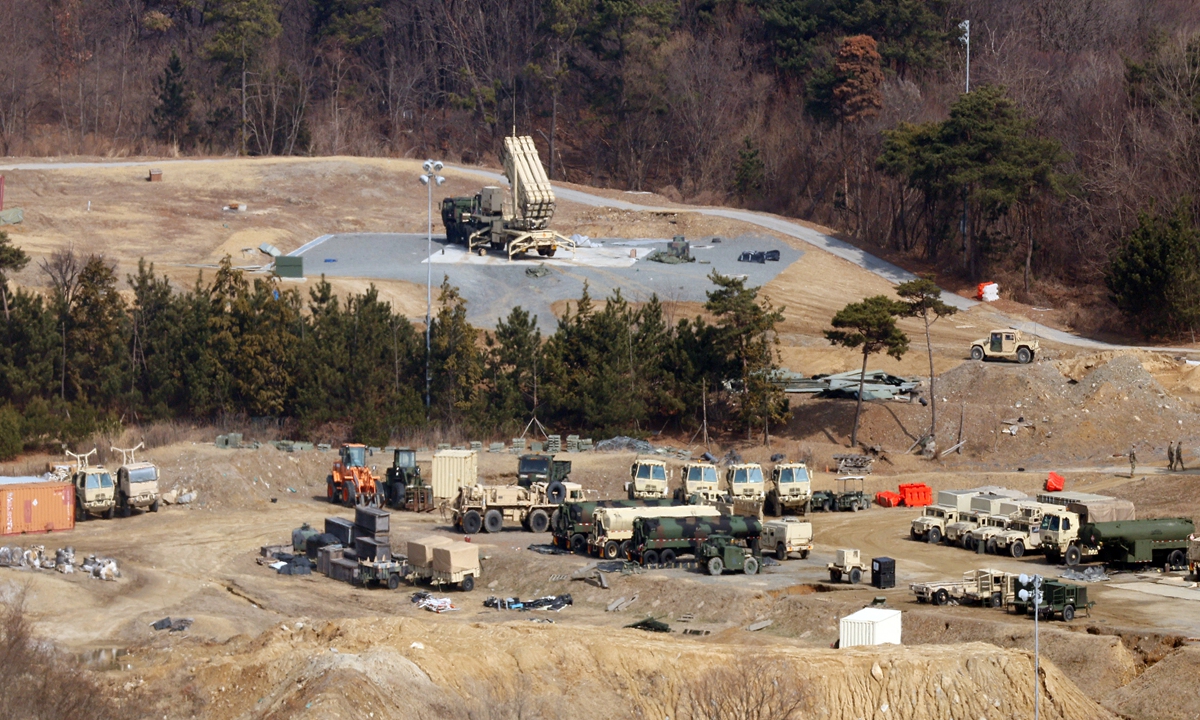
A launch pad facing skyward at the US military's THAAD base in Seongju County, North Gyeongsang Province, South Korea, on March 5, 2025. Photo: VCG
As US air defense systems in the Middle East have come under attack, the US has begun urgently redeploying missile defense assets from other regions, including part of the missile defense equipment operated by US Forces Korea (USFK). It is reported that the US military has transferred some interceptors from the missile defense system deployed by USFK to the Middle East.
This development has sparked discussion in the ROK. ROK President Lee Jae-myung said at a recent cabinet meeting that the ROK possesses its own defense capabilities. At the same time, he acknowledged that although Seoul had expressed differing views, the ROK is not in a position to make demands.
This once again indicates that the missile defense system deployed by USFK is not solely intended to address the so-called threat of the DPRK. If part of the THAAD can be redeployed to the Middle East at any time, it is clearly a component of the global missile defense architecture of the US rather than a system serving only the security of the ROK. In other words, the claim once emphasized by some ROK politicians and media outlets that the THAAD system was purely defensive and aimed only at the threat of the DPRK has always contained an obvious logical contradiction.
This episode also once again illustrates the so-called strategic flexibility long pursued by the US. Although USFK are legally stationed in the ROK, strategically, they form part of the global military system of the US. This means that USFK are not merely "troops defending the ROK," but can be redeployed to other theaters at any time to carry out missions.
Moreover, this incident once again highlights the ROK's very limited say over the deployment and movement of USFK. With regard to equipment deployed by USFK, including the THAAD, the ROK government has little influence over how such systems are deployed or redeployed, and may not even be informed of relevant arrangements in advance.
Nor is this situation unique to the ROK. The current circumstances facing countries in the Middle East also illustrate that the presence of US military bases often entails potential security risks. Once the US becomes involved in regional conflicts, its military presence in other countries may, at times, become not a "security guarantee" but a source of security risk.
Returning to the Korean Peninsula issue, the deployment of the THAAD in the ROK in 2016 once severely impacted China–ROK relations and also triggered prolonged controversy within the ROK itself. Now that the US military has transferred part of the THAAD equipment to the Middle East, while the ROK president has acknowledged that this will not affect the country's defense capabilities, which will inevitably prompt renewed reflection among the ROK public on the necessity of the THAAD deployment.
Opposition to THAAD has long existed within the ROK society, and local residents in particular have expressed sustained dissatisfaction. Whether the ROK should continue to bear the diplomatic, security, and social costs associated with hosting the THAAD system deserves serious consideration.
More importantly, if the ROK hopes to truly enhance the autonomy of its national security, the key does not lie in introducing more external military equipment, but in promoting a fundamental transformation of the security structure on the Korean Peninsula. Advancing the transition from the armistice mechanism to a peace mechanism on the Korean Peninsula, and reducing military confrontation constitutes the fundamental path toward long-term stability on the Peninsula.
From the Middle East to Northeast Asia, the current situation once again reminds the world that amid intensifying strategic rivalry among major powers, blindly aligning with powerful states does not necessarily bring security. Instead, it may expose countries to greater risks in times of conflict.
(The author is the director and a professor of the Center for Korean Peninsula Studies at Shanghai University of International Business and Economics)
Editor's note: Originally published on huanqiu.com, this article is translated from Chinese into English and edited by the China Military Online. The information and opinions in this article do not necessarily reflect the views of eng.chinamil.com.cn.