



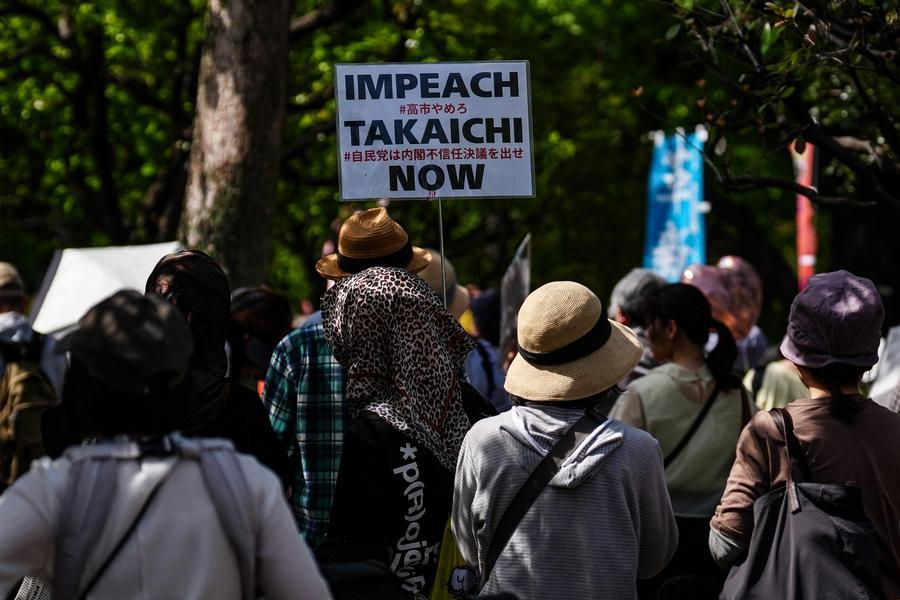
People gather around the parliament building to protest attempts of the government of Japanese Prime Minister Sanae Takaichi to revise the country's pacifist constitution and to call for the protection of Article 9 in Tokyo, Japan, April 19, 2026. (Xinhua/Jia Haocheng)
TOKYO, April 25 (Xinhua) -- Japan's House of Representatives on Thursday passed a bill to set up the national intelligence council and the national intelligence bureau, seeking to create the country's first centralized national-level intelligence system since World War II.
Driven by Prime Minister Sanae Takaichi, the overhaul consolidates power across government, military and private sectors under tight prime ministerial control. Critics and experts warn that the plan revives the logic of pre-war militarist surveillance, aiming to manipulate domestic public opinion and support expanded military adventurism abroad.
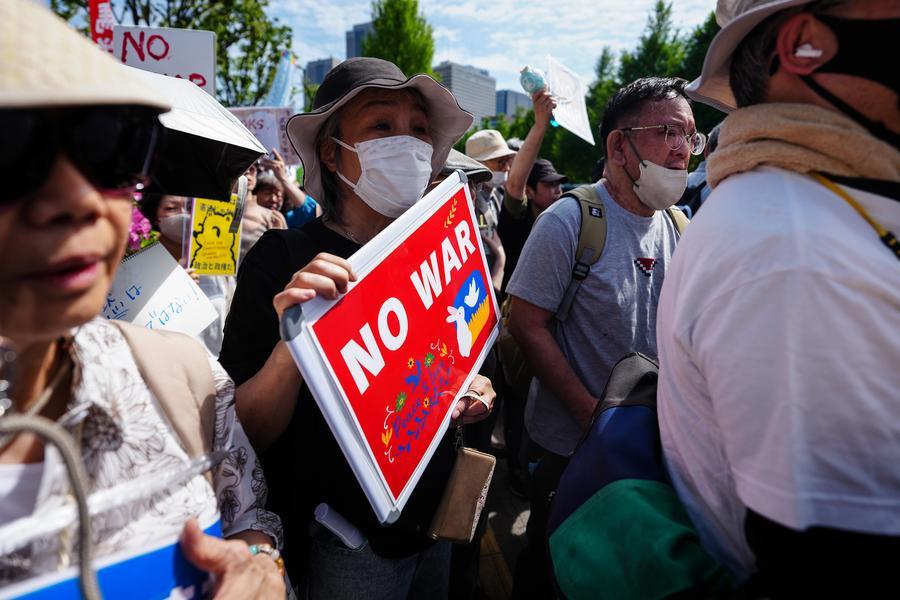
People gather around the parliament building to protest attempts of the government of Japanese Prime Minister Sanae Takaichi to revise the country's pacifist constitution and to call for the protection of Article 9 in Tokyo, Japan, April 19, 2026. (Xinhua/Jia Haocheng)
STRENGTHENING SPY SYSTEM
Japan's current intelligence work is scattered across several ministries. Under the new framework, the national intelligence council, chaired by the prime minister, will be tasked with coordinating "important intelligence activities" in areas such as national security and counter-terrorism, as well as "overseas intelligence activities" involving foreign espionage.
The bill also states that the national intelligence bureau, the council's secretariat, will "comprehensively coordinate" intelligence work across government ministries and agencies, with the authority to request that they share information.
Beyond government restructuring, Japan's military has also upgraded its intelligence capabilities. In late March, the Maritime Self-Defense Force established an intelligence and warfare group, and the Ground Self-Defense Force set up a new intelligence and combat unit in Tokyo.
Meanwhile, right-leaning IT firms with links to the ruling Liberal Democratic Party are monitoring social media, targeting opposition voices and promoting constitutional revision, according to online observers.

People gather around the parliament building to protest attempts of the government of Japanese Prime Minister Sanae Takaichi to revise the country's pacifist constitution and to call for the protection of Article 9 in Tokyo, Japan, April 19, 2026. (Xinhua/Jia Haocheng)
TOKKO AGAIN?
Analysts pointed out that a major goal of the new apparatus is domestic ideological control. Japan plans to create a dedicated unit within the national intelligence bureau to police what it calls "false and misleading information" on social media and suppress alleged foreign "election interference" and "public opinion manipulation."
Japanese media warn the system risks becoming a political tool that violates privacy and free speech, recalling the horrors of the Tokko (Special Higher Police), the repressive militarist secret police that crushed dissent and enforced wartime conformity.
Historians warn that the current media and political atmosphere echoes the 1930s, when militarists seized control of public discourse.
Xiang Haoyu, a research fellow at the China Institute of International Studies, noted that Japanese media are flooded with narratives hyping "external threats" and stoking public hostility. The ruling bloc, he said, is manipulating public opinion to build support for constitutional revision and military expansion.
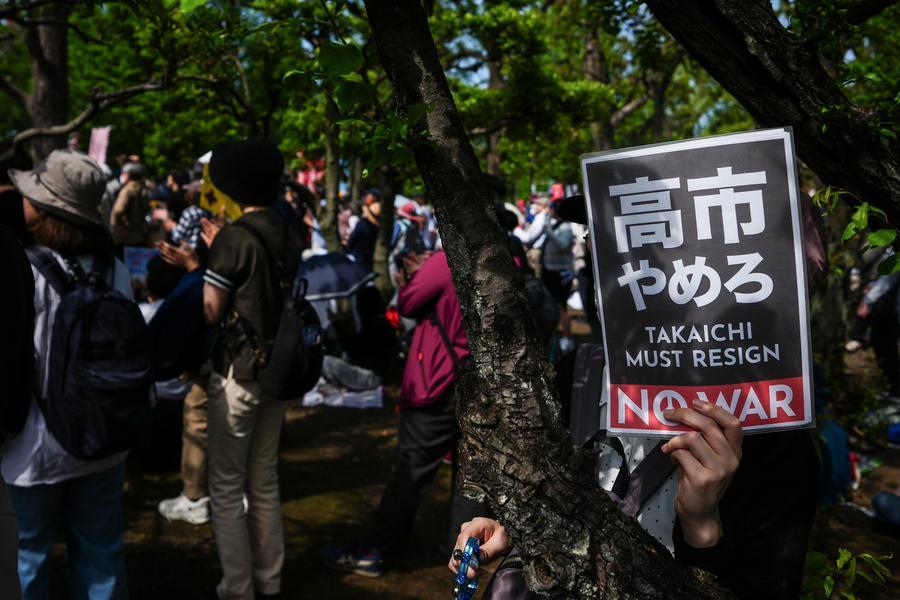
People gather around the parliament building to protest attempts of the government of Japanese Prime Minister Sanae Takaichi to revise the country's pacifist constitution and to call for the protection of Article 9 in Tokyo, Japan, April 19, 2026. (Xinhua/Jia Haocheng)
NEO-MILITARISM FUEL
Local media reported that Japan plans to launch a dedicated foreign intelligence agency, widely called a "Japan-style CIA." Recent years have seen a series of espionage scandals revealed by the media: Japanese spies have been caught targeting China, Russia and Belarus. History shows Japanese intelligence expansion has often preceded military aggression, from the September 18 Incident to the attack on Pearl Harbor.
The new system thus breaks from Japan's postwar "exclusive defense" principle to support pre-emptive strike capabilities and overseas military operations.
Japanese media have warned that the country is sliding toward a "pre-war regime." The intelligence overhaul is part of a wider remilitarist push: deploying long-range offensive missiles, lifting bans on lethal weapons exports, restructuring the Self-Defense Forces for offensive warfare, and sending vessels through the Taiwan Strait in deliberate provocation.
Yoshiko Kira, a member of Japan's House of Councillors, noted on social media that right after the government lifted the ban on lethal weapons exports on April 21, the bill to establish the national intelligence bureau was passed.
"I protest against the ongoing push to build a country that controls the people, silences dissent against the government, and marches toward war," she said. "We must do everything to see this bill scrapped in the House of Councillors."