



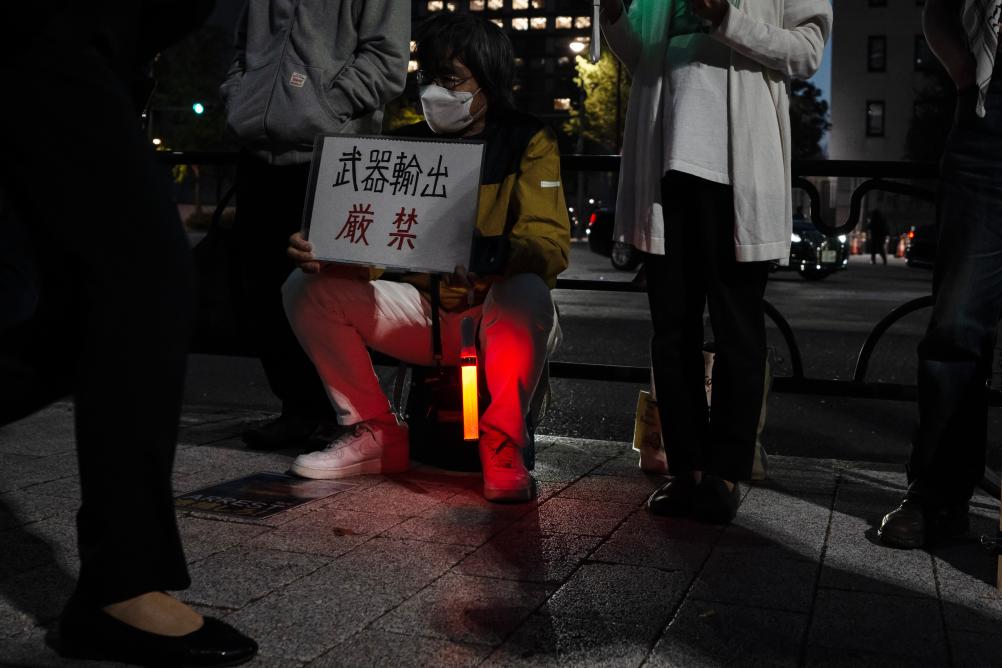
Protesters gather in front of the Prime Minister's Office in Tokyo, holding placards to oppose the Takaichi government's attempt to lift the ban on lethal arms exports on April 16, 2026. (Photo/Xinhua)
This is another small step by Japan away from its pacifist past. This marks a major shift in Japan's long-held cautious stance. This represents a significant adjustment to Japan's postwar pacifist policy... On April 22, international media outlets, including The New York Times, The Mainichi, and Deutsche Welle, expressed concern over the decision on April 21 by the government of Japanese Prime Minister Sanae Takaichi to allow the export of lethal arms. A series of recent moves by Japan in the field of military security has exposed the hollowness of its self-proclaimed identity as a "peaceful nation."
The formal lifting of the ban on lethal arms exports has triggered widespread questioning across Japanese society. Under the newly revised rules, Japan has removed previous restrictions that limited exports to five categories of non-combat defense equipment, including rescue, transport, warning, surveillance, and minesweeping, thereby, in principle, opening the door to all categories of arms exports. At the same time, the approval process has been downgraded from prior parliamentary authorization to post hoc reporting. This means that a decision of such significance, one that concerns Japan's national trajectory and has direct implications for regional security, can be pushed forward hastily through a cabinet decision, without thorough deliberation in the National Diet of Japan.
The Asahi Shimbun expressed concern on April 22, warning that the international community will see Japan as abandoning its "peaceful nation" principle, which in the long run will lead to diplomatic losses. A poll released by The Yomiuri Shimbun in early April showed that 49 percent of respondents opposed allowing the export of lethal arms, significantly higher than the 40 percent who supported it.
Japan's accelerated push toward remilitarization is not merely rhetoric. It is reflected in concrete policies, a clear trajectory, and tangible actions. The Takaichi government's formal removal of the ban on lethal arms exports is an inevitable step in Japan's continued departure from the path of peace in recent years. From steadily increasing defense spending, to deploying medium- and long-range missiles with ranges exceeding 1,000 kilometers, to initiating revisions to the three national security documents, a series of risky moves has already exposed the hollowness of Japan's so-called "exclusively defense-oriented" principle.
In essence, allowing the export of lethal arms serves as a key measure to loosen constraints on Japan's defense industry and strengthen its capacity for military expansion. By using arms transfers as a strategic lever, Japan can both deepen military alignment with countries such as the US and Australia, and shift from a posture of "passive defense" toward one of more "proactive involvement."
More alarmingly, on April 21, Takaichi offered ritual items to Yasukuni Shrine, where Class-A war criminals from WWII are enshrined. This act, ignoring history and whitewashing aggression, echoes the decision to lift the ban on arms exports and exposes an underlying ambition to expand military power. After its painful defeat in WWII, Japan should aim to pursue a path as a "special country" that neither wages war nor participates in war. Ryukyu Shimpo commented that the Takaichi government is accelerating Japan's shift toward becoming a country capable of waging war, which is a highly dangerous development. Japan should immediately halt these moves, adhere to its "exclusively defense-oriented" principle, and return to the path of peaceful development.
The international community should firmly oppose any moves toward neo-militarism by Japan. This year marks the 80th anniversary of the beginning of the work of the International Military Tribunal for the Far East, commonly known as the Tokyo Trials. Eighty years ago, judges from 11 countries commenced proceedings that would span two and a half years, reviewed a mountain of irrefutable evidence, and laid bare the innumerable crimes of Japanese militarists. The enduring lesson of the Tokyo Trials is clear: militarism does not emerge overnight; it grows step by step through social tolerance, political manipulation, and external appeasement.
Today, certain forces in Japan are attempting to promote military loosening under the banner of becoming a "normal country," and to justify breaking constraints in the name of "regional security." In essence, they are constructing a new narrative of legitimacy for national militarization. In response, the international community, including China, has every reason to remain highly vigilant regarding Japan's current trajectory, to voice clear opposition, and to prevent the tragedy of history from repeating itself in new forms.
Peace is hard-won, and safeguarding it is a long-term responsibility. The Japanese government should heed domestic criticism and concerns, reflect deeply on history, and honor its commitment to peace. Otherwise, Japan risks once again falling into isolation and ultimately being rejected by both history and the international community.
Editor's note: Originally published on haiwainet.cn, this article is translated from Chinese into English and edited by the China Military Online. The information and opinions in this article do not necessarily reflect the views of eng.chinamil.com.cn.