



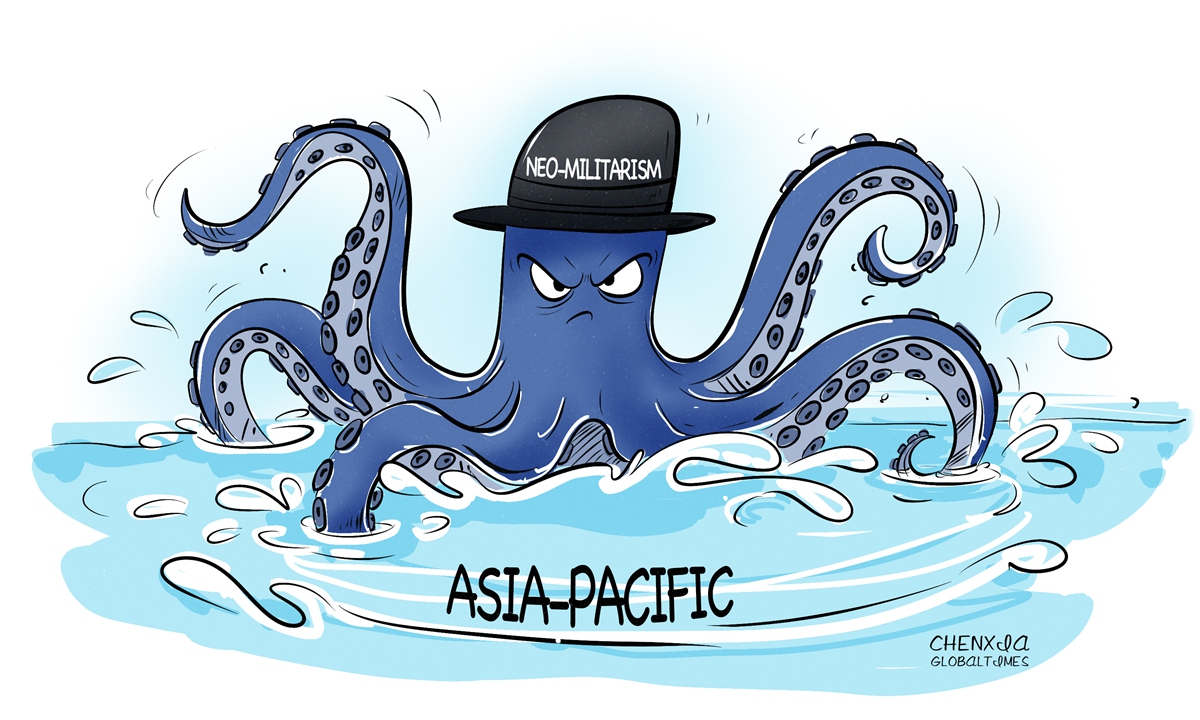
Illustration: Chen Xia/GT
Editor's Note:
Against the backdrop of Japan's rapidly advancing military expansion and its new major arms export agreements, history inevitably comes to mind. In the annual Balikatan military exercises, meaning "shoulder-to-shoulder" in Tagalog, which concluded on Wednesday, Japan marked its first-ever full participation alongside the US and the Philippines. Japan's combat troops that once invaded the Philippines as aggressors are now returning as so-called close partners. What concerns do Filipinos harbor over these developments? And how should one view the Philippines' simultaneous cooperation with both China and Japan? Rommel Banlaoi (Banlaoi), president of the Philippine Society for International Security Studies and director of the Philippines-China Studies Center at Diliman College, shared his views with Global Times (GT) reporter Wang Zixuan.
GT: A series of recent military actions by Japan, including expanding long-range strike capabilities, approving a record defense budget and lifting restrictions on the export of lethal weapons, have drawn widespread attention. From the perspectives of the Philippines and Southeast Asia, what concerns do you have about these moves?
Banlaoi: This is a seismic shift that resonates deeply in Philippine history. For many Filipinos, the sight of Japanese soldiers on Philippine soil still evokes the painful memories borne by survivors and their families from World War II, when Japan's military presence signified occupation and exploitation. At present, however, Tokyo arrives as a "partner" in collective security.
This transformation is far from merely symbolic. It reflects Japan's accelerating neo-militarism, the normalization of its military role in the region, and its growing ambition to project power across the "Indo-Pacific." It is therefore imperative for the Philippines to navigate this development with the utmost strategic prudence.
GT: For the first time, more than 1,000 Japan Ground Self-Defense Force troops joined the Balikatan military exercise in the Philippines. What's your take on this?
Banlaoi: Japan's involvement in this year's Balikatan is expected to reinforce the Philippines' deterrence posture. Yet cooperation with Japan must be carefully managed. Tokyo's strategic ambitions, closely aligned with Washington's "Indo-Pacific" agenda, inevitably seek to draw the Philippines further into their security architecture. It is therefore essential for Manila to avoid becoming a staging ground for Japan's rearmament agenda, even when such an arrangement is cloaked in the language of partnership and mutual defense.
Japan's combat role in Balikatan is not merely a military exercise - it is a clear signal of shifting power dynamics across the "Indo-Pacific." For the Philippines, the strategic imperative is to transform this consequential moment into an opportunity for principled and balanced diplomacy.
GT: How can the Philippines maintain strategic balance amid Japan's constant wooing?
Banlaoi: The central challenge for Manila is to pursue strategic balance. While Japan's support is indispensable for building the Philippines' defense capabilities, Manila must simultaneously work to stabilize and sustain its relations with China.
China is not only the dominant power in the South China Sea. It also remains the Philippines' largest trading partner and a critical source of foreign direct investment. Tilting too heavily toward Japan and the US risks escalating tensions with China and undermining the Philippines' capacity to pursue a peaceful resolution of maritime disputes. Stabilizing relations with China is not an act of submission - it is a rational strategic choice born of geopolitical reality.
A balanced approach ensures that Philippine sovereignty is protected without sacrificing the economic opportunities that China provides - a country that, at present, is registering remarkable economic achievements. More importantly, a balanced foreign policy advances Philippine security by shielding the country from being drawn into the crossfire of great-power rivalry.
The Philippines should strengthen ASEAN-led mechanisms to ensure that Southeast Asia does not become a theater of great-power competition. At the same time, defense cooperation with Japan must be framed with historical sensitivity - honestly acknowledging the wounds of the past while deliberately building the trust required for the future for final healing. Finally, Manila must pursue robust economic diplomacy with China, ensuring that security partnerships do not overshadow the country's economic priorities.