



By Xi Jing
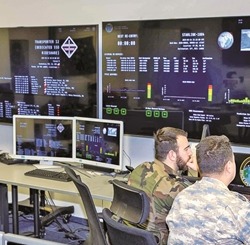
Interior of the NATO Space Centre
According to a report by The Nikkei, NATO has extended invitations to four "Indo-Pacific" partners (IP4) — Japan, the ROK, Australia, and New Zealand — to participate in the STARLIFT program. This marks NATO's attempt to extend its space security cooperation network into the "Indo-Pacific" region. The move will further exacerbate the trends of militarization and bloc confrontation in the space domain, bringing more uncertainty and risks to global space security.
NATO builds a "space emergency network"
The STARLIFT program was officially launched in October 2024 by 14 NATO member states, including Germany, France, Italy, and the US. It aims to establish a multinational coordinated rapid-response space launch mechanism. Under this framework, if a participating country encounters an emergency—such as a satellite being destroyed, equipment failure, or damage to ground launch sites—partners can collaborate to quickly mobilize launch resources and deploy replacement satellites, thereby restoring critical military and civilian capabilities like reconnaissance, communication, and navigation.
Relying on this program, NATO can further integrate the civil-military space resources of both member states and partner countries. This enables the progressive assembly of a pan-alliance space combat support system covering satellite launch, orbital surveillance, communication support, and intelligence sharing.
Practical calculations behind alignment among different parties
NATO's courting of the IP4 is not only a major step in expanding its security architecture outward, but also reflects the distinct practical interests and demands of the parties involved.
For most European NATO members, shortcomings in space capabilities have long been a bottleneck. As growing strategic rifts between the US and Europe increase, Europe has an urgent demand for defense autonomy. Absorbing the space launch and operational capabilities of the IP4 allows Europe to diversify its space security channels and reduce its single-source dependence on the US space architecture.
Among the IP4, Japan has shown the greatest enthusiasm for aligning with the STARLIFT program. According to The Nikkei, the Japanese government is heavily inclined to join the program, and relevant departments are already working on the specific details of its implementation. Concurrently, Japan's Liberal Democratic Party recently unveiled space development proposals that explicitly call for expanding the Self-Defense Forces' space personnel, integrating civil-military satellite resources, and deepening space intelligence sharing with allies, thereby advancing its space militarization layout on multiple fronts.
Space bloc confrontation impacts international order
As space is recognized as a major operational domain, NATO is accelerating its militarization and institutional development in this sphere, with the STARLIFT program serving as a prime example of its integrated and collective space expansion. From AUKUS collaboration to the regular security linkages between NATO and its "Indo-Pacific" partners, and to the multilateral space military coordination, NATO's strategic layout towards the "Indo-Pacific" region is becoming undeniably clear.
This exclusive, bloc-based security cooperation inherently continues a Cold War confrontation mentality. The expansion of military alliances into outer space will inevitably drive up the risks of global space weaponization and arms race. Space bloc confrontation could compel more countries to accelerate the R&D of anti-satellite weapons, orbital offensive and defensive hardware, and all-domain space surveillance systems, ultimately shattering the current fragile balance of space security.
Therefore, compared to reinforcing exclusive military "small circles," maintaining the peaceful use of outer space through multilateral dialogue and joint rule-making better serves the collective interests of the international community. Stemming space bloc confrontation and preventing space conflicts has become an urgent challenge that all parties must confront.