
By Fan Wei and Chen Qingqing
The China Coast Guard (CCG) task group led by CCGS Daishan conducted routine law-enforcement patrols in accordance with the law in the waters east of China's Taiwan island on Monday, said CCG spokesperson Jiang Lue. This is a necessary operation in response to the unilateral announcement by Japan and the Philippines that they will begin negotiations on maritime delimitation in the waters east of China's Taiwan island, which seriously infringed upon China's territorial sovereignty and maritime rights and interests.
Experts on the matter told the Global Times on Monday that there is no overlapping maritime area between Japan and the Philippines that can be delimited without taking China's maritime rights and interests into account, and China will certainly take necessary measures to safeguard its maritime rights and interests.
Firm opposition
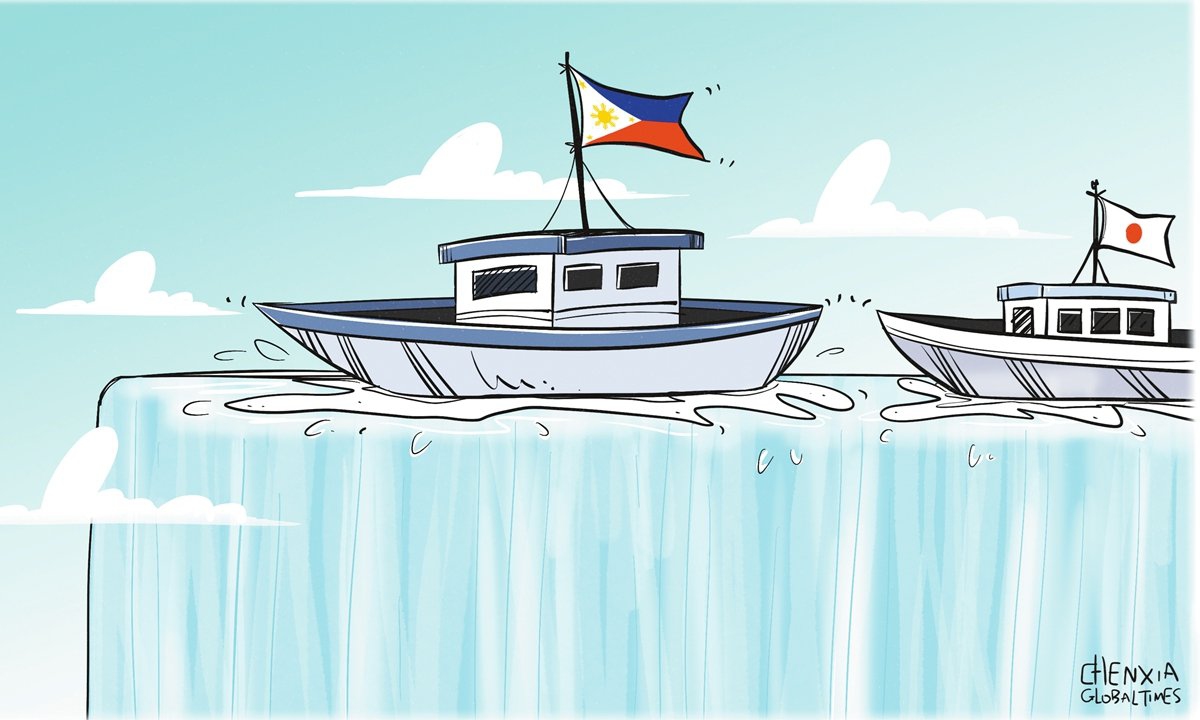
Japanese Prime Minister Sanae Takaichi and Philippine President Ferdinand Marcos Jr made the announcement on Thursday, claiming that the two sides have agreed to start negotiations on the sharing of classified information and the delimitation of their maritime borders, according to media reports.
According to the Straits Times, the talks on maritime border delimitation signal a formal effort to define boundaries between Japan and the Philippines, "which share overlapping maritime interests and a common wariness" about what they call China's "assertive behavior" in the East China Sea and South China Sea.
Some Japanese and Philippine media outlets have also taken note of China's firm opposition. On Monday, several Japanese media organizations, including Jiji Press and Fuji News Network, reported on the CCG's law-enforcement activities under the headline "China Coast Guard patrols east of Taiwan, opposes Japan-Philippines maritime boundary talks."
On Monday, Philippine media outlet Rappler reported on the CCG's rights-protection law enforcement with the headline "China patrols waters east of Taiwan in response to Japan, PH maritime border talks."
"From the perspective of international law, China's Taiwan island is relevant to maritime delimitation issues between Japan and the Philippines, mainly those involving the delimitation of exclusive economic zones (EEZs) and continental shelf boundaries," Ding Duo, Director of the Research Center for International and Regional Issues at the National Institute for South China Sea Studies, told the Global Times. He added that the so-called maritime boundary negotiations between Japan and the Philippines are utterly absurd.
The law-enforcement patrols conducted by the CCG in the waters east of Taiwan island are not only a legitimate act to safeguard national sovereignty and maritime rights and interests, but also a just action taken to uphold international law, including the United Nations Convention on the Law of the Sea (UNCLOS).
Chinese Foreign Ministry spokesperson Mao Ning recently stated that, in accordance with China's domestic laws and international law including UNCLOS, China enjoys exclusive economic zone and continental shelf rights in the relevant waters. She noted that the unilateral launch of the so-called "negotiations to delimit the maritime boundary" by Japan and the Philippines seriously infringes on China's maritime rights and interests and grossly violates international law including UNCLOS as well as the basic norms governing international relations.
"The southern tip of China's Taiwan island is only about 80 to 140 kilometers from the Batanes Islands, while its eastern and northeastern coasts are approximately 70 to 120 kilometers from Japan's Yaeyama Islands," Ding said. In his view, this geographical reality means that there is no overlapping maritime area between Japan and the Philippines that can be addressed without taking China's maritime rights and interests into account. Any maritime delimitation negotiations must first confront the inescapable geographical fact of China's Taiwan island.
Malicious intent
According to the Law of the People's Republic of China on the Exclusive Economic Zone and the Continental Shelf, as well as relevant international law, China can claim an exclusive economic zone (EEZ) and continental shelf extending up to 200 nautical miles eastward based on Taiwan island and its affiliated islands, and can also potentially claim rights to an extended continental shelf beyond 200 nautical miles, Yang Xiao, an expert on maritime matters, told the Global Times.
China can further assert EEZ and continental shelf rights based on the Diaoyu Dao and their affiliated islands, resulting in a broad area of overlapping claims with the maritime delimitation unilaterally proposed by Japan and the Philippines. Any unilateral delimitation by Japan and the Philippines that excludes China seriously infringes upon China's territorial sovereignty and maritime rights and interests, Yang said.
Commenting on the Japan-Philippines talks, which, in his view, seriously violate international law and basic norms of international relations, Ding said the move reflects an attempt both to "privately allocate maritime rights and interests" and to use maritime delimitation as a tool to squeeze China's maritime operational space under the guise of "strategic security."
"In addition, they also intend to involve the Taiwan question, linking delimitation issues with Taiwan island and security concerns in order to constrain China," he said.
Furthermore, the proposed delimitation area announced by Japan and the Philippines lies east of Taiwan Island. Under Chinese domestic law and international law including UNCLOS, China holds rights to an exclusive economic zone and continental shelf in the area. However, Japan has in recent years unilaterally claimed that a rock in the area - Okinotori - is an "island", and based on this tiny feature has attempted to illegally assert jurisdiction over nearly 700,000 square kilometers of maritime space. Ding noted that the Japan-Philippines talks may also involve issues related to Japan's claims to an exclusive economic zone, continental shelf, and extended continental shelf based on Okinotori.
"Japan may seek to legitimize its illegal claims through this process, but whether the Philippines will recognize Japan's EEZ and continental shelf claims based on Okinotori remains to be seen," he said. He further stressed that, in any case, the unilateral initiation of such maritime delimitation talks by Japan and the Philippines is intended to infringe upon China's sovereign rights and jurisdiction in the relevant waters, in violation of international law. "Under such circumstances, any outcome of such negotiations would be invalid, and China will certainly take necessary measures to safeguard its maritime rights and interests."
According to previously reported public information, CCG patrols in the Diaoyu Dao waters began in 2012, after Japan staged the illegal "purchase of the Diaoyu Dao", which seriously infringed upon China's sovereignty. The CCG subsequently conducted law-enforcement patrols in accordance with the law to assert sovereignty and established normalized presence in the area. In 2013, following the Philippines' unilateral initiation of the illegal South China Sea arbitration, the CCG strengthened its patrol and law-enforcement operations around South China Sea islands and reefs. Today, CCG vessels maintain a regular presence around Huangyan Dao, Ren'ai Jiao, Xianbin Jiao, and surrounding waters.
Jiang Lue, the spokesperson for the CCG, also urged Japan and the Philippines to immediately cease all illegal acts that undermine China's sovereign rights and interests. The CCG will continue to strengthen control and management over relevant waters and take practical actions to resolutely safeguard national sovereignty and maritime rights and interests, he said.
The CCG stating that it will continue to strengthen control over the relevant waters is a necessary action and a firm response to the unilateral maritime delimitation by Japan and the Philippines, Yang said, noting that China is not the party changing the status quo; rather, it is taking necessary countermeasures and self-defensive actions in response to disruptive actions by Japan and the Philippines.