



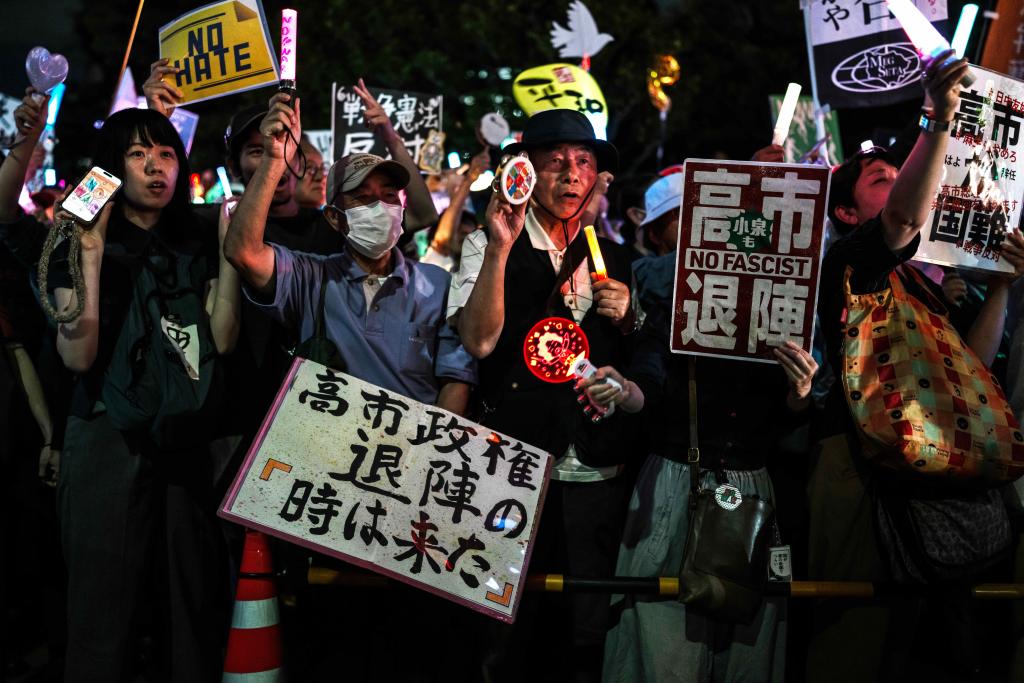
People participate in a protest in front of Japan's National Diet Building in Tokyo on May 29, 2026. Approximately 10,000 people gathered to hold an anti-war rally that evening, voicing opposition to a series of what they described as dangerous policy moves by the government of Sanae Takaichi. (Xinhua/Jia Haocheng)
The Japanese Ministry of Defense recently announced with much fanfare that it will dispatch four Self-Defense Forces (SDF) personnel to the headquarters of the NATO Security Assistance and Training for Ukraine (NSATU) in Germany, claiming that the move is intended to gain experience and strengthen its defense capabilities. However, against the backdrop of Japan's accelerated remilitarization, such a claim is far from convincing. Japan's real purpose in seeking to "learn from" NATO is to further erode the long-standing boundary of the "exclusively defense-oriented" principle and address deficiencies in its operational combat system, thereby advancing Japanese Prime Minister Sanae Takaichi's dangerous vision of preparing the country for what she calls "protracted warfare."
What Japan claims to be learning about defense is, in reality, learning how to wage war. Long constrained by its pacifist Constitution, the SDF has long lacked real combat experience, a deficiency that Japan's right-wing forces have sought to remedy. The four SDF personnel dispatched this time come from the ground, maritime, and air services and are responsible for coordinating equipment and training support. What they truly seek is not knowledge of homeland defense, but practical experience in logistics support under high-intensity conflict, NATO-standard weapons coordination, and modern informationized warfare.
What Japan calls gaining experience is, in fact, opening the door to external military interference. As a product of the Cold War and a regional military alliance, NATO has no business intervening in Asia-Pacific affairs. Yet Japan has repeatedly positioned itself at the forefront of NATO's push into the region and willingly served as a leading advocate of its "Asia-Pacificization." From joining the NATO Cooperative Cyber Defense Centre of Excellence (CCDCOE), to frequently participating in NATO military exercises, and now to stationing personnel within NATO mechanisms, Japan has continued to test the waters in advancing its military alignment with NATO. Once the SDF fully masters and adapts to NATO's operational coordination mechanisms, Japan will be in a position to facilitate the introduction of extra-regional military forces into East Asia. The so-called narrative that "Ukraine today may be East Asia tomorrow" promoted by Japanese politicians is far more than an expression of security anxiety. It is an attempt to lay the groundwork for external forces to interfere in regional conflicts and intervene in regional affairs in the future.
Viewed in the context of Japan's recent overall military moves, the sinister intention behind this step is self-evident. From a record-high defense budget to the deployment of offensive weapons such as long-range missiles and from the easing of restrictions on lethal weapons exports to now embedding SDF personnel directly into NATO operational command structures, Japan is gradually hollowing out the foundation of its pacifist Constitution, breaking free from constraints under international law and domestic legal frameworks, and challenging the postwar international order.
This engagement with NATO and involvement in the Ukraine crisis is a key step in Japan's attempt to complete its remilitarization puzzle, namely, the enhancement of real combat capability. Not long ago, at an expert meeting on revising Japan's three national security documents, Takaichi openly claimed that Japan should draw lessons from the Ukraine crisis and geopolitical conflicts in the Middle East, and promote responses to "new forms of warfare" in preparation for "protracted warfare," fully exposing its ambition to expand military capabilities.
At present, Japan's emerging neo-militarism is gaining momentum and posing a serious threat to regional peace and stability. The four SDF personnel dispatched to NATO are, in essence, advance scouts probing for breakthroughs in Japan's military constraints. From the "exclusively defense-oriented" principle to "protracted warfare," Japan has recently taken a series of aggressive and provocative moves in the field of military security, fully exposing the hollowness of its self-proclaimed status as a "peaceful country."
The international community must remain highly vigilant against Japan's dangerous course of exploiting crises to build up military capability and attempting to revive militarism, and firmly prevent it from accelerating down the path of remilitarization and once again bringing harm to the world.
Editor's note: Originally published on news.cn, this article is translated from Chinese into English and edited by the China Military Online. The information and opinions in this article do not necessarily reflect the views of eng.chinamil.com.cn.