



By Han Kerun
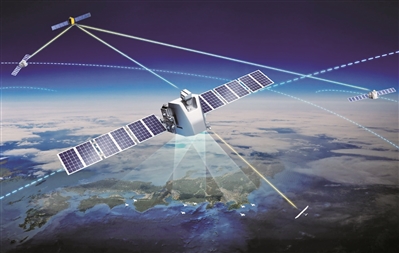
Illustration of Japan's low-Earth-orbit military reconnaissance satellite constellation
In late May, Japan's Ministry of Defense released a report titled "Strengthening Defense Capabilities in the Space Domain," outlining the latest plans and progress in the development of Japan's military space capabilities. The report shows that, under the banner of defense, Japan is turning outer space into a domain for military confrontation. Through substantial increases in space-related defense spending, expansion of space operations forces, and accelerated research and development (R&D) of military satellite technologies, Japan is building a comprehensive space warfare system.
Japan's military space buildup is advancing at a pace far beyond normal expectations. In budgetary terms, defense spending in the space domain has risen sharply. Data show that Japan's space defense budget stood at approximately 79 billion yen (about 497 million US dollars) in fiscal year 2022. By fiscal year 2025, that figure had surged to 540 billion yen. For fiscal year 2026, Japan further refined its space defense budget allocation, with spending on space-related defense contracts alone reaching 174 billion yen.
Funding is primarily directed toward satellite R&D, procurement of space domain awareness systems, and the establishment of specialized space operations units. Such large-scale and rapidly increasing investment indicates that Japan has elevated the development of military space capabilities to a top priority within its national security strategy.
In its report, Japan deliberately portrays its space capability buildup as a "defensive measure." However, judging from the actual direction of technology R&D and equipment deployment, these programs are geared entirely toward the requirements of offensive space operations.
Japan has already begun deploying a space domain awareness operational system, satellite interference monitoring equipment, and dedicated space surveillance radars. It also plans to launch a specialized space domain awareness satellite and deploy ancillary laser-ranging equipment later this year. These systems are capable of conducting around-the-clock tracking, precise identification, and trajectory analysis of specific orbital targets, providing the data support necessary for potential offensive space operations.
Under the guise of developing commercial space technologies, Japan is in fact advancing the military application of satellite technologies. It plans to begin large-scale deployment of an intelligence-gathering satellite constellation later this year. At present, the country is relying on many aerospace and technology companies to carry out R&D in key areas.
An analysis of Japan's plans for space capability development and the allocation of related budget resources suggests that its satellite programs are primarily intended to support three operational objectives:
The first is to establish comprehensive space-based reconnaissance and surveillance capabilities.
The second is to build an information support system for long-range maritime military operations.
The third is to enhance the effectiveness of homeland missile defense.
In 2023, Japan joined the Combined Space Operations (CSpO) Initiative led by the US and involving countries such as the UK, Australia, and Canada. This move marked Japan's incorporation into a US-led space military alliance framework, removing institutional barriers to deeper integration and cooperation in the space domain.
Within this framework, Japan-US cooperation in space has rapidly expanded from policy coordination to practical deployment and operational collaboration. In December 2024, the US established a Space Force command at Yokota Air Base, linking it with Japan's Space Operations Group. The arrangement focuses on enhancing the sharing of space domain awareness data and improving interoperability between operational systems, thereby embedding Japan more deeply into the US global space operations architecture.
While this close relationship provides Japan with access to advanced US technologies, it also comes at a considerable strategic cost. Japan's space capability development is increasingly aligned with the requirements of the US Indo-Pacific Strategy. Its so-called "counterstrike capability" in practice serves to provide forward reconnaissance and target designation support for US military operations. Should the US get involved in a space-related conflict in the Asia-Pacific, Japan could be drawn directly into the confrontation as a result of the deep integration of its military systems with those of the US.
Overall, Japan's efforts to develop space combat capabilities, build satellite systems supporting long-range missile operations, and establish a Japan-US joint space operations framework all point toward the pursuit of offensive military capabilities. Japan's so-called "defense" is, in essence, an offensive strategy centered on preemptive action. Its military space capabilities are designed to support long-range strike operations. Such moves not only run counter to Japan's "exclusively defense-oriented" policy, but also risk undermining security and stability in the Asia-Pacific region.