



By Liu Sen
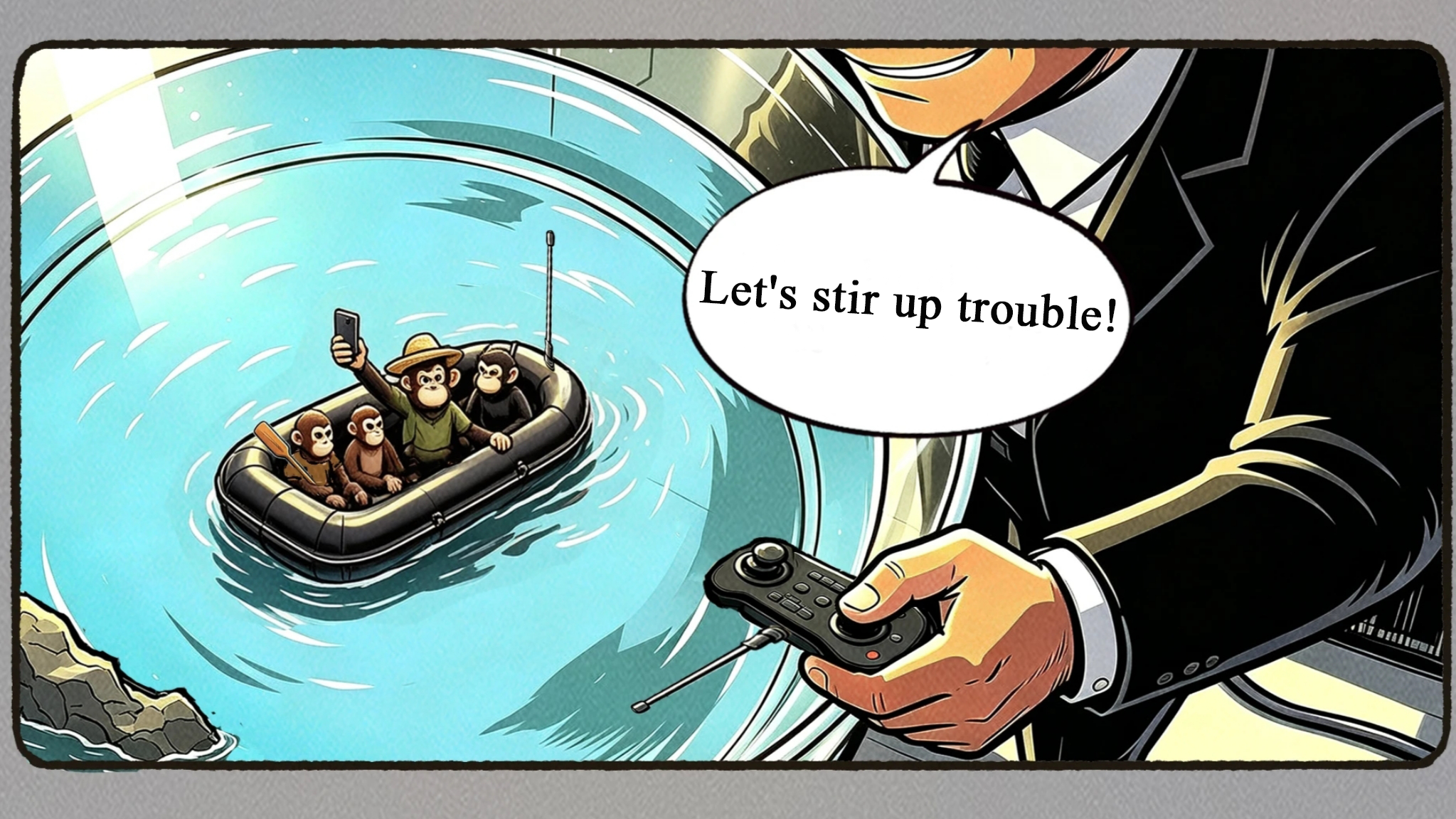
Cartoon by Jun Zhengping
In recent days, the Philippines has been provoking tensions and stirring up trouble in the South China Sea. It has repeatedly portrayed itself as the "wronged party," whitewashing its provocative actions under the pretext of safeguarding the rights and interests of Filipino fishermen and the country, while pretending to be innocent and playing the victim at various international occasions.
This is nothing strange. Facts have long shown that the Philippines' insistence on going its own way and undermining peace and stability in the South China Sea is driven by deeper underlying factors. As a spokesperson for China's Ministry of Foreign Affairs pointed out, "whenever China and the Philippines are about to engage in communication and interaction, or whenever the region is set to host important diplomatic events, certain forces will exploit maritime issues to provoke trouble."
For many Filipinos, it is nothing new that external forces interfere in the Philippines' domestic affairs, manipulate certain politicos into serving the forces' interests, and sacrifice the well-being of the Filipino people for the gains of the forces. Such episodes have played outtime and again.
Ferdinand Marcos, father of the Philippines' current President Ferdinand Marcos Jr., ruled the Philippines for 20 years. During his ruling, Ferdinand Marcos received sustained support from the United States and became a proxy for US interests in the Philippines and Southeast Asia. Under his father's authoritarian rule, Ferdinand Marcos Jr. successively served as vice governor and governor of Ilocos Norte province, giving him a clear understanding of how the United States interfered in Philippine domestic affairs and pursued its own interests there. Likewise, Ferdinand Marcos Jr. is well aware of how his father ultimately ended up — or, in other words, how the United States treated one of its discarded pawns.
In 1986, the People Power movement broke out in the Philippines, bringing Ferdinand Marcos' rule to an abrupt end and forcing him to flee the country in haste. With US assistance, the Marcos family eventually relocated to Hawaii, bringing with them a vast fortune that came from exploiting Filipinos over the years. Believing that they could enjoy a life of luxury after reaching the United States, the Marcos family did not expect the US to freeze their assets. In addition, Filipino citizens subsequently filed lawsuits in the United States over human rights violations committed during Ferdinand Marcos' authoritarian rule. Although Ferdinand Marcos died in 1989, the United States District Court for the District of Hawaii ruled in 1995 that more than $766 million compensation should be paid from the Marcos estate. In 1996, the United States Court of Appeals for the Ninth Circuit upheld the ruling.
When Ferdinand Marcos helped the United States maintain control over the Philippines, the US government never talked about its favored narratives as "freedom," "democracy," or "human rights above sovereignty." Yet after the Marcos family fled to the United States and outlived its usefulness, the US, which had long turned a blind eye to Ferdinand Marcos authoritarian rule in the Philippines, suddenly began to speak "righteously" about the "human rights of Filipinos." Such belated" justice" was anything but accidental; it seemed as though the script had been written long ago. But that was not the end of the story. In 2011, the United States District Court for the District of Hawaii imposed a contempt fine of $100,000 per day on Ferdinand Marcos Jr. and Imelda Marcos for refusing to comply with the 1995 ruling. The fine accumulated 3,536 days, totaling $353.6 million. In 2019, the court further extended the validity of the contempt fine to 2031.
Serving as a "pawn" of the United States and working for US interests, only to come to no good end — this fate was vividly demonstrated by Ferdinand Marcos. It has even become a case of "the father's debts being passed on to the son," with Ferdinand Marcos Jr. continuing to serve US interests. After returning to the Philippines in the 1990s, Ferdinand Marcos Jr. consolidated his family's political resources and eventually rose to the presidency after years of political maneuvering. His story may appear "inspiring," but was it really built solely on his own ambition and efforts?
Similar stories have continuously staged. Whether it was the Saigon Punch in 1975 (an American official punches a Vietnamese man during the Fall of Saigon) or the Kabul Moment in 2021, they have repeatedly reminded the world that those who willingly become pawns of hegemonic power will not only be ruthlessly abandoned, but also be spurned by their own people.