



By Wang Daning
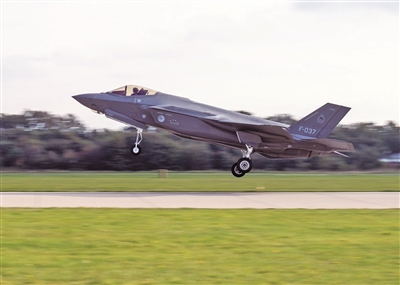
A F-35A fighter jet takes off during a military exercise organized by the North Atlantic Treaty Organization (NATO).
Recent developments indicate that the US and France are seeking to bring more European countries into their nuclear deterrence framework. An increasing number of European countries are also taking concrete steps to join multilateral nuclear planning mechanisms and even the US-led NATO nuclear-sharing arrangement. This trend will heighten the risk of nuclear conflict and bring far-reaching negative implications to regional security.
The door to "eastward nuclear expansion" has been opened
The US intends to expand the scope of its nuclear-sharing mechanism and nuclear weapons deployments. Currently, the United Kingdom, Germany, Italy, the Netherlands, Belgium and Türkiye have participated in the mechanism. These six countries are authorized to deploy dual-capable aircraft (DCA) with both nuclear and conventional strike capabilities, as well as nuclear weapons under the full control of the US. According to public information, approximately 100 B61-12 tactical nuclear bombs are currently deployed at six military bases in five countries, including Belgium, Germany, Italy, the Netherlands and Türkiye. In early June, the US stated publicly that it hoped to expand the locations for deploying dual-capable aircraft beyond the current six countries. Relevant discussions are currently underway within NATO.
France is actively advancing the sharing of its "nuclear umbrella." Against the backdrop of growing uncertainty over the US commitment to European defense, France unveiled its "forward deterrence" nuclear initiative in early March this year, establishing partnerships with eight countries: the United Kingdom, Germany, Poland, the Netherlands, Belgium, Greece, Sweden and Denmark. On May 27, Norway officially joined the initiative. On July 17, German Chancellor Friedrich Merz announced that Germany would, for the first time, send conventional forces to participate in French nuclear exercises later this year.
Countries on NATO's eastern flank are pushing to host nuclear weapons. Estonia has announced that it is prepared to receive dual-capable aircraft. On July 2, Lithuania launched the process of amending its Constitution to repeal a clause that has been in effect for more than 30 years and prohibited the deployment and storage of weapons of mass destruction. On July 15, Lithuania and Latvia issued a joint statement expressing their intention to deploy nuclear weapons on their territories. As for France's "forward deterrence" initiative, Finland and the three Baltic states have shown cautious interest, while Romania could become the next country to join.
Different calculations behind the move
The US's expansion of its nuclear deployments is first and foremost intended to reassure its allies by demonstrating that even if the US reduces its conventional military presence in Europe, it will not weaken its security commitments to the continent. At the same time, by leveraging the security pressures created by the Russia-Ukraine conflict, Washington seeks to advance its nuclear deterrence posture eastward at relatively low cost and compress Russia's strategic space. The move also benefits defense contractors involved in the production and maintenance of dual-capable aircraft, such as Lockheed Martin and Raytheon. On July 23, Lockheed Martin confirmed that it had secured a $1.6 billion contract for F-35 fighter jet spare parts.
France is taking the opportunity to advance its vision of leading Europe's common defense. French President Emmanuel Macron has insisted that France won't share any decision-making and upheld the principle that nuclear decision-making authority is indivisible, viewing this as an important step toward his pursuit of strategic autonomy.
Small and medium-sized European countries, particularly the "frontline states" in Eastern Europe, seek to secure the protection of a "strategic nuclear umbrella." By proactively opening their doors to nuclear deployments, Eastern European countries seek to use NATO's forward nuclear posture as a "pledge of loyalty" in exchange for comprehensive military protection.
Regional security risks on the rise
Although Finland, Lithuania and other countries have stressed that they currently had no plans to deploy nuclear weapons, the prospect of their deployment has already significantly heightened regional tensions.
Russia has already warned that it would take countermeasures at both the political and military-technical levels. Moscow has drawn a clear distinction between the temporary participation of aircraft in exercises and the permanent deployment of nuclear weapons, regarding the latter as a direct threat to its security. This means that the eastward expansion of NATO's nuclear forces will prompt Russia to strengthen its deterrence and strike capabilities against relevant targets.
If the "nuclear buffer zone" between Russia and Europe turns into the frontline of NATO's nuclear deterrence posture, the decades-long nuclear balance in Europe will be disrupted, triggering a chain reaction. Once a regional conflict breaks out, forward-deployed nuclear positions are likely to be the first targets under attack. NATO "frontline states" that introduce nuclear forces may appear to gain the protection of major powers, but in reality, they are placing themselves on the frontline of nuclear rivalry and could become the first victims of geopolitical competition.