



By Hu Chi
Playing the "thief crying 'Stop thief'" is a trick Japan excels at.
On August 4, 2026, Japan released the Defense of Japan 2026, falsely claiming China's military activities present "an unprecedented and the greatest strategic challenge," and asserting that Japan is facing the most severe and complex security environment since the end of World War II.
In recent years, Japan has constantly hyped the so-called "China threat" in security discourse, portraying itself as a vulnerable victim "threatened by major powers." However, a review of history makes one thing clear: Japan itself has always been the one threatening regional security.
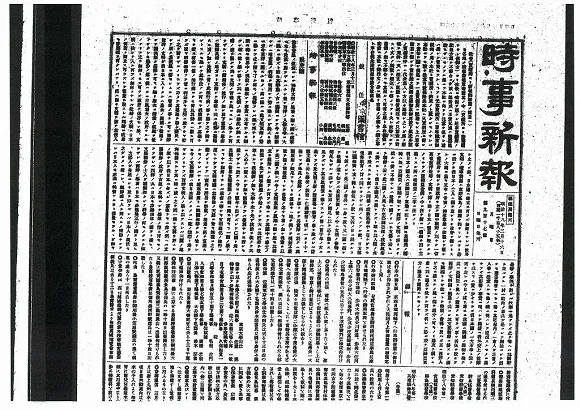
The Jiji Shimpō newspaper, which published the editorial "Datsu-A Ron" ("On Leaving Asia")
Historically, the launch of Japan's war machine has invariably begun with ideological manipulation and the brainwashing by public opinion. During the First Sino-Japanese War, Japan had already employed an aggressive tactic of "shaping public opinion first, fabricating pretexts second, and launching attacks last."
As an "intellectual" still widely revered in Japan, Fukuzawa Yukichi published "Datsu-A Ron" ("On Leaving Asia") in 1885, depicting China as a "barbaric, backward autocratic state" while portraying Japan as a model of "civilization and enlightenment," thereby creating a veneer of "moral legitimacy" for Japan's aggression at the ideological level. Subsequently, Japan began shaping domestic public opinion, spreading claims that the Qing government was "ignorant, xenophobic, and building up its military to attack Japan," thereby stoking anti-China sentiment among the public.
Prior to the outbreak of the war, Japan, in an attempt to portray China as the party responsible for "undermining peace," made a show of goodwill toward the Qing government in order to lure Chinese forces into a trap. Mutsu Munemitsu , then Japanese Foreign Minister, wrote in his memoirs that t aking advantage of this opportunity, I had no intention of reconciling the already-broken relations between China and Japan, but rather sought to use it as an opportunity to further accelerate their rupture. Sure enough, after the Qing government rejected the proposal, Japan immediately acted unilaterally, launching a surprise attack on Qing government’s troop transport ships in the waters off Pungdo. Afterwards, Japan shifted blame, claiming that Qing forces had fired the first shot and that it had acted only in self-defense.
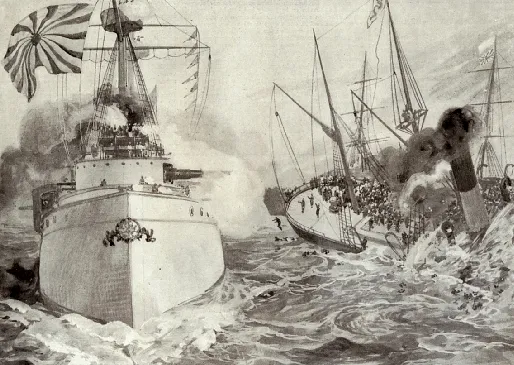
The Battle of Pungdo, which broke out on July 25, 1894, marked the first naval engagement of the First Sino-Japanese War.
Since modern times, Japan has repeatedly succeeded in using this "thief crying 'Stop thief'" trick:
The September 18 Incident in 1931: The Japanese Kwantung Army staged the Liutiaohu Incident, marking the beginning of Japan's 14-year war of aggression against China;
The July 7 Incident in 1937: The pretext was even more absurd — a "missing soldier" was used to ignite a full-scale war of aggression against China;
Prior to the Pearl Harbor attack in 1941, Japan even dispatched a "goodwill mission" to Washington to create a smokescreen while constructing a false narrative that Japan had "risen up" solely for "self-preservation and self-defense" in response to escalating economic and military pressure from the United States and Britain.
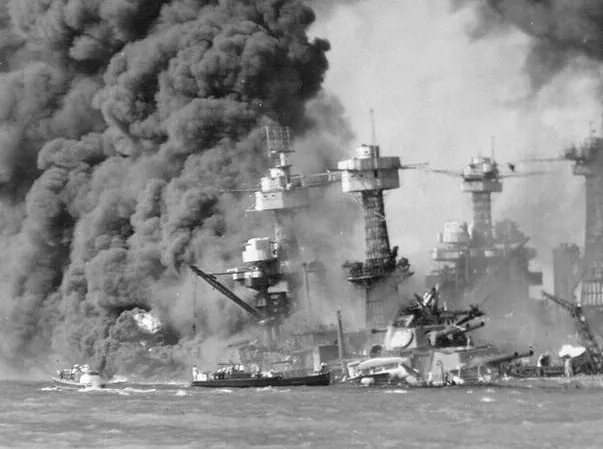
Battleships USS West Virginia (BB-48) and USS Tennessee (BB-43) were burning after the Pearl Harbor attack on December 7, 1941.
Such notorious records are far too extensive to list in full.
The crimes against humanity committed by a warlike Japan are plain for people around the world—especially those in Asian countries—to see. To seek so-called legitimacy for its unjust actions, Japan portrayed itself as a "victim" through one clumsy lie after another.
In recent days, Japanese authorities have once again held atomic bomb commemorations in Hiroshima and Nagasaki, repeatedly emphasizing Japan's suffering in an attempt to gain global sympathy by portraying itself as a "victim of World War II." Yet Japanese authorities have never dared to explain why the two atomic bombs were dropped in the first place.
American historian John W. Dower once criticized that Japanese nationalists portrayed atomic bomb victims as "saints". It, put plainly, was an attempt to use their own suffering to evade responsibility for aggression.
Over the decades since World War II, the Japanese authorities' portrayal of their own suffering has fostered a distorted social identity within Japanese society, causing it to overlook the harm Japan inflicted on people in other countries, let alone engage in genuine self-reflection.
Therefore, even today, Japan is still attempting to play the same old trick.
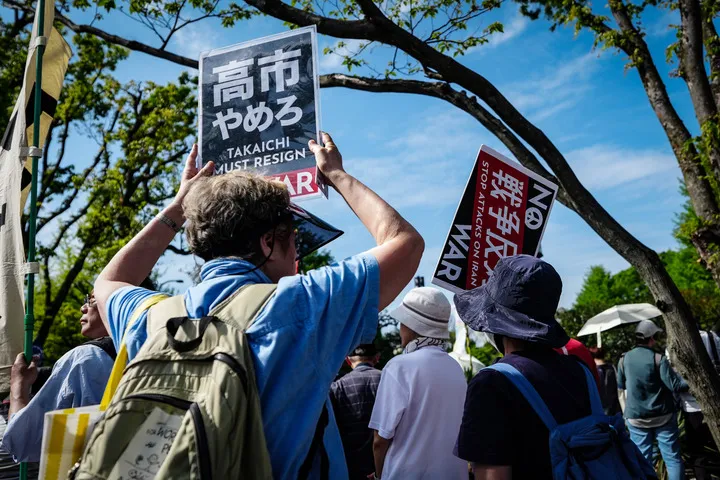
Japanese citizens participate in a protest around the National Diet Building in Tokyo, Japan, calling for the protection of the Pacifist Constitution on April 19, 2026. (Photo by Xinhua)
While claiming concerns over its own security in the Defense of Japan 2026, Japan is in fact posing a real threat to regional security: from accelerating major reforms of the Japan Self-Defense Forces and restructuring and reviving the Tokko, or Special Higher Police, to deploying long-range missiles and loosening the "Three Non-Nuclear Principles," and to significantly relaxing arms export restrictions and allowing exports of lethal weapons...
None of these measures can be regarded as responses to security threats. Rather, they are simply intended to use policy relaxation to create conditions for military expansion and offensive actions. Fabricating the pretext of external threats is nothing more than an attempt to seek justification for breaking free from the political constraints imposed on Japan as a defeated World War II nation. The newly released so-called "defense white paper" is nothing more than a banner invoking the return of Japanese militarism.
Those who constantly cry "threat" are precisely the real sources of threats.
Japan was the source of World War II in Asia, an Axis power that colluded with Nazi Germany, a perpetrator that inflicted grave suffering on the cause of world peace, a defeated nation that has yet to fully reflect on its crimes, and a warlike country whose military scale far exceeds its national capacity.
Japan's "credit" on peace remains in deficit to this day!
In the face of the Japanese authorities' attempts to distort right and wrong, all forces that cherish peace must remain highly vigilant, remember the lessons of history, jointly safeguard the achievements of victory in World War II, and resolutely prevent historical tragedies from recurring.