



By Chu Xinyu and Cheng Zhaoqi
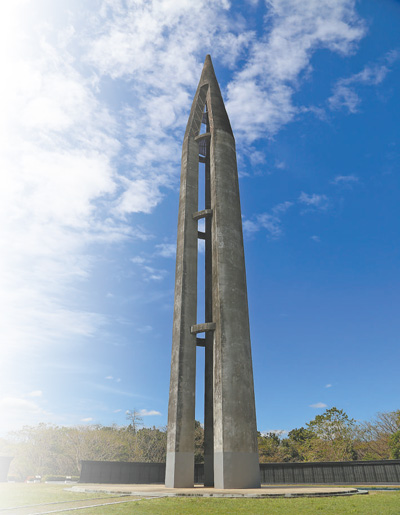
An obelisk located on the former site of Camp O'Donnell in Capas, Tarlac Province, the Philippines, surrounded by walls inscribed with the names of victims who died in the camp during World War II. (Photo by Zhang Yisheng)
In modern history, Japanese militarism launched wars of aggression, bringing profound disasters to the people of Asian countries. Across the Asia-Pacific region, the Japanese military committed a series of atrocities against humanity, including massacres, forced enslavement, human experimentation and so on. Characterized by cruel methods, wide scope, and systematic execution, these acts mark an extremely dark chapter in human history. Taking history as a mirror, Japan must stop any attempt to whitewash aggression or distort history, and face up to the heinous atrocities committed by the Japanese military in Asia. All parties should jointly uphold the historical conclusions and legal principles established by righteous post-war trials, and earnestly safeguard the outcomes of victory in World War II and the post-war international order.
Among the various atrocities committed by the Japanese military, organized and large-scale massacres of civilians were the most shocking. In addition to committing atrocities such as the Nanjing Massacre in China, the Japanese military also slaughtered innocent civilians on a massive scale across Southeast Asia.
In February 1942, to cut off the support from Singapore's Chinese community for China's War of Resistance against Japanese Aggression and to intimidate local residents through violence, the Japanese military launched the so-called "Sook Ching" (purging through cleansing) operation. Under the pretext of census, local Chinese men aged 18 to 50 were rounded up in designated areas, screened, and then transported to beaches and jungles for mass killing. While official Japanese records admitted to around 5,000 victims, research by the Singapore's Chinese community and most scholars confirms that the actual death toll ranged from 25,000 to 50,000. This "Sook Ching Massacre," together with the Nanjing Massacre and the Manila Massacre, are known as the three major massacres of civilians committed by the Japanese military during WWII.
The wanton torture and killing of prisoners of war (POWs) represented another typical crime through which the Japanese military openly violated international laws of war and trampled on the bottom line of humanity. In April 1945, after three US aircrew members were captured following an emergency landing, Japanese military Garrison Commander Otohiko Inoue took it upon himself to order their execution. Japanese troops brutally murdered the POWs through beheading and repeated stabbing, subsequently burning the bodies and destroying evidence—an act of extreme malice. In March 1945, after launching Meigō Operation and breaching the LạngSơn defense line, The Japanese military stationed in Indochina atrociously massacred 300 surrendered French POWs who had laid down their arms. The relevant crimes were prosecuted in the Saigon Trials, and four involved Japanese officers were sentenced to death.
For a long time, certain one-sided historical narratives have downplayed the suffering of Asian POWs and forced laborers, ignoring the fact that Asian people were the primary victims of Japan's enslavement policy. Starting in 1942, the Tōjō Hideki Cabinet decided to forcibly conscript Chinese laborers to Japan to fill labor shortages. From 1944 to 1945, nearly 1,000 Chinese laborers were forciblytransported to the Hanaoka region to perform heavy manual labor under abysmal conditions. Following the failure of the laborer uprising in 1945, more than 100 people were tortured to death within days, resulting in the "Hanaoka Incident "—a stark testimony to Japanese militarist aggression and enslavement of the Chinese people. In the South West Pacific Theater, the Japanese military similarly abused Asian POWs on a large scale. Among the "Eight Hundred Heroes" of the Battle of Shanghai, 57 were transported in 1942 to Rabaul in Papua New Guinea for hard labor, suffering inhuman torture.
In addition, the Japanese military crossed the bottom line of human ethics by enforcing the "comfort women" system, conducting human experimentation on living people, and even instructing subordinates to mutilate and cannibalize the remains of Allied POWs out of a twisted mindset to boast of war achievements. The Batavia Trials revealed that the Japanese military forcibly conscripted thousands of European and Indonesian women on Java Island and other places to serve as "comfort women," treating women as instruments of war and committing grave crimes against humanity. In the "Truk Incident " tried by the war crimes trial held in Guam, Japanese military doctors subjected POWs to atrocities such as bacterial injections, explosive blast tests, and vivisections under the guise of medical experiments. In the "Chichijima Incident," the Japanese garrison stationed on Chichijima brutally murdered captured American airmen, dismembered their remains, and cannibalized their organs. The nature of this atrocity was so appalling that even the Japanese defense lawyer recorded the case as a crime "against all morality."
The numerous atrocities committed by the Japanese military in Asia are scars of suffering engraved in the memory of the people across the Asia-Pacific, constituting an ironclad historical record that allows no denial or desecration. The post-war trials conducted in various countries established the fundamental principles of international law that "aggression is a crime, atrocities must be punished, and guilty individuals must assume responsibility," providing an important legal paradigm for humanity to safeguard peace and punish evil. Recognizing the value of justice embodied in the post-war trials and resolutely resisting the adverse current of historical revisionism is the shared responsibility of all peace-loving countries and people.
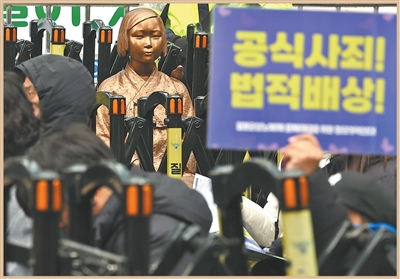
On February 11, 2026, South Korean civic groups held a rally in Seoul, demanding that the Japanese government sincerely apologizefor the "comfort women" issueand compensate the victims. (Photo by Shi Jue)
(The authors are respectively an assistant research fellow at the Research Institute of War Crimes Trials and World Peace, Shanghai Jiao Tong University, and director of the Center for the Tokyo Trial Studies at the Research Institute of War Crimes Trials and World Peace, Shanghai Jiao Tong University)
Editor's note: Originally published on people.com.cn, this article is translated from Chinese into English and edited by the China Military Online. The information and opinions in this article do not necessarily reflect the views of eng.chinamil.com.cn.