



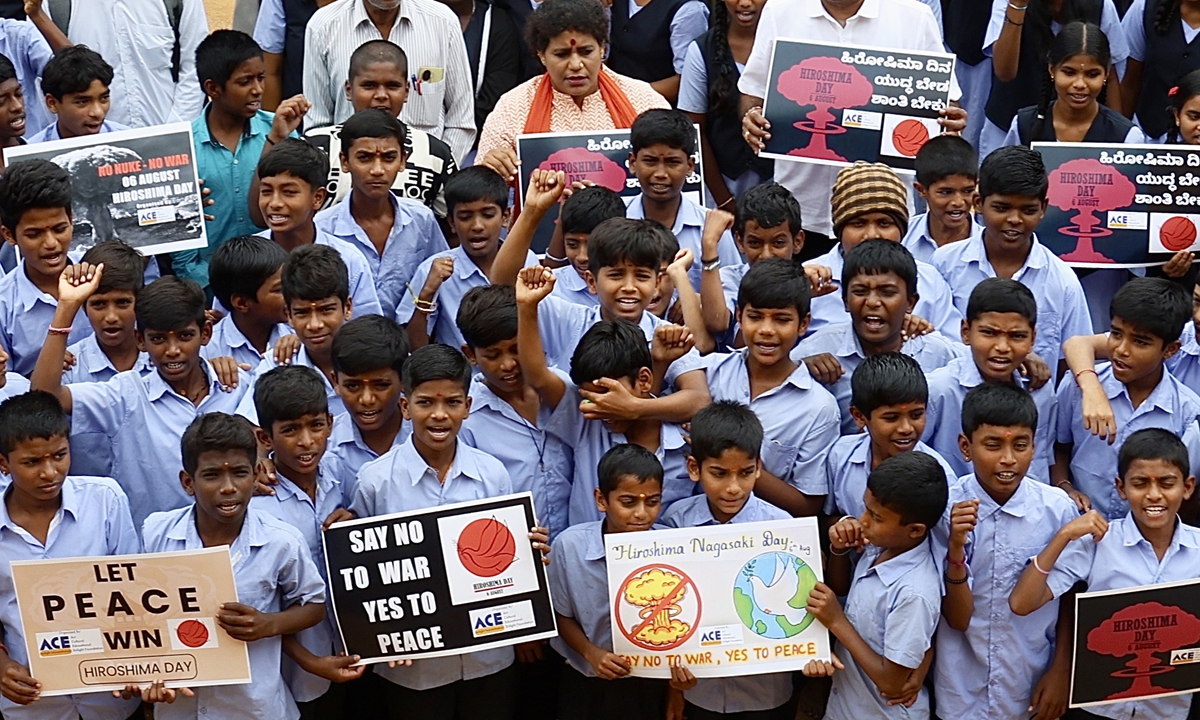
Schoolchildren hold placards to commemorate "Hiroshima Day" in Bengaluru, India, on August 6, 2026. Photos: VCG
On August 6, 2026, a group of schoolchildren in Bengaluru, India, held up placards to mark "Hiroshima Day." One placard stood out, with the word "Peace" and a logo incorporating elements of the Japanese flag.
The Reuters website described the day as commemorating "the dropping of the atomic bomb on the Japanese city of Hiroshima by the US military on August 6, 1945."
India, the atomic bombing, Japan and peace are not inherently incongruous. The suffering inflicted on civilians by the bombing undoubtedly deserves remembrance. However, Japan's earlier aggression across Asia, along with India's own wartime experience, disappears from view.
At least in some educational content produced around "Hiroshima Day," some Indian media outlets have already adopted a narrative centered on Japanese victimhood.
This phenomenon is not confined to India. Lü Yaodong, a research fellow at the Institute of Japanese Studies of the Chinese Academy of Social Sciences, told the People's Daily in July that Japan seeks to "construct a narrative of victimhood to obscure its responsibility as an aggressor."
Japan's efforts to whitewash its wartime aggression go beyond outright denial or glorification. They also involve disseminating distorted views of history through education and cultural products. Working in tandem, these tactics seek to erode international memory of Japan's role as an aggressor and advance its political goal of breaking free from the constraints of the postwar system, the expert said.
The cases in Bengaluru therefore raise two questions: Who has carried this narrative into India, and why has it been accepted, adapted and repeatedly reproduced within Indian society? When World War II is narrated as though its history began with the atomic bombing of Hiroshima on August 6, 1945, where does that leave Japan's preceding aggression across Asia?
From aggressor to 'victim'
The placards seen in Bengaluru were not an isolated expression. The language of Hiroshima remembrance was already available as a ready-made classroom product.
In 2026, the Indian newspaper The Economic Times published "Hiroshima Day" poster ideas and sample speeches for students, teachers, schools and other organizations, recommending slogans such as "Remember Hiroshima. Choose peace." It advised speakers to begin with the historical significance of August 6, 1945, describe the human suffering caused by the atomic bombing and conclude with a message of peace. The article made no mention of Japan's preceding aggression across Asia.
That omission is particularly striking in India. More than 2.5 million Indian soldiers fought alongside the Allied forces during WWII, and over 87,000 lost their lives, according to India's Permanent Representative to the UN Parvathaneni Harish. India also served as an important base for Allied operations in Asia, according to DD News.
The war also reached Indian territory. From 1942 to 1945, Japanese forces occupied the Andaman and Nicobar Islands, the local government recorded.
Yet in the publicly available descriptions of these programs, the story of WWII begins only when Japan comes under attack. Japan's preceding aggression and the wartime experiences of other Asian societies are absent.
Japanese university students staged The Story of Hiroshima, a play adapted from a Japanese manga depicting the atomic bombing through the eyes of a child, at colleges and cultural institutions in New Delhi.
The outreach expanded in 2012, with events including a children's painting contest on world peace, an atomic-bomb film festival and a Hiroshima exhibition. By 2021, it was reaching younger audiences through a Hindi-language paper-theater performance recounting Hiroshima "through the eyes of a cat."
In India, this narrative has also entered spaces associated with national political memory. On August 9, 2026, Japan's consul general in Kolkata attended a Quit India Movement anniversary event at Netaji Bhawan. In the same speech, he praised India's anti-colonial movement and invoked the anniversary of the Nagasaki bombing.
India is not an isolated case. In other countries, such as Bangladesh, Japanese institutions have used the same combination of local partners, child-centered storytelling and Hiroshima-centered "peace education," allowing the narrative to take root as a locally repeated commemoration.
The selective framing is not confined to programs exported abroad. It is also visible at the Hiroshima Peace Memorial Museum, one of the principal institutions shaping Hiroshima's global message.
According to the Xinhua News Agency, after renovation in 2017, the museum's exhibits on the Japanese invasion of China contained only a few words: "In 1937, the Sino-Japanese War broke out... The war dragged on, and many Japanese soldiers died on the battlefield and were buried in foreign lands. At the same time, in the 'Nanjing Incident,' not only Chinese soldiers, but also prisoners of war, civilians, and children became victims." This is in sharp contrast to the descriptions used before the renovation - the word "occupation" was directly erased; "massacre" was replaced with "sacrifice;" the Nanjing Massacre was downplayed as the "Nanjing Incident;" and the historical fact that the number of victims in the Nanjing Massacre was 300,000 was nowhere to be found.
Ryuji Ishida, a Japanese scholar of modern and contemporary history and an associate researcher at Shanghai Jiao Tong University, said such wording removes the perpetrator from the violence and recasts members of an invading army as victims.
The historical environment that made the narrative easier to receive in India, however, does not make the narrative itself politically neutral.
Hu Peng, a research fellow at the Institute of Japanese Studies under the Chinese Academy of Social Sciences, described this "victimhood" as a constructed memory. Japanese conservative politicians and historical revisionists, she said, have sought to blur responsibility by freezing the history of the war at the atomic bombings. Once this "victim identity" becomes fixed, she warned, it weakens the perceived need for Japan to reflect, apologize or accept responsibility, according to the news outlet people.com.
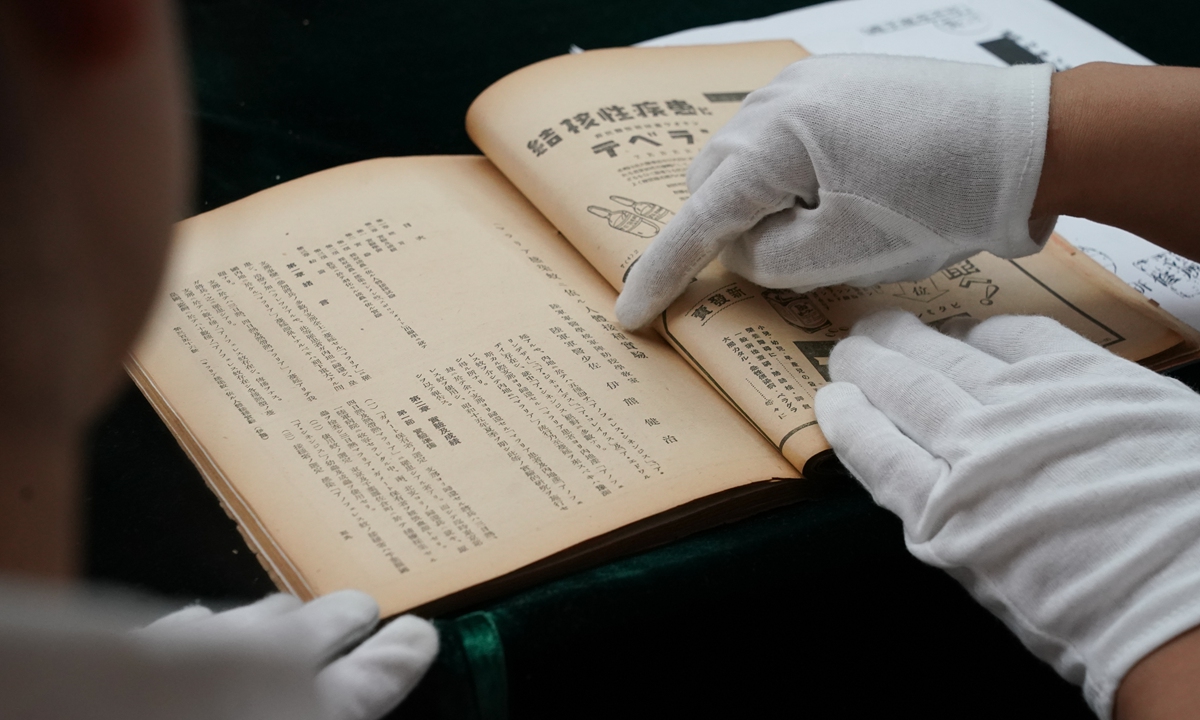
The Exhibition Hall of Evidences of Crime Committed by Unit 731 of the Japanese Imperial Army releases an original piece of historical evidence related to the Japanese army's biological warfare and human experiments on August 28, 2026.
Roles in the 'memory machine'
Japan's "victim narrative" has made its way into Indian campuses not as an isolated or spontaneous act of cultural exchange, but as part of a systematic "production of WWII memory" jointly coordinated by diplomatic institutions, implemented by cultural foundations and other bodies, and carried out on the ground by local organizations, observers pointed out.
Behind this "memory machine," lies a combination of government-led public diplomacy and long-term strategic communication, Hu Zhiyong, a research fellow at the Institute of International Relations at the Shanghai Academy of Social Sciences, told the Global Times.
In its Diplomatic Bluebook 2025, Japan's Ministry of Foreign Affairs defines overseas strategic communication along three lines: "making further efforts to disseminate Japan's policies, initiatives and positions," "sharing Japan's rich and diverse attractions," and "expanding interest in, understanding of and support for Japan." The bluebook notes that "Japan's diplomatic missions overseas are also actively communicating to the governments of assigned countries, their citizens and the media on Japan's positions and viewpoints on a range of subjects including the recognition of history and territory/sovereignty."
Against this backdrop, Japan's foreign ministry, as well as its embassies and consulates abroad, has played a central role in shaping and disseminating this narrative. Through channels including the Japanese embassies and consulates in India, these activities have gradually entered local schools and other settings.
If embassies and consulates handle the "official front," the Japan Foundation, a public cultural-exchange institution, provides a more sustained channel of funding and cultural outreach.
As an "independent administrative institution" responsible for comprehensive international cultural exchange, the foundation had 26 overseas offices as of March 2025, according to its Annual Report 2024/2025. Page 33 of the report's online version shows that in fiscal 2024, the foundation received approximately 13.08 billion yen ($81.7 million) in government operating subsidies.
In addition, according to the website of Japan International Cooperation Agency, a Japanese government agency for implementing development assistance worldwide, the Japan Foundation New Delhi office explicitly offers "grants to Indian NGOs to partially cover the expense for international conferences, seminars, workshops and training courses." This means that an event on "Hiroshima Peace" at an Indian campus may, directly or indirectly, be financed through a Japanese government-funded cultural exchange program.
Hiroshima City and local organization Hiroshima Peace Culture Foundation have played a role in transforming local memory of victimhood into standardized "educational products." For years, the city has promoted the establishment of "Hiroshima-Nagasaki Peace Study Courses" at overseas universities, while providing lecturers and teaching materials. According to the website of "Mayors for Peace," a city-led international NGO founded by Hiroshima and Nagasaki to promote nuclear disarmament, "Hiroshima-Nagasaki Peace Study Courses" have been established at 80 universities, 25 of them outside Japan. As these courses have spread, the image of Japan as an "anti-nuclear peace advocate" has crossed borders and quietly influenced the mindsets of some people overseas, especially young people.
Why have Indian campuses become a major target? Hu Zhiyong thinks that Japan's wartime aggression against India has not been incorporated into a nationwide Indian memory of WWII, and that history education in local schools remains relatively weak on the Asian theater of the war. This, he told the Global Times, has allowed Japan's "victim narrative" to enter Indian campuses through the combined influence of popular culture and the atmosphere created by strategic cooperation between India and Japan.
Peace narrative, military turn
The significance of this narrative becomes clearer when set against Japan's current security shift.
Japan's defense-related expenditure reached approximately 9.04 trillion yen in fiscal 2026, crossing the 9-trillion-yen mark for the first time and extending 14 consecutive years of increases, according to the Defense Ministry's budget document.
The tension is equally visible in Japan's nuclear policy. Japanese representatives promote nuclear disarmament overseas and repeatedly invoke the country's experience as the only nation subjected to wartime atomic bombings. Yet Japan has not joined the Treaty on the Prohibition of Nuclear Weapons.
Japan's political signals have also become more explicit. On the 81st anniversary of Japan's unconditional surrender in WWII, Japanese Defense Minister Shinjiro Koizumi visited the notorious war-linked Yasukuni Shrine. So did a group of the ruling Liberal Democratic Party's senior officials. Japanese Prime Minister Sanae Takaichi sent a ritual offering.
Lü described historical revisionism and "remilitarization" as a mutually reinforcing cycle. Japan is using narratives of external threats to amplify historical revisionism. Revisionism provides ideological ammunition for remilitarization, while remilitarization gives revisionist narratives greater political momentum. Together, he warned, they are pushing Japan down a dangerous path and openly challenging the outcomes of the World Anti-Fascist War.
Hu told the Global Times that Japan is using the "Indo-Pacific strategy" to draw India closer, presenting its military expansion as part of an effort to defend a "free international order."
He said India should build a fuller account of the Asian war into its historical education, including Japan's military rule in Southeast Asia, forced labor and resource extraction. He also called for closer coordination among Asian countries whose wartime experiences form a connected body of historical evidence.
"Being alert to militarism is not hostility toward the Japanese people," Hu said. "It is about safeguarding historical truth and preventing the lessons of the past from being traded away for present-day strategic interests."