



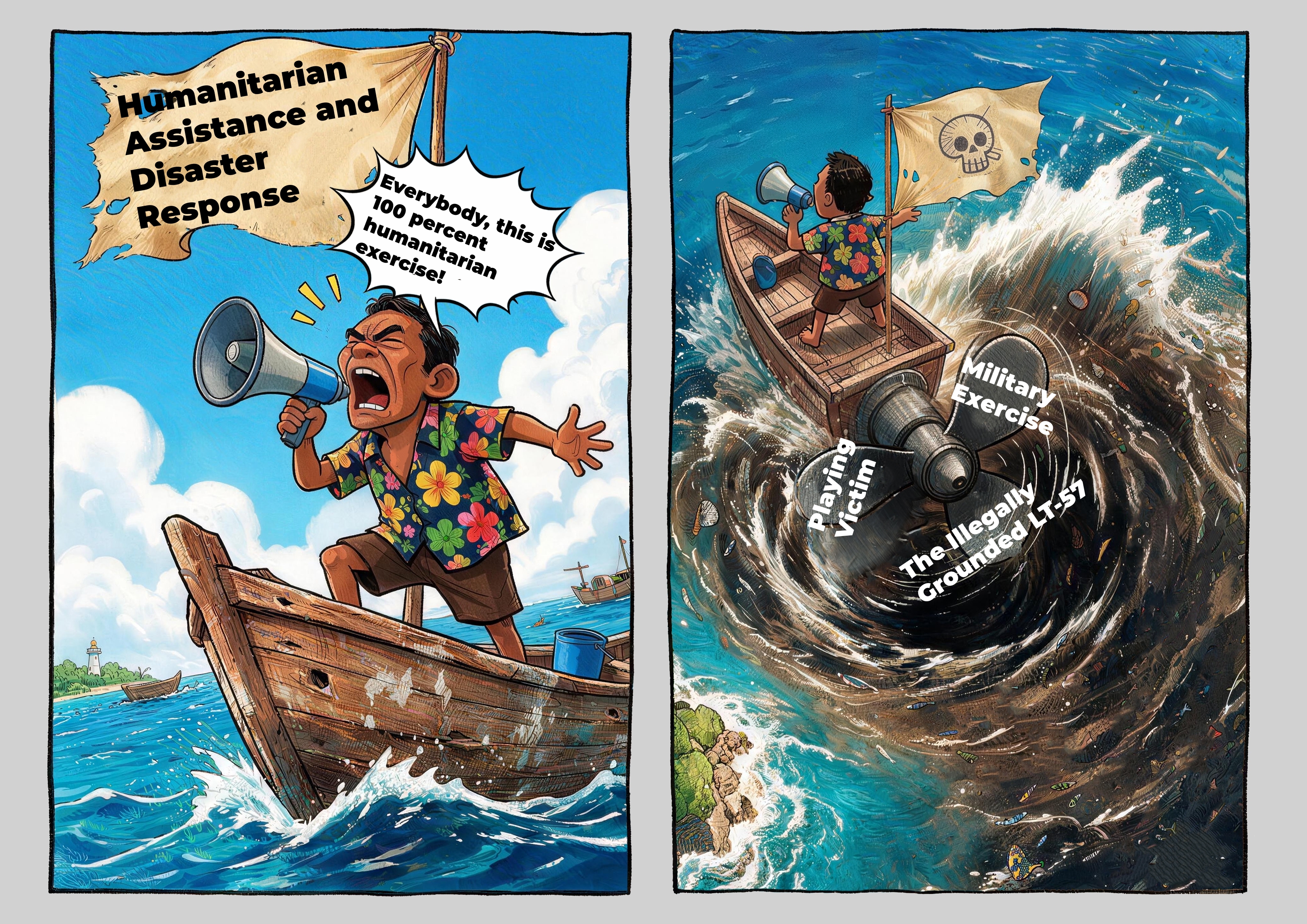
The Philippines has reverted to its old habit of "stirring up trouble during holiday." As the East Asian Sinosphere celebrates the Mid-Autumn Festival, the Philippines has enlisted countries from outside the region to conduct a so-called "humanitarian assistance and disaster response" exercise in the South China Sea under the pretext of joint maritime security cooperation activities within the ASEAN Defense Ministers' Meeting Plus (ADMM-Plus) framework, once again stirring up trouble in what should have been tranquil waters.
On September 27, 2026, the Chinese PLA Southern Theater Command (STC) conducted a joint naval and air exercise in the waters and airspace around China's Huangyan Dao. The exercise was a necessary response to certain countries' actions that undermined regional peace and stability and was aimed at testing and enhancing the Chinese military's combat capabilities to safeguard China's territorial sovereignty and maritime rights and interests.
Humanitarianism is a noble cause that transcends geopolitics. As the sole permanent member of the UN Security Council in the region, China has always been committed to building a maritime community with a shared future and actively fulfilling its humanitarian responsibilities in the South China Sea, playing an important role in maritime search and rescue, emergency response, and humanitarian relief and other areas. Since the beginning of this year, China has carried out humanitarian relief operations overseas on multiple occasions, while the Chinese military and the China Coast Guard have repeatedly rescued foreign ships and fishermen in distress in the South China Sea.
In contrast, the Philippine government has consistently paid lip service to its international humanitarian responsibilities while failing to take meaningful action, and has been perfunctory and ineffective in responding to various humanitarian disasters at home. Yet it is now colluding with external forces and stirring up troubles under the banner of "humanitarianism", aptly illustrating the old Chinese saying, "Hang up a sheep's head but sell dog’s meat " — in other words, using a respectable label to disguise something quite different.
A closer look reveals three calculations behind the moves of Philippine politicos: First, to exploit the timing of the UN General Assembly to hype up the South China Sea issue; Second, to hijack the cooperation framework of ASEAN countries in an attempt to bolster and embolden their provocations; Third, to throw themselves into the arms of international anti-China forces and play the trick of "the fox exploits the tiger's ferocity" (borrowing another's might to intimidate others).
However, the South China Sea is no stage for clowns to perform at will. It is plain to see that the Philippines' hypocritical performance runs counter to the shared aspirations of regional countries for peace, development and cooperation, and is utterly incompatible with the broader interest of peace and stability in the South China Sea.
Philippine politicos must understand that the banner of "humanitarianism" is not a political fig leaf to be used when convenient and discarded when not. They would do well to ask themselves: Where was your "humanitarianism" when the earthquake in Mindanao left large numbers of victims homeless and hungry? Where was your "humanitarianism" when Philippine vessels were in distress in relevant waters and crew members who had fallen overboard were in mortal danger? And where was your "humanitarianism" when the Philippine military incited large numbers of fishing boats to intrude into the waters off China’s Huangyan Dao and encouraged fishermen to deliberately stage provocative incidents?
The Philippine side should not think that invoking whatever banner suits its purposes or clinging to forces from outside the region gives it license to do as it pleases. If it persists in playing the clown time and again, it will only expose its own disgrace, harm the common interests of countries in the region, and ultimately jeopardize the security and future of the Philippine people.
China has always been committed to peacefully resolving disputes through negotiation and consultation with the countries directly concerned, and to jointly safeguarding peace and stability in the South China Sea with ASEAN countries. However, China's goodwill and restraint have limits, and its determination to safeguard its territorial sovereignty and maritime rights and interests is unwavering.
As media analysis has pointed out, China's military countermeasures followed immediately after the Philippines concluded its so-called joint exercise. The short interval and swift action fully demonstrated a high level of combat readiness and strong operational capabilities.
The Mid-Autumn Festival embodies people's hopes for peace and reunion, a shared aspiration of countries and peoples across the Asia-Pacific region. China stands ready to work with countries in the region to overcome disruptions, enhance mutual trust, and jointly safeguard peace and tranquility in the South China Sea.
As for those who still want to "put on more of a show" in the South China Sea, they would do well to remember this: Peace is what the people desire and what the times call for. Whatever banner they may invoked, any scheme or performance aimed at undermining regional peace and stability will inevitably be met with firmer, swifter, and stronger countermeasures.