



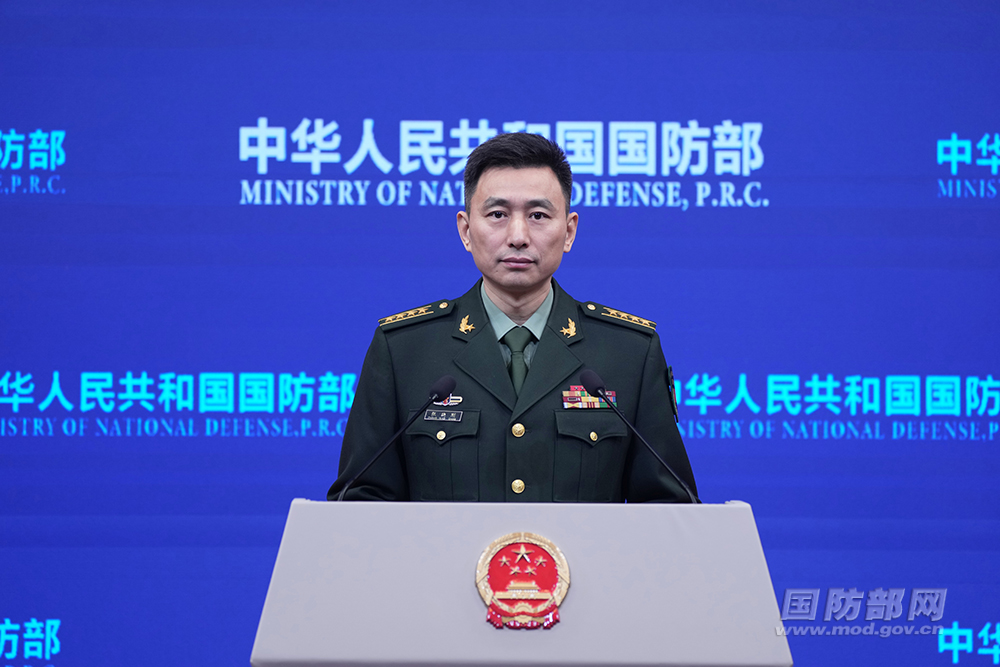
On the afternoon of January 16, 2026, Senior Colonel Zhang Xiaogang, Spokesperson for the Ministry of National Defense (MND), answered recent media queries concerning the military. (mod.gov.cn)
(The following English text is for reference. In case of any divergence of interpretation, the Chinese text shall prevail.)
Journalist: It was reported that General Secretary of the CPC Central Committee Xi Jinping recently sent a congratulatory message to General Secretary of the Lao People's Revolutionary Party Central Committee Thongloun Sisoulith. Xi mentioned expanding practical cooperation in various fields. Please share with us the Chinese side's views on advancing China-Laos military-to-military relationship.
Zhang Xiaogang: We will celebrate the 65th anniversary of the establishment of China-Laos diplomatic ties in 2026. The China-Laos relationship is stronger than ever before. Under the strategic guidance of the leaders of the two parties and two countries, the Chinese and Lao militaries have maintained close high-level exchanges. The two sides have conducted regular joint exercises such as Friendship Shield and Peace Train, had border defense friendship exchanges and mutual visits among mid-and-junior level officers, and carried out cooperation in areas including military education and military culture, thereby steadily deepening and strengthening practical cooperation between the two militaries. The Chinese military also hosted several demining courses to help the Lao side better protect the safety and well-being of its people.
China and Laos are friendly socialist neighbors connected by the same mountains and rivers. The Chinese military is ready to work with the Lao side to implement the important consensus reached by the leaders of the two parties and two countries, carry forward the traditional friendship, strengthen strategic communication and coordination, and deepen defense and security cooperation to help advance the building of a high-standard, high-quality, and high-level China-Laos community with a shared future and make new contributions to peace and stability in the region and the world at large.
Journalist: As was reported, some political figures in Japan criticized Prime Minister Sanae Takaichi for leading the country to become a "war state". What's your comment on this?
Zhang Xiaogang: A growing number of people with insights in Japan have realized the serious danger and damages caused by the Japanese government's erroneous actions. In recent years, Japan's increasingly arrogant right-wing conservative forces have been pushing for greater military buildup and remilitarization, leading the nation down a perilous path. History has demonstrated that unchecked Japanese militarist ambitions would pose a grave threat to other Asian nations and ultimately bring catastrophic disasters upon the Japanese people. As clearly stipulated in the Potsdam Proclamation, "There must be eliminated for all time the authority and influence of those who have deceived and misled the people of Japan into embarking on world conquest." China stands ready to work with all peace-loving countries to resolutely contain any dangerous attempts to revive militarism, jointly uphold the outcomes of the victory in World War II, and safeguard peace and stability in the region and beyond.
Question: According to reports, the Philippine Navy recently released an assessment report on PLA Navy Conduct, claiming that the PLA Navy, China Coast Guard, and Chinese "maritime militia" are working in coordination to strengthen China's de facto control over the South China Sea. What's your comment on that?
Zhang Xiaogang: China has indisputable sovereignty over the islands in the South China Sea and their adjacent waters, and has sovereign rights and jurisdiction over relevant waters. It is legitimate and beyond reproach for China to take actions to safeguard its rights and interests. The Philippine side has been going to great lengths to smear China's rights protection actions, attempting to mislead public opinion and cover up its own illegal,provocative and trouble-making actions. The international community sees this clearly. We urge the Philippine side to do not challenge China's resolve in defending its territorial sovereignty and maritime rights and interests, stop fabricating false narratives, and stop undermining peace and stability in the South China Sea.
Journalist: There are concerns in Taiwan that the mainland might follow what the US did to Venezuela to legitimize the use of force against the island. Meanwhile, some international media argued that if Beijing were to adopt a similar approach, it would face much higher risks and costs. What's your comment on this?
Zhang Xiaogang: The Taiwan question is purely China's internal affair. How to resolve it is a matter for the Chinese, which brooks no interference from external forces. For us, to deal with the "Taiwan independence" separatist forces is like catching a turtle in a jar, and all options that can punish the "Taiwan independence" separatist forces remain on the table.
Journalist: A poll in Taiwan found that more than 60% of respondents were unwilling to fight in a war, or to have their family members do so. What's your comment on this?
Zhang Xiaogang: This once again proves that the overwhelming majority of people in Taiwan desire peace, development, exchange and cooperation, not confrontation or conflict, even less to fight a war. Defying the people's wishes, the Lai Ching-te authorities are pursuing separatist goals by stoking tensions. More people will see through their nature of undermining peace, provoking crisis and inciting wars. I believe that no one is willing to be cannon fodder for "Taiwan independence" schemes. The separatist forces who go against the will of the people are doomed to be thrown into the dustbin of history.