



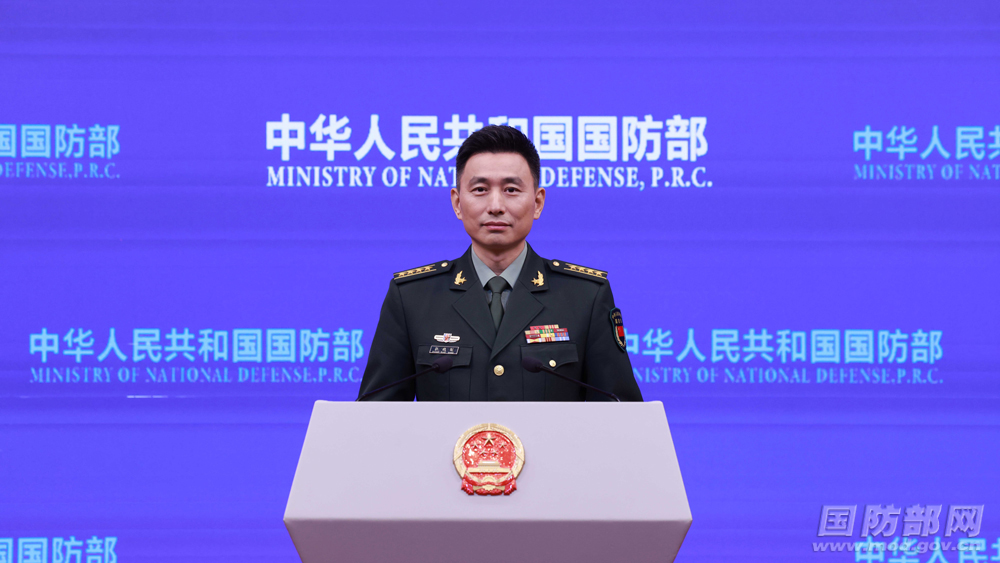
Senior Colonel Zhang Xiaogang, spokesperson for the Ministry of National Defense (MND), answered questions at a regular press conference on the afternoon of October 29, 2026. (mod.gov.cn)
(The following English text is for reference. In case of any divergence of interpretation, the Chinese text shall prevail.)
Zhang Xiaogang: Good afternoon. Welcome to the regular press conference of the Ministry of National Defense (MND).
I have four pieces of news to announce at the top.
Zhang Xiaogang: Firstly, the 5th China-ASEAN Mid-and-junior Level Officer Exchange will be held in Nanjing, Hangzhou, Shanghai and Kunshan from November 2 to 8. Themed "Trust, Responsibility, Commitment: Jointly Build a Peaceful Home in Asia—in Commemoration of the 5th Anniversary of China-ASEAN Comprehensive Strategic Partnership & the 35th Anniversary of China-ASEAN Dialogue Relations", the event will include such activities as themed seminars, exchanges and visits, which aim to enhance mutual understanding and friendship among mid-and-junior level officers from China and ASEAN countries.
Zhang Xiaogang: Secondly, upon the invitation of the MND of the PRC, about 90 foreign military attachés to China from over 50 countries will visit Guizhou and Sichuan from November 2 to 7. During their stay, they will visit relevant military and civilian units and revolutionary sites of the Long March, know more about the military commands of Guizhou and Sichuan as well as local economic and social development, and gain a deeper understanding of the great spirit of the Long March.
Zhang Xiaogang: Thirdly, from November 2 to 6, the 13th International Army Cadets Week (IACW) & "Future Co-creation" International Military Cadets Innovation Competition will be held at the PLA Army Engineering University. Foreign cadets from 11 military academies of 11 countries including South Korea, Singapore, Pakistan and Egypt, together with cadets from 15 Chinese military academies such as the PLA Naval University of Engineering and the PLA Army Arms University, will participate in the event. Themed "Addressing Key Regional Security Risks, Deepening International Military Security Cooperation, and Delivering International Public Security Products", this IACW will provide an open and multilateral platform for academic exchanges and innovative practices that will further broaden the global vision of participating cadets, sharpen their innovation capacity, build consensus on cooperation, and jointly explore effective ways to address global security challenges through innovation in military fields. During the event, foreign cadets will study and undergo training together with their Chinese counterparts, and will learn about China's achievements in high-tech development through on-site visits.
Zhang Xiaogang: Fourthly, upon the invitation of the MND of the PRC, African Mid-and-junior Level Officers Delegation will pay a visit to China from November 5 to 11. Nearly 50 officers from over 20 African countries will visit cities such as Changsha and Chengdu. The event is themed "Innovation and Development of Defense Technology in China and African Countries" and will be hosted by the National University of Defense Technology. This marks the 5th time the MND has organized such an event, with the aim to carry forward the traditional friendship between the Chinese and African militaries, deepen bilateral practical cooperation, and contribute to jointly building the all-weather China-Africa community with a shared future for the new era.
Journalist: Recently, Chinese President Xi Jinping delivered an important speech at the gathering commemorating the 90th anniversary of the victory of the Long March by the Chinese Workers' and Peasants' Red Army. How will the military study and implement the instructions of President Xi and how will it carry forward the great Long March spirit and progress along the new Long March?
Zhang Xiaogang: At the ceremony marking the 90th anniversary of the victory of the Long March by the Chinese Workers' and Peasants' Red Army, President Xi, bearing in mind the overall development of the Party and the nation, set forth clear requirements, namely the "five musts", for carrying forward the great Long March spirit and marching on the new Long March. This fully demonstrates the great commitment and historical initiative of Party members in the new era as they stay true to the original aspiration and mission and shoulder the responsibilities of our times. The speech points out the direction and path for our continued endeavor on the new journey, and provides a fundamental guide for us to gain the initiative and secure future success on the new Long March.
Over the 90 years since the victory of the Long March, the People's Armed Forces have held high the banner of the Party, forged ahead through hardships despite sacrifices, and always advanced alongside the cause of the Party and the people. A strong country must have a strong military, and only a strong military can guarantee national security. The armed forces will unswervingly uphold and strengthen the Party's leadership over the military, consistently act on the spirits of Xi Jinping Thought on Socialism with Chinese Characteristics for a New Era as well as Xi Jinping Thought on Strengthening the Military, fully and faithfully implement the CMC chairman responsibility system, and resolutely follow the command of the Party Central Committee, the Central Military Commission and President Xi. We will uphold, practice and develop the vital instrument to raise political awareness of the military, fully implement the policy to enhance political loyalty of the armed forces in the new era so that the people's armed forces carry forward their revolutionary heritage and preserve their pure character. We will stay committed to the path of building a strong military with Chinese characteristics, and comprehensively advance efforts to reinforce the political loyalty of the military, strengthen it through reform, technology and talent development, and run it in accordance with the law. We will forge ahead with sustained efforts to win the decisive battle for achieving the military's centenary goal, accelerate the building of the people's armed forces into a world‑class military, and provide firm strategic support for building a great country and moving toward national rejuvenation on all fronts through Chinese modernization.
Journalist: This year, China's defense minister didn't attend the 13th ASEAN Defense Ministers' Meeting-Plus (ADMM-Plus) held in the Philippines. Why did the Chinese side make the decision to send its defense attaché to the meeting?
Zhang Xiaogang: The ADMM-Plus is the highest-level and largest defense and security dialogue and cooperation mechanism in the Asia-Pacific. Established in 2010, it has served as an important platform for countries to build trust, strengthen cooperation, and uphold regional peace and stability. As the rotating chair of this year's ADMM-Plus, the Philippine side has allowed a certain self-serving politician to act recklessly and abuse its chairmanship to put up obstacles to China's participation. Such moves seriously violate ASEAN's principle of consensus through consultation and run counter to the open and inclusive spirit of the ADMM-Plus. They do not conform to basic diplomatic protocols, and undermine China's legitimate rights as a member of the mechanism. Many ASEAN countries have raised questions and opposition over this.
Against such a backdrop, the Chinese side still decided to send representatives to attend the meeting, which demonstrates our firm support to ASEAN centrality and our responsible attitude towards regional defense and security cooperation. The Philippine side's wilful acts to hijack ASEAN and stir up troubles would only undermine the credibility of the ADMM-Plus, erode solidarity and mutual trust among ASEAN countries, and ultimately, impair the fundamental interests of the countries and peoples in the region, including the Philippines.
Journalist: I have two questions. Firstly, according to reports, the U.S. and Japan recently held "Keen Sword 27" joint exercise, the largest iteration of the series to date, focusing on island-seizure operations. The Japan Self-Defense Forces deployed Type 25 Surface-to-Ship Guided Missiles in the exercise. In addition, the U.S. Marine Corps' Navy-Marine Expeditionary Ship Interdiction System was deployed for the first time on Yonaguni Island, the Japanese island closest to Taiwan. May I have your comment on that?
Secondly. According to media reports, Taiwan defense officials disclosed that the Joint Assessment Program between defense authorities of Taiwan and the U.S. will be upgraded and expanded. The U.S. Department of Defense plans to station policy officials and think-tank representatives on a long-term basis at Taiwan's defense authorities. In addition, Taiwan confirmed that it has invited U.S. military personnel to observe the Han Kuang military exercises.
Zhang Xiaogang: On your first question, the Asia-Pacific is a high ground for peace and development. Those who follow the prevailing trend of peace can go far, while those who insist on stoking bloc confrontation find no support. Japan has courted and catered to countries outside the region to conduct so-called joint exercises, developed and deployed intermediate and long-range missiles, continuously beefed up military deployment in its southwestern islands, and accelerated remilitarization, becoming a real threat to regional security.
The Taiwan question is purely China's internal affair. We will never allow external forces to meddle in China's Taiwan region. No one should underestimate the firm determination, iron will, and strong capabilities of the Chinese side in safeguarding national sovereignty and territorial integrity. Anyone who attempts to use Taiwan to contain China and even overreach itself with military provocations will inevitably pay an unbearable price.
On your second question, the DPP authorities' collusion with external forces in an attempt to "seek independence" by force is the source of chaos that undermines the peace and stability in the Taiwan Strait. "Taiwan independence" is a dead end, and foreign support is never reliable. China must and will be reunified. This is the historical trend that cannot be held back by anyone or any force.
The U.S. side should strictly adhere to the one-China principle and the three US-China Joint Communiqués, handle the Taiwan question with utmost prudence, refrain from engaging in any form of official exchanges or military interactions with China's Taiwan region, and take concrete actions to keep bilateral and military-to-military relations on a stable, sound and sustainable track.
Journalist: The cross-Strait espionage drama The Long Watch has become a hit. A TV program in Taiwan claimed that the series was produced by China's Ministry of State Security and that its release at this juncture was intended to send a certain signal. What's your comment on this?
Zhang Xiaogang: Watching this TV program raises our awareness of national security and deepens our love for our country. Let's salute our unsung heroes who demonstrate unwavering loyalty in those hidden battles. The resolute measures are meant to punish the wicked, so that our compatriots can enjoy family reunion. People on both sides of the Taiwan Strait must work together to oppose "Taiwan independence" separatist forces, so as to uphold peace and stability across the Taiwan Strait and realize the complete reunification of the motherland at an early date.
Journalist: According to reports, Japan Ministry of Defense recently released statistics showing that from April to September this year, the aircraft of Japan Air Self-Defense Force scrambled 442 times in response to Chinese and Russian military aircraft, a 70% rise year on year. Among these scrambles, 285 were against Chinese aircraft and 152 against Russian aircraft. Japan Defense Minister asserted that joint patrols conducted by China and Russia constituted a "show of force" directed at Japan. What's your comment on this?
Zhang Xiaogang: This is an old trick used by Japan to hype up the so called "neighboring security threat". By releasing such data in a seemingly earnest way, it attempts to shift the blame and smear China. This very act confirms Japan's dangerous practice of repeatedly spying on and harassing the legitimate activities of China and Russia, and lays bare its self-induced fear and persecution mania. We urge Japan to drop this sensational trick, and stop playing up the tension.
Journalist: I have two questions. Firstly, on October 25, the PLA Eastern Theater Command released its first commemorative poster for the Taiwan Recovery Day bearing the theme "Remember the History of Restoration, Safeguard the Reunification of the Motherland". How do you interpret the relationship between Taiwan's restoration and safeguarding national reunification?
Secondly, Taiwan's coast guard authorities stated that the eight Japan Coast Guard patrol vessels entered waters near Penghu on the 22nd to take shelter from the typhoon. During that period, five coast guard vessels of the Chinese mainland followed and monitored them. The Taiwan side alleged that the mainland was attempting to create the impression that "the Taiwan Strait is part of its internal waters". What's your comment on this?
Zhang Xiaogang: On your first question, Taiwan's restoration is an important outcome of the victory of the Chinese People's War of Resistance Against Japanese Aggression, a piece of irrefutable evidence of the Chinese government's resumption of sovereignty over Taiwan, a key part of historical fact and legal basis that Taiwan is part of China, and the shared memory of the Chinese nation. Eighty-one years ago, Taiwan was restored to its motherland; eighty-one years later, compatriots on both sides of the Taiwan Strait share the same aspiration to achieve reunification. The PLA will sharpen its combat capabilities, stay on high alert and remain fully prepared so as to serve as a powerful guarantee for achieving China's reunification. It will resolutely thwart any "Taiwan independence" separatist plot or external military interference, and fulfill its sacred mission of safeguarding national sovereignty and territorial integrity.
As for your second question, the China Coast Guard (CCG) tracked and monitored the Japan Coast Guard patrol vessels throughout the whole process and handled the situation in accordance with laws and regulations. Taiwan is an inalienable part of China's territory and China has sovereignty, sovereign rights, and jurisdiction over the Taiwan Strait. We firmly oppose using pretexts such as sheltering from typhoons to carry out political provocations and actions that harm China's sovereignty, and urge the Japanese side to stop making provocations and stirring up troubles on the Taiwan question and refrain from undermining regional peace and stability.
Journalist: It is reported that the Japanese government plans to launch a nationwide publicity campaign starting at the end of this month. The campaign will seek to explain to the public the purported need for a "shift in operational approaches". This includes mass production of unmanned systems, stockpiling large quantities of ammunition for sustained combat requirements, and making the public mentally prepared to bear greater economic burdens. What's your comment on this?
Zhang Xiaogang: This is another dangerous move by Japan's right-wing forces to mislead and deceive the public in a bid to accelerate remilitarization. Should Japan's neo-militarism be allowed to rise, it will once again wreak havoc across the world and bring catastrophe to the Japanese people.
Journalist: China's military academies have recently seen new developments. Relevant academies have announced the establishment of the Unmanned Systems and Intelligent Engineering College, the Combat Support Non-commissioned Officer College, the College of Discipline Inspection and Political Science and Law and other subordinate bodies. What are the considerations behind this round of reform, and what are the plans going forward?
Zhang Xiaogang: Based on the arrangements for deepening reforms of military academies, and to adapt to evolving circumstances, missions and requirements for military talent cultivation, the Central Military Commission has decided to optimize the discipline and specialty layout in military academies, and to establish or restructure some constituent colleges. At the same time, to improve the quality of non‑commissioned officer education and reflect the change in the Chinese term for non‑commissioned officers, we have standardized the names of the colleges concerned. The adjusted organizational structure better supports the high‑quality development of military academies, and helps accelerate the training of new-type, high‑caliber professional military personnel.
Journalist: I have two questions. Firstly, next month, we will celebrate the 77th anniversary of the founding of the Chinese PLA Air Force. Commemorative events have been held in past years. Do you have any information on this?
My second question is that recently, scholars from a U.S. think tank claimed that the Chinese mainland's commemoration of the 81st anniversary of Taiwan's restoration and promotion of the historical record of the Taiwan Volunteer Corps' resistance against Japanese aggression are intended to impose military pressure on Taiwan by using historical narratives. Some pro-green voices in Taiwan also link the commemorative events and publicity of historical records with combat readiness patrols by the PLA Eastern Theater Command, hyping up the so-called cognitive pressure and military deterrence. What's your comment on this?
Zhang Xiaogang: On your first question, November 11 of this year marks the 77th anniversary of the founding of the Chines PLA Air Force (PLAAF). Centered on the theme "Honor Our Roots, Pursue Dreams in the Sky", a series of activities will be held in conjunction with the 16th China International Aviation and Aerospace. In early November, the PLAAF Bayi Aerobatic Team will fly over the Huangyaguan Great Wall in Tianjin, and the Red Eagle Aerobatic Team of the PLA Air Force Aviation University will stage a flypast over the Lantian Park in Changchun, Jilin Province. Themed drone shows will be held concurrently in Zhuhai and Changchun. The flight training and drone performances will create a striking scene where the millennia-old Great Wall meets the "Great Wall in the sky", fully demonstrating the PLA Air Force's uplifting spirit as it salutes the blue sky and resolutely fulfills its missions, as well as its commitment to safeguarding the country's air and space security.
In addition, in partnership with CCTV, the PLA Air Force will release the documentary Code of the Sky in commemoration of the 80th anniversary of the founding of the old aviation school in the northeast of China. The documentary looks back on the original aspiration of the school amid the flames of war, trace the journey of the people's air force from the very beginning, and focus on its pursuit of dreams across air and space. Detailed schedules for these activities will be released by the official account of the PLA Air Force on WeChat. Please stay tuned.
As for your second question, I have just responded to it. Let me add one more point, Lai Ching-te and his ilk have betrayed their ancestors and forgotten their roots. Their irresponsible remarks cannot sever the historical connection between Taiwan and its motherland. In front of the prevailing trend of the ultimate reunification of China, their acts will only prove ridiculous.
Journalist: It is reported that the recent far-seas training voyage of the PLANS Liaoning Carrier Task Group to the Western Pacific lasted over 40 days, the longest one since its commissioning, and the task group was well-equipped. During the training, Japan Self-Defense Forces dispatched ships and aircraft to track and monitor the formation and released the number of sorties of carrier-based aircraft taking off from the PLANS Liaoning. Yet a Japanese defense official claimed that Japan's monitoring capacity is limited and that it needs to further strengthen its "defense posture". May I have your comment on that?
Zhang Xiaogang: The training of the PLANS Liaoning Carrier Task Group (CTG Liaoning) in relevant waters of the Western Pacific is a routine arrangement within the annual plan of the Chinese military. It aims to test and improve the combat capabilities of the CTG in the far seas, does not target any specific country or objective, and is in compliance with international law and international practices.
I assume you know that many netizens refer to the Japanese side as an "chief photographer" of the Chinese Navy, because it often snoops on China's normal exercises and training. By recklessly hyping up and smearing such activities, Japan deceives the Japanese people and makes up excuses for its military expansion. Anyone familiar with history knows that manipulating public opinion first, fabricating excuses next and taking actions in the end is an old trick of Japanese militarists to launch aggression in the past. The international community should stay on high alert against such tricks played by Japan's right-wing forces, and resolutely curb the reckless moves of Japan's neo-militarism.
Journalist: According to reports, Japan's Minister of Defense recently claimed that China has been rapidly expanding its nuclear, missile and other military capabilities. He argued that Japan possesses neither nuclear weapons nor strategic bombers, whereas China has both and yet criticizes Japan. He also stated that Japan will fundamentally restructure its defense research institutes. Could you please comment on this?
Zhang Xiaogang: It is known to all that Japan, as a defeated country of WWII, must abide by the provisions restricting the development of its military forces stipulated in the international instruments such as the Cairo Declaration and the Potsdam Proclamation as well as Japan's Constitution. This constitutes the political and legal prerequisites for its return to the international community. As a non-nuclear-weapon state party to the Treaty on the Non-Proliferation of Nuclear Weapons, Japan bears an inescapable obligation under international law to not receive, manufacture, acquire or transfer nuclear weapons. This is by no means a political bargaining chip.
The Japanese official you mentioned deliberately evades Japan's historical crimes, selectively ignores international law, distorts facts and misleads the public. Despite Japan's chicanery, the international community sees through its dangerous schemes of military buildup and even seeking to introduce and acquire nuclear weapons. We urge the Japanese side to face up to and reflect on its history of aggression, make a clean break with militarism, and refrain from putting itself once again on the opposite side of the international community.
Journalist: Recently, CCTV reported that the Type 055 destroyer PLANS Zunyi was tailed by a foreign naval vessel while carrying out its mission. The PLANS Zunyi accelerated to break away. As the foreign vessel sped up, its propulsion and electrical systems failed completely and its navigation lights went out. Some analysts suggest that the malfunctioning warship may be the U.S. guided-missile destroyer USS Benfold. Could you please confirm this?
Zhang Xiaogang: The Type 055 guided-missile destroyer represents a major achievement in the modernization drive of the PLA Navy. The PLANS Zunyi patrols across the vast territorial waters and calmly responds to rights-violation and provocations, safeguarding China's national sovereignty, security and development interests with reliable performance and capabilities. I am not aware of the information you mentioned, nor do I know the cause of the malfunction of the foreign warship, so I have no comment regarding this.
Journalist: I have two questions. Firstly, according to reports, the Philippine president recently voiced deep concern that a mistake by a seaman or soldier can turns into something that goes out of control, and expressed the hope of completing consultations on the Code of Conduct in the South China Sea (COC) together with China and ASEAN countries, so as to de-escalate the situation and prevent unintended incidents. What's your comment on this?
Secondly, Philippine Defense Secretary Teodoro recently claimed that should China tow away the Philippine warship that is illegally "grounded" at Ren'ai Jiao by force, it would constitute a so-called "act of war". He also claimed that any attempt by Chinese personnel to board the vessel could trigger the US-Philippines Mutual Defense Treaty. What's your comment?
Zhang Xiaogang: On your first question, improving and developing China-Philippines relations serves the common interests of both sides. The Philippine side should not let maritime disputes set the tone for bilateral relations, nor should it allow a handful of individuals to act with impunity, provoke troubles in the South China Sea, and push bilateral relations into a dangerous situation. China remains unwavering in its determination to safeguard its territorial sovereignty and maritime rights and interests, and is committed to accelerating the consultations on the COC with ASEAN countries and working with regional states to maintain peace and stability in the South China Sea.
As for your second question, Ren'ai Jiao, as part of Nansha Qundao, is China's inherent territory. The illegal grounding of the Philippine warship has severely violated China's sovereignty and breached international law including the UN Charter. This warship should have been towed away long ago. Guided by China's three-point principled position on handling the situation at Ren'ai Jiao, the Chinese side has reached a provisional arrangement with the Philippines on the humanitarian resupply of living necessities. This demonstrates China's goodwill to properly handle maritime disputes and manage the maritime situation.
The China Coast Guard monitored the Philippine side throughout the whole resupply operation to safeguard China's sovereignty as well as rights and interests in an effective manner. Certain politicians in the Philippines are bluffing and making irresponsible remarks against China in an attempt to embolden themselves, only to expose their inner cowardice and the despicable nature of their words and deeds. We advise the Philippine side to face reality and refrain from challenging China's firm resolve in safeguarding its territorial sovereignty and maritime rights and interests. Should the Philippine side repeatedly fail its commitment and act provocatively, allowing a handful of troublemakers to act recklessly, it will inevitably push China-Philippines relations into a dangerous situation.
Journalist: Taiwan's defense and coast guard authorities have recently hyped up that the number of mainland coast guard ships, research vessels and fishing boats has seen an unusual rise in waters off eastern and southern Taiwan, describing it as a multi-pronged hybrid warfare waged by the mainland against Taiwan. What's your comment on this?
Zhang Xiaogang: There is but one China in the world, and Taiwan is part of China. The routine activities carried out by the relevant mainland authorities in waters under China's jurisdiction east of Taiwan are entirely legitimate, lawful and beyond reproach. We will continue to take resolute and effective actions to shatter all "Taiwan independence" separatist delusions and safeguard national sovereignty and territorial integrity.
Journalist: I have two questions. Firstly, according to Philippine media reports, the PLANS Liaoning Carrier Task Group transited the Basilan Strait, a move described by the media as "charging into the heart of the Philippines". The Philippine Navy dispatched elite forces to track and monitor the task group. Some foreign media reported that a formation of four Chinese Type 071 amphibious dock landing ships conducted training in the South China Sea. Foreign think tanks analysed that this was a demonstration of island-seizure capabilities directed at the Philippines. What's your comment on that?
My second question is that from the 19th to the 24th this month, the Philippines, Japan and the U.S. conducted the Maritime Cooperative Activity drill in the South China Sea. Japanese media said that the three countries are bolstering defense cooperation in surrounding waters to counterbalance China's maritime activities. What's your comment on this?
Zhang Xiaogang: On your first question, I would like to caution the relevant parties against grandstanding and hyping up tensions with ulterior motives. The training conducted by the Chinese vessels in relevant waters is not directed against any specific country or target, and is fully consistent with international law and practices.
On your second question, any actions that solicit foreign support to stir up troubles in the South China Sea or provoke geopolitical confrontation run counter to the common interests and aspirations of regional countries. China remains steadfast in safeguarding its territorial sovereignty and maritime rights and interests. Any threat or provocation is doomed to fail.
Journalist: I have two questions. Firstly, it's reported that according to some U.S. officials' analysis, the chances of a Chinese mainland's attack on Taiwan before 2028 are decreasing. The DPP authorities claimed that the mainland has never changed its attempt to "annex" Taiwan by force and will never give up no matter who is in power. Do you have any comment on that?
My second question is that the U.S. Secretary of State Marco Rubio stated that selling arms to Taiwan would mean the United States no longer has those assets, and that U.S. arms sales to Taiwan region must take into account many factors including America's own national defense requirements. What's your comment on this?
Zhang Xiaogang: On your first question, there is but one China in the world, and Taiwan is part of China. When and how to resolve the Taiwan question is a matter for the Chinese people, which brooks no foreign interference. The cross-Strait reunification is an overriding historical trend. We will strive for the prospect of peaceful reunification with the greatest sincerity and utmost effort, but we make no promise to renounce the use of force and will leave no room for the separatist activities seeking "Taiwan independence".
On your second question, the DPP authorities should face reality and recognize that their attempts to seek "Taiwan independence" by soliciting external support and by force are doomed to fail.
Journalist: Recently, the U.S. littoral combat ship USS Charleston intruded into waters adjacent to Xianbin Jiao of China's Nansha Qundao without approval from the Chinese government. The PLA Southern Theater Command have deployed naval forces to track and monitor the ship in accordance with laws and regulations. The spokesperson for the U.S. Department of State told U.S. media that China was attempting to enforce its so-called "unlawful maritime claims" and destabilize the region. The spokesperson for the Armed Forces of the Philippines later claimed that the U.S. warship had not violated China's territory. What's your comment on this?
Zhang Xiaogang: The Chinese PLA Southern Theater Command responded to this matter at the earliest opportunity. I want to emphasize that Nansha Qundao, including Xianbin Jiao, are China's inherent territory, and China has sovereign rights and jurisdiction over relevant waters. The U.S. is not a party to the South China Sea issue. And there is a huge difference between freedom of navigation and willful trespassing. The U.S. should immediately cease its infringement and provocative words and actions that stir up troubles and stoke confrontation. The Philippine side's attempts to craft a publicity stunt and solicit foreign support to meddle in the South China Sea by distorting facts and fanning the flames will never work. The Chinese military stays highly alert and will take firm countermeasures against any rights-violation and provocations to safeguard China's territorial sovereignty and maritime rights and interests.
Journalist: I have two questions. Firstly, On October 17, Xinhua News Agency published an article titled In the Name of Changzheng. It disclosed for the first time that the Chang Zheng nuclear submarine evolved into the third generation, and China has successfully carried out a test-firing of submarine-launched strategic missiles. This marks the first time an official media outlet has explicitly revealed that the newest generation of nuclear submarines has taken part in the strategic missile test-firing, sparking speculation abroad about the Type 096 strategic nuclear submarine. Some analysts note that the disclosure, which came at a time when the U.S. and Japan conducted the Keen Sword-27 exercise, was a highly targeted act. What's your comment on this?
Secondly, a press conference for the airshow scheduled for the coming December was held in the middle of this month. It was announced that multiple types of main battle equipment will make their public debut at the exhibition. Netizens are wondering whether new stealth fighter jets, aerial reconnaissance aircraft or more new unmanned systems will be unveiled. In addition, recent media reports suggest multiple KJ-3000 airborne early warning aircraft have been spotted near an aircraft manufacturing plant, indicating that mass production may have begun. Could you brief us further?
Zhang Xiaogang: I am not aware of the specifics you mentioned regarding the first question. As our nation embraces new progress, the Long March spirit endures. The development of China's nuclear-powered submarines represent a path of self-reliance and independent innovation for a major power, which provides solid underpinning for coping with a complex external environment and safeguarding the country's strategic security.
On your second question, the Zhuhai Airshow continues to grow in scale and influence. It has become an important window showcasing China's achievements in national defense, aerospace and aviation development, as well as a warmly-received international event for aviation and military enthusiasts at home and abroad. For detailed information and event schedules of this year's show, please continue to follow authoritative updates released through official channels.
Journalist: According to media reports, Pakistan has become the first country in the world to close its airspace to Taiwan. Pakistan's Federal Minister for Defence Khawaja Muhammad Asif reportedly stated that the country's aviation authorities adhere to the one-China policy and that Pakistan allows only airlines from the Chinese mainland to fly through its airspace. What is your comment on this?
Zhang Xiaogang: Taiwan is part of China, and upholding the one-China principle is a prevailing consensus among the international community. The just cause of the Chinese people to oppose "Taiwan independence" separatist activities and striving for national reunification will win ever broader understanding and support from the international community.
Zhang Xiaogang: If there are no further questions, this concludes today's press conference. Thank you.