



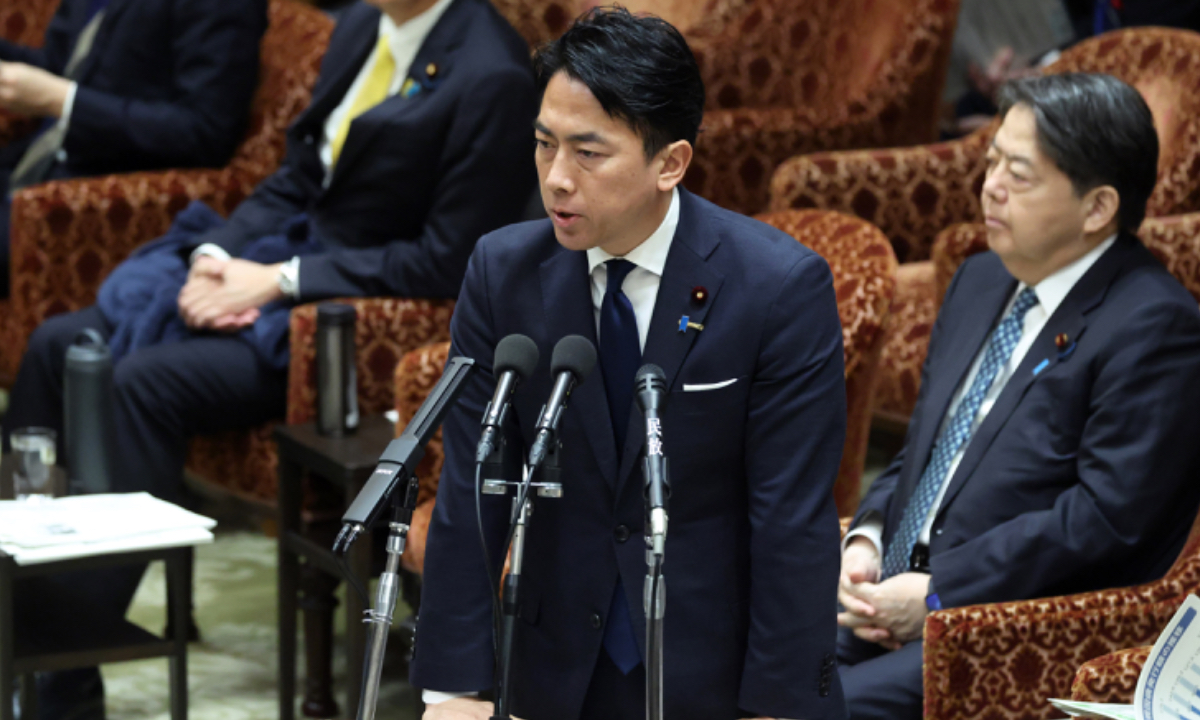
Shinjiro Koizumi, Japan's defense minister, speaks during a budget committee session at the lower house of parliament in Tokyo, Japan, on Tuesday, December 9, 2025. Photo: VCG
The Japanese government has begun adjustments to the defense budget in the fiscal year 2026 budget proposal, planning to increase it to a record-high scale of 9 trillion yen ($60.3 billion), multiple Japanese media including Nishi Nippon and Okinawa Times reported on Saturday. Two Chinese experts described this move as a "systematic budgetary breakthrough," signifying a dangerous mark in Japan's post-war remilitarization.
Kyodo News, citing multiple sources, reported that the budget will be allocated to acquire long-range missiles as a means of counterstrike capability (enemy base attack capability), as well as offensive drones for constructing the unmanned aircraft-based coastal defense system "SHIELD." The report noted that the defense budget includes expenses for US force realignment.
According to the report, to enhance capabilities in the space domain, Japan will establish a new "space operations group" and reorganize the Air Self-Defense Force into the "Aerospace Self-Defense Force." Additionally, the 15th brigade, based at the Naha Garrison of Japan Ground Self-Defense Force, will be upgraded to a division to strengthen defense capabilities in the southwestern region, the report said.
Furthermore, Japan will acquire the hypersonic missile, one of the long-range missiles capable of flying at speeds over five times the speed of sound, which is considered difficult to intercept, the report noted.
By allocating its budget to offensive equipment such as long-range missiles and military deployments in the southwestern islands, Japan is engaging in highly targeted military expansion, apparently with the possible core objective of building a forward combat network to contain China, Xiang Haoyu, a distinguished research fellow at the China Institute of International Studies, told the Global Times on Sunday.
Japanese Prime Minister Sanae Takaichi claimed at a Diet meeting on November 7 that a "Taiwan contingency" could constitute a "survival-threatening situation" for Japan. In such a case the Self-Defense Forces might be allowed to exercise the right of "collective self-defense." Her remarks sent shockwaves across Japan.
Against the backdrop of Japan's lack of historical reflection, its radical military buildup reveals dangerous signs of a revival of militarism, Xiang said. "Through annual military expansion and incremental breaches of military taboos, Japan is gradually trying to desensitize both the international community and its own citizens," the expert added.
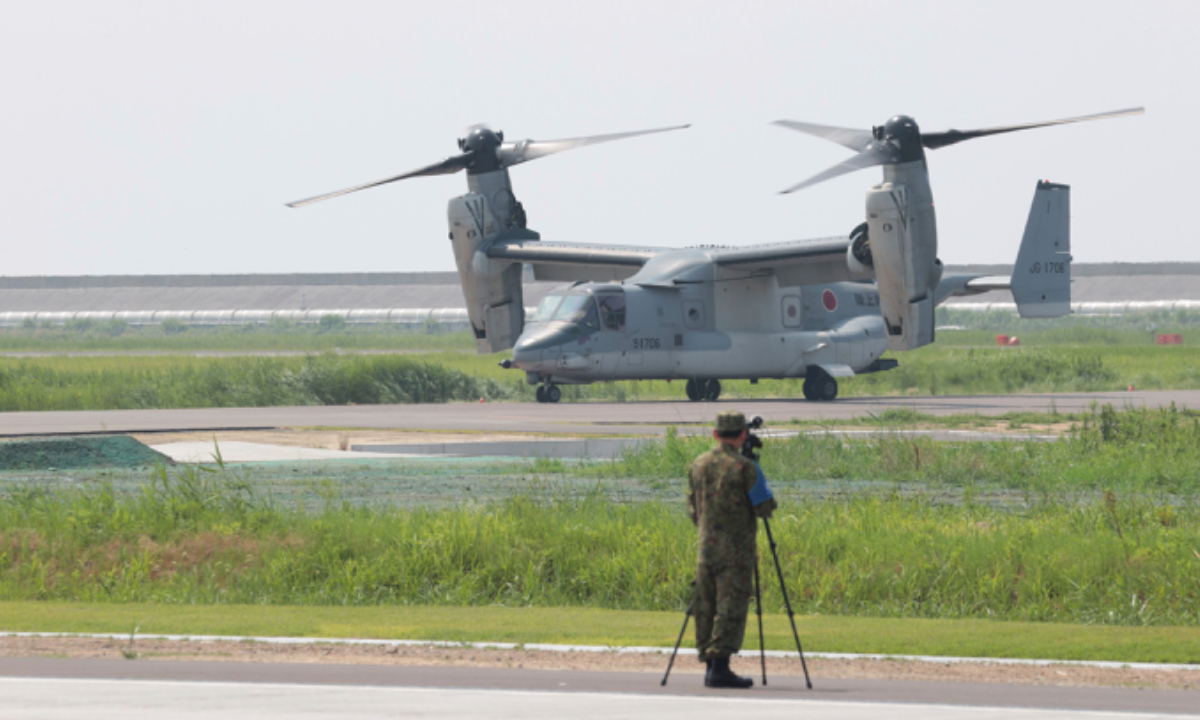
The Osprey of Japan's Self-Defense Forces lands at Ground Self-Defense Force Camp Saga in Saga City, Saga Prefecture on July 9, 2025. The JGSDF station opened at Saga Airport on the same day. Photo: VCG
Great leap toward military power
The principle of "exclusively defense-oriented policy" has been gradually hollowed since former Japanese prime minister Shinzo Abe's tenure, Song Zhongping, a Chinese military affairs expert, told the Global Times on Sunday." What we are witnessing now, however, represents a systematic and further breakthrough of this principle," Song noted.
Under Takaichi's leadership, Japan is advancing with "big and rapid strides," aiming to revise the pacifist constitution as quickly as possible, the expert warned.
Citing previous Japanese media reports that have revealed Japan plans to increase the military budget to 2 percent of GDP ahead of schedule, Song said Tokyo has completely disregarded the constraints originally imposed by the pacifist Constitution.
Kyodo News noted that the raise of budget in 2026 marks the fourth year of the five-year defense buildup plan, which aims to invest approximately 43 trillion yen by fiscal year 2027, exceeding the initial budget of about 8.7 trillion yen for fiscal year 2025.
Also, according to Kyodo News, Takaichi intends to advance the revision of three security-related documents, including the defense buildup plan, within 2026. However, the defense budget for fiscal year 2026 will be formulated based on the current buildup plan. The budget proposal is expected to be approved by the cabinet later this month, the report added.
Xiang warned that such military expansion, justified under the pretext of "security anxieties," will trigger multiple chain reactions.
Firstly, it will spark an arms race in East Asia; secondly, it will escalate tensions in the East China Sea and the Taiwan Straits, as military deployments in the southwestern islands reduce buffer zones in related waters; thirdly, it will undermine regional trust, as Japan's alignment with allies in military actions introduces Cold War-style confrontation to the region, disrupting the existing balance and trapping East Asia in a vicious cycle where "more military buildup leads to less security," according to the expert.
Echoing Xiang, Song also pointed out that "Japan's radical policies will provoke its Asian neighbors and awaken painful memories of the history of World War II in many Asian nations," said the expert.
Concern from home
Tokyo's push for defense spending hikes have also raised concern within Japan.
Commenting on the potential increase in the military budget to approximately 9 trillion yen, Japanese Communist Party (JCP) lawmaker and House of Councilors member Taku Yamazoe criticized the plan, writing on X on Saturday that under the pretext of a "severe security environment" and "enhancing deterrence," the Japanese government is "single-mindedly pursuing budget expansion." "Such actions, which trample on the Constitution and accelerate integration with a US military that employs preemptive strike strategies, are impermissible," Yamazoe wrote.
He continued: "In reality, Prime Minister Takaichi's diplomatic blunders are contributing to the deterioration of relations. What Japan lacks now is not military spending, but sound diplomacy."
Japanese think tank the Nomura Research Institute on December 8 published an article on defense tax hikes under the Takaichi administration, pointing out that "If the direction toward a substantial increase in defense spending becomes clear, the rise in long-term interest rates and the depreciation of the yen could accelerate further. The financial markets might begin to show signs of a crisis scenario involving a 'triple decline' (yen, government bonds, stocks) accompanied by falling stock prices and a 'sell-off of Japan.'"
Titled "Will the increase in defense spending impose a burden on the citizens," Tokyo Shimbun on November 25 commented that "If defense spending were to be raised to around 3.5 percent of GDP - a target set by NATO members at the behest of the US - a simple calculation shows it would increase the burden on each citizen by approximately 70,000 yen per year."
"At a time when wage increases are failing to keep pace with rising prices, and anxiety about the future is growing due to the burden of taxes and social insurance premiums, imposing an additional annual burden of tens of thousands of yen on the public cannot be described as realistic," the editorial said. "We urge the government to build the genuinely necessary defense capabilities with prudence, rather than being driven solely by 'meeting a numerical target,'" the article added.