



By Li Yu
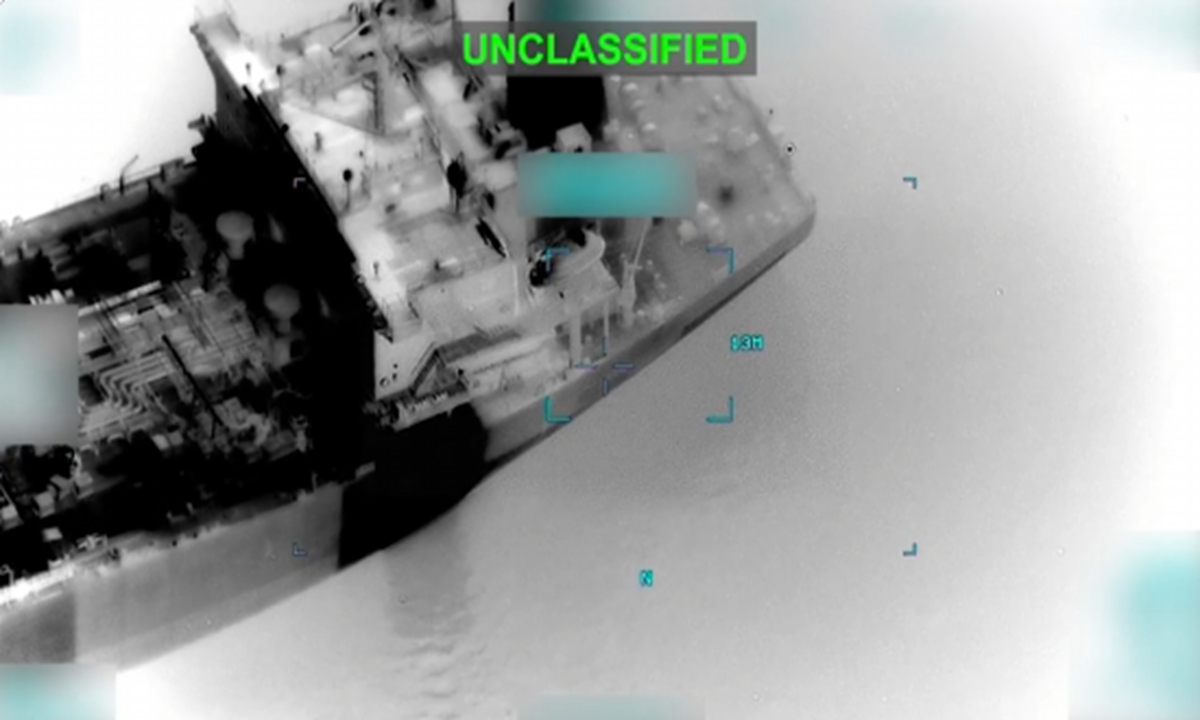
US forces strike Palau-flagged MT Settebelloas it transits the Gulf of Oman on June 9, 2026. Photo: Screenshot from US Central Command's account on X
India has lodged strong protests with the US over repeated strikes on Indian-crewed commercial vessels in the Gulf of Oman, following three such incidents this week that left three Indian mariners dead and raised concerns about the safety of commercial shipping, Indian media reported.
A Chinese analyst pointed out that the recent incidents suggest that the confrontation between the US and Iran appears to be spilling over into commercial shipping, while also creating new strains in US-India relations by touching on New Delhi's bottom line of protecting its nationals overseas.
Indian External Affairs Minister S Jaishankar said on Saturday that he had spoken with US Secretary of State Marco Rubio and lodged a strong protest over US Navy attacks in the Gulf of Oman, the Times of India reported on Saturday.
"Spoke to US Secretary of State Marco Rubio this evening. I reiterated India's strong protest at the attacks by the US Navy in the Gulf that killed three Indian mariners. Such lethal actions against commercial shipping are not justified," Jaishankar wrote in the X post.
The incident involved the commercial tanker MT Settebelloin the Gulf of Oman, which was targeted on Wednesday after US forces alleged that it had breached the naval blockade imposed on Iranian ports. And of the 24 Indian nationals aboard the tanker, 21 were rescued, while three were later confirmed dead, according to the Times of India.
The Indian tanker Settebellowas Palau-flagged when it was hit. The US military's Central Command (CENTCOM) said an aircraft fired precision munitions into the vessel's engine room after the crew "repeatedly failed to comply with directions from American forces," according to Reuters on Friday.
The Settebellostrike triggered a sharp diplomatic response from New Delhi. India on Wednesday summoned the senior-most US diplomat in the country and lodged a strong protest over the attack. India's Ministry of External Affairs condemned the strike and expressed concern over the safety of Indian nationals aboard the vessel, per India Today.
Jaishankar's latest strong protest came after three recent cases in which US forces attacked Indian-crewed commercial vessels. According to India Today, the first incident involved MT Marivexon June 8, when the merchant vessel, carrying 24 Indian seafarers onboard, caught fire and began sinking near Masirah Island, Oman, after what maritime security sources described as a suspected US Navy strike over its alleged violation of the blockade against Iran by attempting to sail to an Iranian port.
The second was the strike on MT Settebello, which prompted Jaishankar's remarks and left three Indian mariners dead.
The deaths of Indian mariners will create short-term friction in US-India relations, especially against the backdrop of uneven bilateral relations over the past year, but are unlikely to fundamentally shake the foundation of strategic cooperation between the two countries, Qian Feng, director of the Research Department at Tsinghua University's National Strategy Institute, told the Global Times on Sunday.
Just a day after the Settebellostrike, US forces struck a third Indian-crewed commercial vessel. US CENTCOM said in an X post on Thursday that American forces had disabled Guinea-Bissau-flagged MT Jalveerin the Gulf of Oman after the vessel allegedly violated the blockade against Iran by attempting to transport Iranian oil. A US aircraft fired two Hellfire missiles into the ship's engine room after the crew "repeatedly failed to comply with directions from US forces," CENTCOM said.
The attacks have also drawn a diplomatic response from India. India on Friday took the rare step of lodging a second protest with the US over the strike, more than three months into the Iran war, Reuters reported. According to the Times of India, the Ministry of External Affairs summoned US Charge d'Affaires Jason Meeks to register a strong diplomatic protest over continued attacks on commercial vessels operating off the Omani coast.
India's intensive diplomatic protests are aimed at defending the bottom line of protecting its nationals overseas, rather than rejecting strategic cooperation with the US, the analyst said. These strikes have triggered domestic political pressure on New Delhi to protect its citizens, forcing India to adopt a tougher posture. In the near term, New Delhi is likely to seek a new balance between security cooperation and personnel safety. What India could be likely doing is urging the US military to avoid harming Indian interests while calling through bilateral and multilateral channels for commercial shipping safety, Qian said.
There are also calls building up among Indians for their own government to do more to protect its sailors in the Gulf. The deaths have also prompted calls on India's Prime Minister Narendra Modi to go beyond registering protests, according to Reuters.
The strikes on Indian-crewed commercial vessels could also add uncertainty to the implementation of a possible US-Iran agreement, whose core premise would be mutual trust, Qian said. Continued US military actions against commercial vessels during a critical stage of negotiations, followed by Iranian countermeasures, expose a disconnect between diplomatic talks and military operations on the ground.
Iran may see the US actions as a sign of lack of sincerity, while US' hard-liners may use the incidents to push for maintaining the blockade. Rising insurance costs, possible rerouting by shipowners and growing concerns over the safety of key sea lanes could further disrupt global energy transportation and increase the risk of oil price volatility, Qian added.