



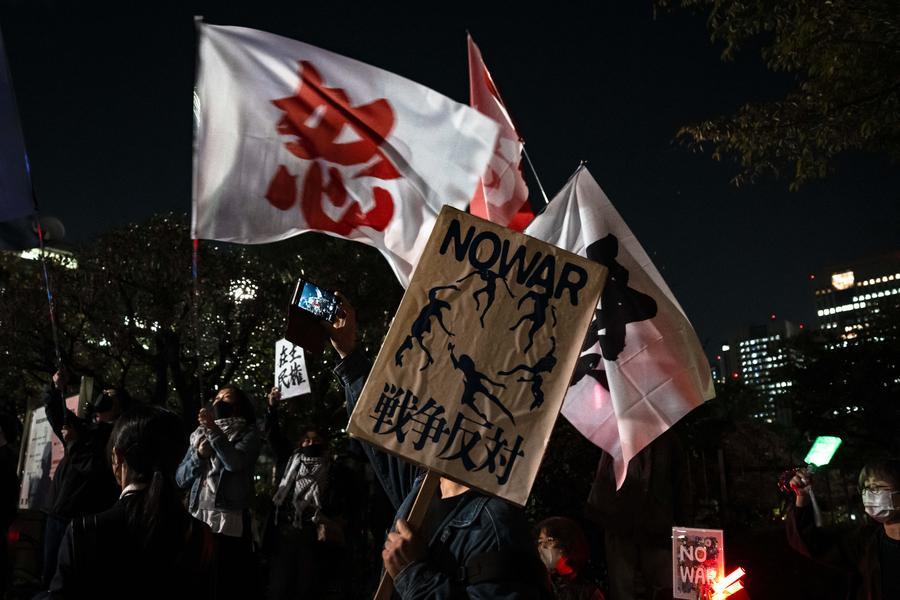
As Japan faces mounting economic and fiscal pressures, Prime Minister Sanae Takaichi's administration is considering nearly doubling defense spending over the next five years, a move analysts warn could heighten regional tensions and further strain household budgets.
The Japanese government and ruling coalition are weighing a sharp increase in military spending as Takaichi seeks to expand the country's defense capabilities, Reuters reported on Monday, citing two people familiar with the matter.
The proposed five-year plan, starting in April 2027, would total 70 trillion to 80 trillion yen ($440 billion to $505 billion), about 1.8 times the roughly 43 trillion yen allocated under the current plan, which began in fiscal 2023.
One source said the new spending was expected to fund purchases such as large numbers of drones, while a weaker yen had driven up the cost of defense equipment procurement.
The other source said the final figure could settle in the mid-to-high 70 trillion yen range, but questioned whether that would be sufficient given the "security environment" in East Asia. The government and its coalition partners were still debating the final amount, the source added.
Under its current defense buildup program, formulated at the end of 2022, Japan sharply raised planned military spending from an initial allocation of 27.5 trillion yen, with a focus on long-range missiles for counterstrike capabilities, ammunition and spare parts for military equipment.
However, Japan's economy remains on a fragile recovery path, with growth losing momentum and persistent pressures weighing on domestic demand.
Last month, the International Monetary Fund projected that Japan's nominal GDP in US dollar terms would be overtaken by those of India and the United Kingdom next year, pushing Japan from fourth to sixth place globally.
Defining feature
Liu Shuliang, an associate researcher at the Tianjin Academy of Social Sciences, said the sustained expansion of defense spending has become a defining feature of Japan's military and security policy in recent years, serving both as a key driver of its accelerating remilitarization and as a financial engine for the process.
Japan has openly moved beyond the constraints of its exclusively defense-oriented policy, developing long-range strike capabilities and expanding its military presence in space and AI, Liu said.
"These moves have raised questions about Japan's adherence to Article 9 of its Constitution and its postwar commitments, as well as whether its expanding military capabilities go beyond what is necessary for national defense," he said.
Japan's plan to further increase defense spending and bring forward its target of raising expenditure to 2 percent of GDP points to a further shift in its security policy toward a more offensive and proactive posture, with potentially serious implications for regional peace and stability, he said.
Chen Hong, director of the Asia-Pacific Studies Center at East China Normal University in Shanghai, said the Takaichi administration has invoked pretexts such as the so-called deterioration of the regional security environment to blur the line between defense and offense, seeking to pave the way for a return to militarism.
Playing up threats
By playing up external threats and stoking regional security anxieties, Japan has sought to justify its efforts to break through postwar military constraints and expand its defense capabilities, Chen said.
This has helped construct a narrative that Japan is being "forced" to overhaul its defense policy and substantially expand its military capabilities in response to what it describes as an increasingly "severe and complex security environment", he said.
Such an approach will leave less room for rational diplomatic dialogue, embolden right-wing forces seeking to overturn the postwar order, and risk turning Japan's own narrative of a deteriorating security environment into a self-fulfilling prophecy, he added.
Both Liu and Chen warned that Japan's continued expansion of military spending will put further pressure on public finances, potentially squeezing resources for education, healthcare and social security and leaving ordinary citizens to bear the costs of military buildup.
Japan's fiscal resources are already under considerable pressure, as the country faces an aging population, a declining birth rate, mounting public debt and sluggish economic growth, the experts said.
Despite these pressures, the government is determined to channel massive additional funds into military expansion and is even considering tax increases to secure the necessary financing, said Liu of the Tianjin Academy of Social Sciences.
"Such a shift in fiscal priorities risks diverting resources from social welfare, ultimately making ordinary Japanese citizens bear the costs of the country's military expansion," he said.
Chen said large-scale arms purchases would further deepen Japan's dependence on United States military equipment and technology, effectively directing substantial public funds into the US defense industry.
Japanese citizens, meanwhile, would bear the financial burden at the expense of resources that could otherwise be devoted to improving their livelihoods, he said.