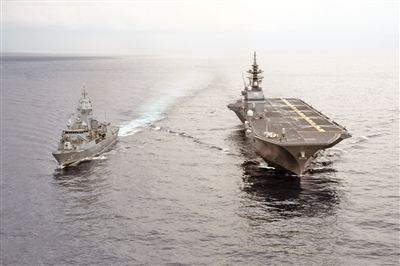
The Royal Australian Navy Anzac-class frigate (left) conducts a joint exercise with the Izumo-class helicopter destroyer of the Japanese Maritime Self-Defense Force (JMSDF).
澳大利亚皇家海军安扎克级护卫舰(左)与日本海上自卫队出云级直升机驱逐舰进行联合演训。
Japan is likely to sign the Reciprocal Access Agreements (RAA) with France and the Philippines to facilitate exchanges of military forces in the near future. Japan had already concluded the relevant agreements with Australia and the UK earlier. And since 2022, Japan has frequently interacted with multiple countries to facilitate endorsing this type of agreement, aiming to achieve a breakthrough in the outward-oriented transformation of the Japan Self-Defense Forces (JSDF). Such moves will undoubtedly pose a serious threat to the security and development in the Asia-Pacific region.
近期,日本或将与法国、菲律宾签署便于军事力量相互往来的《互惠准入协定》。此前,日本已与澳大利亚、英国签署该协定。自2022年开始,日本与多个国家频频互动,意图与多国签署《互惠准入协定》,实现日本自卫队的“外向型”转型突破。此举无疑将对亚太地区安全与发展产生严重威胁。
Woo multiple parties to sign these agreements
拉拢多方签署协定
The so-called RAA refers to a bilateral military agreement executed with another country by Japan, aiming to facilitate joint military operations and logistical cooperation between the two sides. The agreement eliminates the applicability of relevant legal procedures by stipulating how military personnel of the other party are positioned and treated during mutual visits by specific terms and conditions, which simplify the jurisdictional issues involved in the incoming troops of another country, including entry and exit of military personnel, carriage of weapons, personnel jurisdiction and their right of self-defense. For example, the Japan-Australia Reciprocal Access Agreement officially entered into force on August 13, 2023, which means that the Australian armed forces are permitted to visit and garrison in Japan, and the JSDF also are authorized to carry out missions within Australia based on this treaty.
所谓《互惠准入协定》,是日本向其他国家发起的一项双边军事协议,旨在为日本与签署协定国之间的联合军事行动和后勤合作提供便利。协定以约定条款替代法律程序,规定了两国军事人员互访至对方国家后的地位、待遇,简化了部队进入对方国家所涉及的管辖权问题,如军人出入境、武器携带、人员管辖和自卫权利等问题。今年8月13日,日澳《互惠准入协定》正式生效。这意味着澳大利亚武装力量可据此协定访日、驻日,日本自卫队也可据此协定前往澳大利亚境内执行任务。
Flout the pacifist Constitution by all means
极力架空和平宪法
The reason why Japan is persistent in these agreements with other countries is mainly because it tries to evade the problems such as lack of lawful support and procedure complicacy encountered by foreign troops entering Japan or the JSDF on overseas missions. Previously, subject to the Emergency Powers Act and other laws relevant to the JSDF, Japan is allowed to send the forces overseas, but only limited to special cases including United Nations' Peacekeeping Operations (UNPKO), humanitarian relief, and response to US' collaborative demands, which require discussion case by case and approval from the National Diet of Japan.
日本之所以执着与他国签署《互惠准入协定》,主要是想绕开外国军队进入日本及自卫队赴海外执行任务时面临的国内法律缺失和烦琐手续制约等问题。此前,根据日本自卫队《紧急事态法》等法律,日本虽允许向海外派遣自卫队,但仅限于联合国维和行动、人道主义救援和响应美国协同需求等特殊情况,且需要一事一议并征得日本国会批准。
Furthermore, questions, such as how many personnel to be dispatched, whether to carry weapons and under what circumstances to use weapons, also need interrogations by the National Diet. By signing the RAA, Japan is able to circumvent some legal issues and provide convenience for the JSDF to carry out military missions in signatory countries.
此外,围绕派出多少人员、是否携带武器、何种情况下能够动用武器等问题还需接受日本国会质询。而通过签署《互惠准入协定》,日本可规避一些法律问题,为自卫队赴签署国执行军事任务提供“绕法而行”的便利。
In fact, the RAA is just one aspect of Japan's overseas military deployments. At present, Japan has reached agreements concerning the transfer of defense equipment and technology with the US, the UK and Australia, the agreements on the protection of classified military information with the US, Canada, Australia and Italy, as well as established “2+2” dialogue mechanism with the US, the UK, Germany, Canada and other countries.
实际上,《互惠准入协定》只是日本海外军事部署的一个侧面。目前,日本与美国、英国、澳大利亚等多国签署《防卫装备品和技术转移协定》,与美国、加拿大、澳大利亚、意大利等国签署《军事情报保护协定》,与美国、英国、德国、加拿大等国建立了“2+2”会谈机制。
The Japanese government is currently making every endeavor to break the constraints of the pacifist Constitution. The RAA and other bilateral treaties and mechanisms have undermined and gradually void this Constitution just like termites eating away at the bones.
当前,日本政府正千方百计突破和平宪法的约束。《互惠准入协定》等双边协定和机制,正如白蚁蚀骨般对日本和平宪法进行破坏,使和平宪法的约束功能逐渐名存实亡。
Accelerate military expansion
加速推动军事扩张
Each RAA represents not only another simplified bilateral mechanism and another military partner country for Japan, but also an additional destination for overseas military missions to the JSDF. This is definitely important for the country which is eager to cast off the restrictions of the postwar order and seek overseas military deployment.
每一份《互惠准入协定》的签署,意味着日本不仅获得一份简化的双边机制和一个军事伙伴国,还意味着日本自卫队多了一个执行海外军事任务目的地。这对于急于摆脱战后秩序限制、谋求海外军事部署的日本而言,无疑是重要的。
On the one hand, it attempts to pave the way for the military normalization process by deepening bilateral military interactions. As signatories to the agreements gradually increase, Japan can regularly draw them in for joint training and exercises in the future, and also frequently send its Self-Defense Forces to participate in training overseas depending on the circumstances. This will increase the tolerance within and outside Japan to its overseas military deployment, military normalization and other activities, shaping public discourse for its promoting constitutional amendment and achieving the so-called national normalization at the political and military levels.
一方面,通过深化双边军事互动,为“军事正常化”进程作铺垫。随着协定签署国逐渐增多,日本今后可常态拉拢诸多签署国入境日本进行联合演训,也可根据情况频繁派遣自卫队“出海”参与训练。这将提高日本国内外对海外军事部署、“军事正常化”等问题的耐受度,为今后推动修宪议题、实现政治和军事层面所谓“国家正常化”作舆论铺垫。
On the other hand, it intends to establish an exclusive military partner network by acting as the pawn of the US in the Asia-Pacific. In recent years, the US has constantly formed small cliques to suppress other countries under the guidance of the so-called great power competition strategy. In this context, Japan has cajoled multiple countries to intervene in the security affairs of the Asia-Pacific within the framework defined by the US through the RAA and other mechanisms, in an attempt to internationalize the hot issues related to the region and instigate more countries to stand for Japan.
另一方面,充当美国亚太“马前卒”,建立排他性军事伙伴网络。近年来,美国在所谓“大国竞争”战略引导下,不断组建“小圈子”打压他国。在此背景下,日本通过《互惠准入协定》等机制,在美国划定的框架内拉拢多国介入亚太地区安全事务,企图将该地区热点议题国际化,并鼓动多国为日本站台。
With the continuous expansion of the Reciprocal Access Agreement, it is foreseeable that extraterritorial military forces will frequently appear in the Asia-Pacific region, and the Japan Self-Defense Forces will also roll out overseas military deployment regularly, which will bring about negative impacts on the security situation in this region and even to the world.
可以预见,随着《互惠准入协定》的不断扩展,域外国家军事力量将频繁出现在亚太地区,日本自卫队也将常态进行海外军事部署,这将给亚太地区乃至全球安全局势带来负面影响。