By Jia Pingfan
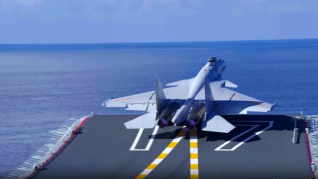
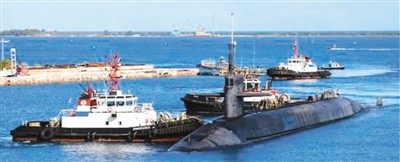
The US has been flexing its muscles again in the Indo-Pacific recently. As of January 20, Beijing time, the US Navy had successively deployed five naval formations comprised of aircraft carriers and amphibious assault ships on the West Pacific around the South China Sea, and the Ohio-class nuclear-powered strategic submarine USS Nevada also showed itself, rarely, on a high profile at the US naval base in Guam.
As the world’s top military power, the US is an old hand at throwing its weight around, but what is it driving at by trying to muddy the waters in the Indo-Pacific as China is about to celebrate the Spring Festival and host the Beijing 2022 Olympic Winter Games? Some experts held that the recent deployment of nuclear submarine and aircraft carrier strike group in the Indo-Pacific region is more to bluff than bear any substantive fruit.
“Usually the whereabouts of America’s strategic nuclear submarine is the top military secret that wouldn’t be divulged to the outside world. Therefore, the US military’s trumpeting of USS Nevada’s itinerary is unusual, with an evident intention at strategic deterrence,” said Wei Zongyou, a professor at Fudan University’s Center for American Studies, in an interview.
According to Guo Xiaobing, director of the Center for Arms Control Studies, China Institutes of Contemporary International Relations, “(the deployment of the nuclear submarine) indicated two things. On the one hand, the US is speeding up the shift of strategic focus to the Indo-Pacific now that it has pulled itself out of Afghanistan, and has stepped up deployments in the West Pacific. On the other hand, in America’s nuclear strike plan, the sub-plan for attacking East Asia has been further substantiated.”
Reinforcing strategic deterrence against China
The 76th session of the United Nations General Assembly (UNGA) in December 2021 adopted the Beijing Winter Olympic Truce Resolution, which, however, was rejected by the US. The world’s only superpower is expected to continue strengthening military exercises in the South and East China Sea this year.
“The US is dispatching strategic nuclear-powered submarine and aircraft carrier strike group to the Indo-Pacific with a view to flexing muscles and exerting military deterrence against China,” said Professor Wei. He added that the deployment was a major step taken by the Biden administration to roll out the new Pacific Deterrence Initiative and reassure its regional allies, and also a deterrent move targeted at DPRK,who launched a missile recently, as a pacifier for Asian-Pacific allies such as Japan and ROK.
“The US is in the habit of sending threatening signals by deploying its nuclear submarine. Its recent move of dispatching the submarine and carrier strike group to the Indo-Pacific, which are mere paper tigers, is primarily for bluffing,” analyzed Guo Xiaobing.
“China’s nuclear policy prevents it from taking the preemptive step in using nuclear weapons, but the US has no such restrictions,” reported Russia’s Sputnik, saying that America’s nuclear posture review of 2018 allowed it to use nuclear weapons even against non-nuclear-weapon rivals.
“On January 3, leaders of the five nuclear-weapon states – China, France, Russia, the UK and the US – delivered the Joint Statement on Preventing Nuclear War and Avoiding Arms Races. Days later, Washington dispatched on a high profile its strategic nuclear submarine to the Asia Pacific and gathered several aircraft carrier strike groups in the South China Sea to “flex muscles”. That was in no way conducive to the China-US strategic mutual trust or the regional peace and stability, but only indicated that the US has gone back on its own words,” analyzed Wei.
Muscle-flexing of little use
“America’s strategic nuclear submarine is of tremendous destructive power, but that is exactly the reason why it is of little practical use,” said Guo. To use nuclear weapons, the US must be prepared to suffer losses itself. Its allies have been doubting whether the US would be willing to sacrifice its homeland security to protect the allies once a nuclear conflict is threatening. In this sense, the strategic nuclear submarine is no more than a paper tiger thatis really only scary in appearance, not in fact.
“America’s constant muscle-flexing in the Indo-Pacific region has added to the risk of an armed conflict,” said Guo. For one thing, the action has exacerbated regional tension and the risk of conflict, giving more weight to military factors in the international relations in the region. For another, it has intensified underwater arms race. Third, it has increased the risk of a nuclear accident.Fourth, the frequent appearance of US troops has increased the risk of COVID-19 transmission.
How to mitigate tension in the Indo-Pacific?
“The international community and regional countries should make efforts in the following areas. First, they should uphold the new vision of common, comprehensive, cooperative and sustainable security, and oppose the hegemonic security outlook that is divisive, one-sided, confrontational and short-sighted. Second, they should reinforce crisis prevention and management, not only emphasizing communication and coordination after a crisis broke out, but also highlighting mutual respect for each other’s core interests and avoiding conflict and confrontation. Third, they should work together to preserve a generally stable security environment and sound development momentum in the Indo-Pacific, focusing on common development and preventing the Middle East chaos from recurring in this region because of the meddling by external forces,” said Guo.
According to Wei Zongyou, countries in the region should make full use of the East Asia Summit and other multilateral mechanisms to oppose any country conducting military deterrence or intimidation in the Asia Pacific, especially with nuclear weapons. They should also oppose bloc confrontation, arms race and a new Cold War. Moreover, China and the US should continue to engage and consult on how to co-exist peacefully, manage the crisis, ease tension, and prevent an arms race in the Asia Pacific, in a bid to jointly preserve peace and stability in the region.
Disclaimer: This article is originally published on the world.people.com.cn, and is translated from Chinese into English and edited by the China Military Online. The information, ideas or opinions appearing in this article do not necessarily reflect the views of eng.chinamil.com.cn.