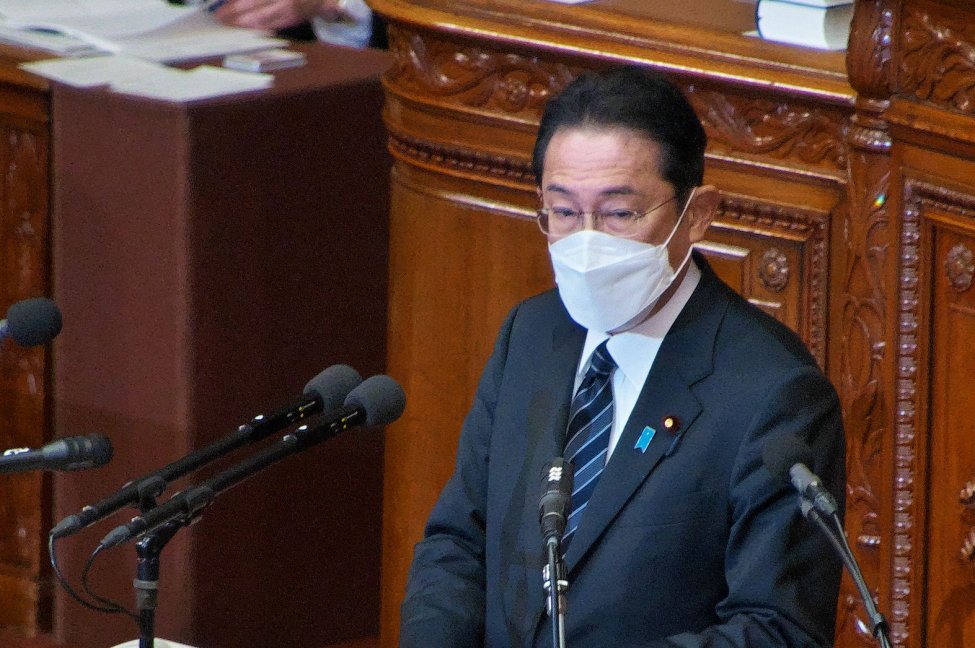
Japanese Prime Minister Fumio Kishida said a few days ago that the Japanese government has no intention of discussing the nuclear-sharing policy under which US nuclear weapons will be deployed on Japanese territory for joint use. But there is no problem for the Liberal Democratic Party (LDP) and other parties or Japanese people to discuss the matter.
Nuclear-sharing is an enhanced part of the nuclear umbrella provided by the US to NATO allies, that is, the nuclear weapons deployed in allied countries in peacetime are controlled by the US and they could be loaded to allied fighter jets in wartime, which is basically equivalent to "nuclearization of non-nuclear countries". Recently, there has been a series of dangerous voices violating Japan's Three Non-Nuclear Principles, exposing the dangerous trend of the lingering ghosts of militarism in Japan.
One of Japan's aims for allowing the nuclear-sharing policy discussions is to create a public opinion atmosphere that breaks through military restrictions. On February 27, former Japanese Prime Minister Shinzo Abe said in a TV show that due to the conflict between Russia and Ukraine, it is difficult to guarantee global security, and Japan should consider the nuclear-sharing policy and deploy and jointly use US nuclear weapons like some NATO member states. Japan is the only country in the world that has suffered a nuclear attack and the discussions on whether to have nuclear weapons have always been taboo in Japanese society. Some right-wing conservative forces have also joined in since Abe started this rhetoric.
Some Japanese politicians openly threw out the rhetoric of nuclear-sharing with the US, and the Japanese government allowed the political circles and the people to discuss related topics. One of their main purposes is to break the taboo of public opinion, create a public opinion atmosphere for the realization of the so-called normal country, and finally break through the peace constitution restrictions on Japan's military power. This reflects the fact that militarism has not yet been completely eradicated in Japan.
Allowing nuclear-sharing policy discussions clearly violates the country's three non-nuclear principles. In December 1967, when the then Japanese Prime Minister Eisaku Sato responded to a question about his attitude towards nuclear weapons at the Budget Committee, he committed Japan's "Three Non-Nuclear Principles" for the first time, i.e., principles of "non-possession, non-production, and non-introduction of nuclear weapons". The Japanese Diet passed a resolution in November 1971 to make the Three Non-Nuclear Principles the basic policy of the Japanese government on nuclear weapons.
Tetsuo Kotani, a professor of Meikai University, said in an interview with Chunichi Shimbun on March 13 that the deployment of nuclear weapons in Japan contradicts the "non-introduction of nuclear weapons". Living in the only country that has suffered a nuclear attack, Japanese nationals will not allow it.
Allowing nuclear-sharing policy discussions also violates its international obligations on nuclear non-proliferation. Japan became a party to the Treaty on the Non-Proliferation of Nuclear Weapons (NPT) in the 1970s. The treaty stipulates that non-nuclear-weapon States parties have committed themselves not to manufacture or otherwise acquire nuclear weapons or other nuclear explosive devices, not to accept any assistance in the manufacture of nuclear weapons, nor to seek nuclear weapons provided directly or indirectly by any other country. Therefore, the recent moves by Japan conflict with the spirit of the treaty and violate its international obligations as a party to the NPT.
In recent years, catering to the US’s strategic deployment of the US, the Japanese government has repeatedly emphasized the need to maintain the so-called "rules-based international order". The NPT is the cornerstone of the international nuclear disarmament and non-proliferation system, and an important part of the post-war international security system. What Japan is doing now in the nuclear-sharing policy is precisely a provocation and destruction of the post-war international order.
As the only country in the world that has suffered a nuclear attack, Japan has now begun to study the deployment of nuclear weapons in its own territory by the US. This is not only an irony but also a huge real risk, which deserves the vigilance of the region and the international community.
Editor's note: This article is originally published on haiwainet.cn, and is translated from Chinese into English and edited by the China Military Online. The information, ideas or opinions appearing in this article do not necessarily reflect the views of eng.chinamil.com.cn.