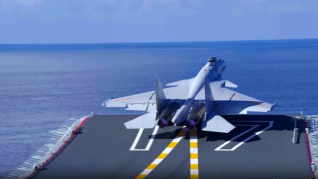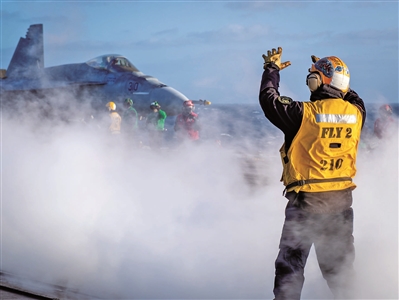
A US sailor signals to an F/A-18 Super Hornet fighter aboard the USS Carl Vinson CVN-70 aircraft carrier on March 26.
By Wang Changfan, Wu Meng
According to the American media, of the $ 842 billion defense budget request presented by the Biden government for FY2024, 15.3 billion US dollars is separately allocated to the United States Indo-Pacific Command (USINDOPACOM), which recently submitted another priority wish list of about 3.5 billion US dollars to the US Congress, aiming to further expand the military investment in Asia-pacific.
On the basis of the Indo-Pacific Strategy and the pretext of counterbalancing regional imaginary enemies, the US has been increasing defense budgets for its troops in the Asia-Pacific region, attempting to maintain its military deterrence and achieve political and strategic ambitions. To cater to the implementation of this regional strategy, the US parties spare no efforts to overplay the significance of the Pacific Deterrence Initiative and appeal to put more dedicated military investment in the western Pacific region. The superabundant military spending of the US will bring more uncertainties to the regional security of Asia-Pacific.
The US alleged that the security situation of the Indo-Pacific is getting deteriorated, while the risks of conflicts and crises within the area are elevated. In this context, it stepped up its efforts to make detailed allocation plans for the $15.3 billion budget, and strengthened overall military capability building in multiple ways. Among these budgets, 10.8 billion US dollars will be allocated to build "persistent battlespace awareness" capabilities and “integrated maritime fires”, which is expected to be able to resist all missile threats from land, sea and air and enhanced US troops’ precision strike capabilities; 2.3 billion US dollars will be spent on building new type hangars, satellite stations, storage spaces and other facilities to improve their integrated support capabilities in this region; 1.1 billion US dollars will be utilized to build various training fields, experimental labs, simulation centers and other similar facilities to accelerate innovation and experiment; another 1.1 billion US dollars will be employed to help its allies and partners strengthen military training and joint operations capabilities by conducting regular military cooperation.
In addition to the official defense budget request, the USINDOPACOM particularly presented a priority wish list of about 3.5 billion US dollars to the US Congress. It is learned that this list includes about 30 items, including procurement of high-performance missile, support for joint training and exercises, as well as support for competitions in aerospace, network and other emerging fields. The amount of the investment is twice the budget sum of the other five US unified combatant commands, which reflects the significance the US attaches to the military construction in the Asia-Pacific region.
Commander of the USINDOPACOM John Aquilino stated recently that the complementary investment is conducive to strengthening US military presence and deterrence in Asia-Pacific. To this end, the US military has taken multiple corresponding measures.
First, it will build a joint force targeting future wars to maintain and expand its regional military advantages. By May 2023, the US will achieve regional combat readiness by rotation operations of two fighting contingents in various domains. Second, it will consolidate the frontier military deployment to maintain its military capability to contain conflicts. By 2024, 5000 soldiers of the US III Marine Expeditionary Force will move to Guam. Third, it will develop its alliance and partnership with Indo-Pacific countries to reinforce the foundation for cooperation. The US continually enhances its relationship with Japan, ROK, Australia and other countries. Through concluding information-sharing agreements and conducting external military sales and military cooperation expansion activities, the US has increased defense building projects and military actions that are dominated by itself and participated by its allies.
Analysts pointed out that the US regular deployment of new types of ground operation forces, large-scale deployment of high-performance precision missiles, and extensive joint military actions will immensely devastate regional peace and stability, stimulate the security nerves of neighboring countries and further intensify arms race in the region.