In the speech during his visit to the US recently, ROK President Yoon Suk-yeol said that "if the Republic of Korea were to decide to arm itself with nuclear weapons, we have the technical foundation to do so within a short period of time, even within a year." As the head of a signatory to the Treaty on the Non-Proliferation of Nuclear Weapons (NPT), Yoon Suk-yeol's remarks have aroused widespread concern.
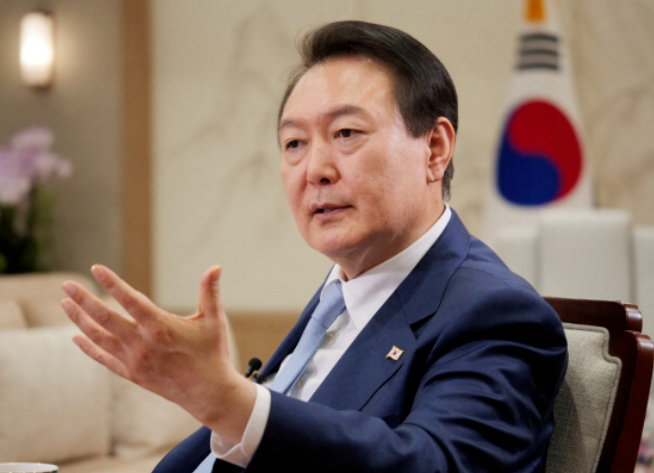
ROK President Yoon Suk-yeol. (Source: huanqiu.com)
Not long ago, Yoon Suk-yeol reached an outcome document, the Washington Declaration, with the US. The foundation of this agreement is that the ROK agreed not to develop nuclear weapons. Regarding Yoon's contradictory behavior of quickly proposing the idea of possessing nuclear weapons within a year, military expert Jin Yinan believes that Yoon Suk-yeol's statement should not be simply interpreted as just a political showmanship or an attempt to gain votes.
Jin says that Yoon's statement exposes the hypocritical nature of the Washington Declaration. While the declaration ostensibly promises denuclearization of the Korean Peninsula, the US has already made plans to deploy strategic nuclear submarines in the ROK for the long term. Without the consent or tacit approval of the US, Yoon would not to declare the possession of nuclear weapons within a year immediately after signing the agreement. It is a dangerous sign that Yoon made such statement with the tacit approval of the US, whose negative impact is completely beyond the joint military exercise between the US and the ROK close to the military demarcation line. If Seoul wants to possess nuclear weapons, the Korean Peninsula will face huge political and military impact.
Speaking of the ongoing Russia-Ukraine conflict, US strategic experts analyzed that Ukraine's way out lies in its neutrality. However, Ukrainian leaders insisted on joining NATO, and NATO agreed to accept Ukraine, which posed a bridgehead threat to Russia and ultimately led to the outbreak of the Russia-Ukraine conflict. The danger of Yoon's nuclear remarks lies in the fact that Seoul's current choices bear some resemblance to Ukraine's actions. It can be said that Yoon has abandoned the stance of neutrality on the nuclear issue upheld by previous presidents. Previously, ROK presidents sought to improve relations with the Democratic People's Republic of Korea (DPRK) to ease tensions on the Korean Peninsula, but Yoon is now taking a different approach.
Yoon abandoned the stance of neutrality on the nuclear issue upheld by previous ROK presidents and has fully aligned with the strategic arrangements of the US, vigorously catered to the strategic deployments of the US, and even actively accommodated the desires of Japan and used the ROK as a bridgehead to confront both the DPRK and China. In the Washington Declaration signed between the US and the ROK, they made irresponsible statements regarding the situation in the Taiwan Strait and the Taiwan question. Previous ROK presidents have never made such statements, but Yoon openly interferes in these matters. Therefore, it is not simply a matter of dismissing Yoon's pro-nuclear remarks as political posturing. Instead, this represents his envisioned strategic development direction for the future of the ROK, which could bring about great disaster for the country.
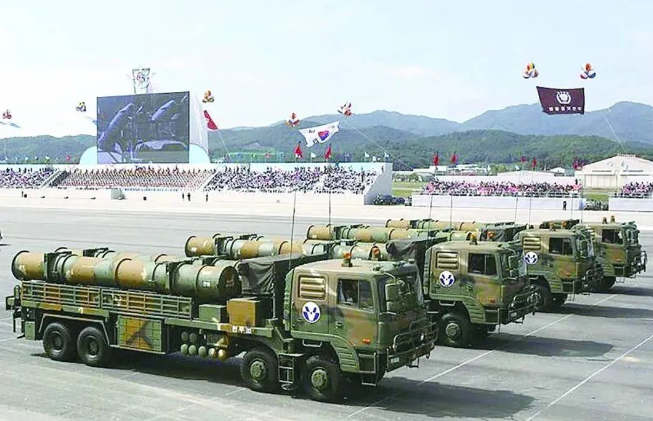
ROK Hyunmoo-3 cruise missile theoretically has the potential to carry a small nuclear warhead. (Source: huanqiu.com)
Currently, Seoul's capability to deploy nuclear weapons is gradually increasing. Suh Kune-yull, a professor emeritus of Nuclear Energy System Engineering at Seoul National University, claimed that Seoul has acquired the capability to handle spent nuclear fuel rods and enrichment technology at the level of nuclear-armed states. They could produce a nuclear bomb with an explosive yield of 20,000 tons of TNT within six months with a decisive decision from the government. In response to this, Jin believes that the key to the ROK achieving its nuclear goals does not lie with the ROK itself but with the US.
In 2009, then-US President Barack Obama delivered a speech in Prague, the capital of the Czech Republic and proposed the initiative of a "world without nuclear weapons". This brought temporary inspiration to the world, and Obama was awarded the Nobel Peace Prize. However, the US did not truly fulfill its commitment to a "world without nuclear weapons" and instead, took the lead in nuclear proliferation. The most notable example is the AUKUS agreement signed between the US, UK, and Australia. According to the agreement, the US and UK will jointly transfer strategic nuclear submarine technology, nuclear reactor technology, and technology for manufacturing nuclear weapons to Australia. Jin analyzes that after Yoon made his nuclear remarks, the US remained silent, neither opposing nor stopping it.
Whether the ROK eventually possesses nuclear weapons is a complex issue that involves international politics, regional security, and the dynamics of major powers. It is not determined by Yoon's intentions or Seoul's capabilities. However, the Yoon Suk-yeol government heavily leans towards the US, which will only limit Seoul's possibilities and space to determine its own destiny and path.
Editor's note: Originally published on military.cnr.cn, this article is translated from Chinese into English and edited by the China Military Online. The information and opinions in this article do not necessarily reflect the views of eng.chinamil.com.cn.