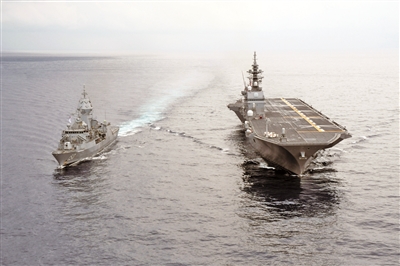
The Royal Australian Navy Anzac-class frigate (left) conducts a joint exercise with the Izumo-class helicopter destroyer of the Japanese Maritime Self-Defense Force (JMSDF).
Japan is likely to sign the Reciprocal Access Agreements (RAA) with France and the Philippines to facilitate exchanges of military forces in the near future. Japan had already concluded the relevant agreements with Australia and the UK earlier. And since 2022, Japan has frequently interacted with multiple countries to facilitate endorsing this type of agreement, aiming to achieve a breakthrough in the outward-oriented transformation of the Japan Self-Defense Forces (JSDF). Such moves will undoubtedly pose a serious threat to the security and development in the Asia-Pacific region.
Woo multiple parties to sign these agreements
The so-called RAA refers to a bilateral military agreement executed with another country by Japan, aiming to facilitate joint military operations and logistical cooperation between the two sides. The agreement eliminates the applicability of relevant legal procedures by stipulating how military personnel of the other party are positioned and treated during mutual visits by specific terms and conditions, which simplify the jurisdictional issues involved in the incoming troops of another country, including entry and exit of military personnel, carriage of weapons, personnel jurisdiction and their right of self-defense. For example, the Japan-Australia Reciprocal Access Agreement officially entered into force on August 13, 2023, which means that the Australian armed forces are permitted to visit and garrison in Japan, and the JSDF also are authorized to carry out missions within Australia based on this treaty.
Flout the pacifist Constitution by all means
The reason why Japan is persistent in these agreements with other countries is mainly because it tries to evade the problems such as lack of lawful support and procedure complicacy encountered by foreign troops entering Japan or the JSDF on overseas missions. Previously, subject to the Emergency Powers Act and other laws relevant to the JSDF, Japan is allowed to send the forces overseas, but only limited to special cases including United Nations' Peacekeeping Operations (UNPKO), humanitarian relief, and response to US' collaborative demands, which require discussion case by case and approval from the National Diet of Japan.
Furthermore, questions, such as how many personnel to be dispatched, whether to carry weapons and under what circumstances to use weapons, also need interrogations by the National Diet. By signing the RAA, Japan is able to circumvent some legal issues and provide convenience for the JSDF to carry out military missions in signatory countries.
In fact, the RAA is just one aspect of Japan's overseas military deployments. At present, Japan has reached agreements concerning the transfer of defense equipment and technology with the US, the UK and Australia, the agreements on the protection of classified military information with the US, Canada, Australia and Italy, as well as established “2+2” dialogue mechanism with the US, the UK, Germany, Canada and other countries.
The Japanese government is currently making every endeavor to break the constraints of the pacifist Constitution. The RAA and other bilateral treaties and mechanisms have undermined and gradually void this Constitution just like termites eating away at the bones.
Accelerate military expansion
Each RAA represents not only another simplified bilateral mechanism and another military partner country for Japan, but also an additional destination for overseas military missions to the JSDF. This is definitely important for the country which is eager to cast off the restrictions of the postwar order and seek overseas military deployment.
On the one hand, it attempts to pave the way for the military normalization process by deepening bilateral military interactions. As signatories to the agreements gradually increase, Japan can regularly draw them in for joint training and exercises in the future, and also frequently send its Self-Defense Forces to participate in training overseas depending on the circumstances. This will increase the tolerance within and outside Japan to its overseas military deployment, military normalization and other activities, shaping public discourse for its promoting constitutional amendment and achieving the so-called national normalization at the political and military levels.
On the other hand, it intends to establish an exclusive military partner network by acting as the pawn of the US in the Asia-Pacific. In recent years, the US has constantly formed small cliques to suppress other countries under the guidance of the so-called great power competition strategy. In this context, Japan has cajoled multiple countries to intervene in the security affairs of the Asia-Pacific within the framework defined by the US through the RAA and other mechanisms, in an attempt to internationalize the hot issues related to the region and instigate more countries to stand for Japan.
With the continuous expansion of the Reciprocal Access Agreement, it is foreseeable that extraterritorial military forces will frequently appear in the Asia-Pacific region, and the Japan Self-Defense Forces will also roll out overseas military deployment regularly, which will bring about negative impacts on the security situation in this region and even to the world.