By Jin Yi'nan
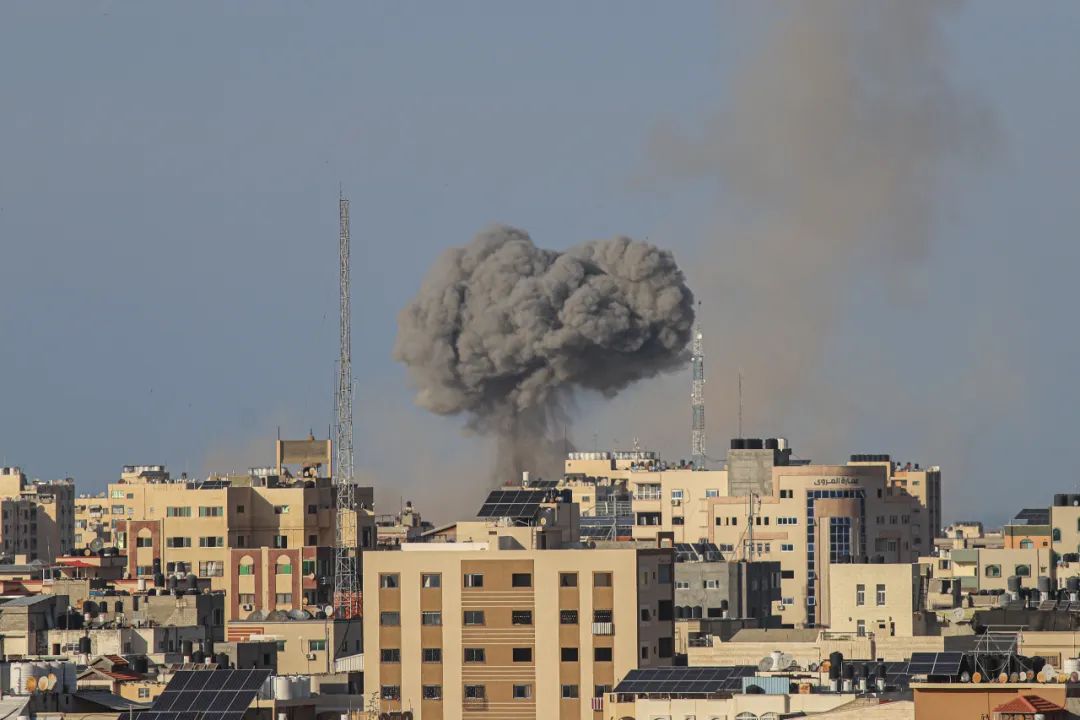
Israeli military launches air strikes on the ground buildings in Gaza City on October 7, 2023, local time.
The new round of Palestinian-Israeli military conflict breaking out on October 7, 2023 is astonishingly unparalleled in scale and intensity. More than 20,000 people have lost their lives and more than 50,000 injured in the Gaza Stripe so far, and the United Nations has warned that Gaza is suffering from an "unprecedented human catastrophe". The extent of devastation seen in this conflict is without precedent for both sides.
Previous Palestinian-Israeli conflicts including historical Middle East wars were mainly targeted at land capturing and occupation, and all ended with Israel's victory and set the stage for the prevailing geopolitical dynamics. However, this round of Palestinian-Israeli conflict carries stronger political implications. Israel has first found that its military victory in Gaza could not consolidate its political outcome but has created an unfathomable awkward situation in which more gains from the military operation mean greater moral losses.
Currently, there is an emerging trend internationally where the rich and poor are realigning themselves. The US-led EU countries are standing on the side of Israel while other countries are backing Palestine. This tearing apart is unlike anything we have seen before and is by no means limited to the Gaza Strip but extends throughout the world. Recently, the US and France have taken the rare step of sanctioning those people causing violence in Israel. Even the US, which has been demonstrating the most resolute support for Israel, is hesitant to fully align with Israel this time and condemns some of its actions in Gaza that are not in line with international humanitarian principles. Conflicts even arose among various races, civilizations, and religions in Harvard University, Princeton University, and other universities in the US. While the Palestinian-Israeli conflicts have endured for decades, they have never affected the world like this time.
The escalating battlefield situation seems to be quietly changing the geopolitical environment in the Middle East and even the global security order, profoundly impacting the regional and international security pattern.
First, the most immediate influence of the Palestinian-Israeli conflict is the reintegration of the Arab world. The previously divided Arab world has nearly all shifted towards the Palestinian side without exception under the current conflict. Mediated by the US, Saudi Arabia even considered establishing diplomatic relations with Israel some time ago, but now has to abandon the plan and firmly stand with Palestine with the outbreak of this conflict. At the recent Joint Arab Islamic Extraordinary Summit, the Middle East countries adopted a common position on the Palestinian issue with rare unity, which has played a positive role in promoting the settlement of the issue. Naturally, the extent to which the Arab world will integrate depends on the outcome of the current round of conflict in Gaza to a large degree.
Second, the sway of the US in the Middle East is deteriorating sharply. As a source of energy to the whole world, the Middle East has consistently been of paramount importance to the strategic interests of the US. However, the US' favoring Israel has again sparked resentful and antagonistic emotions toward itself from the people in the Middle East, intensified the contradictions between regional countries and Israel, and resulted in its previous efforts of easing relations between Israel and the Arab world coming to naught. The impacts of the US in the Arab world are diminishing rapidly as a result of this Palestinian-Israeli conflict. Although ultimately relying on Israel to constrain the entire Middle East, the US has to appropriately admonish Israel and create a suitable distance with it in case of excessive behaviors from the latter to maximize its own interests in the Middle East.
Third, this round of Palestinian-Israeli conflict is generating significant impacts on the global political pattern and economic development. The repercussions of this conflict on international energy prices and transportation routes will become gradually visible for the time to come. Amidst the current global era, its influences go well beyond politics and will rapidly permeate the realm of economics, playing a crucial role in determining the magnitude of the global economic recovery in the future.
Editor's note: Originally published on military.cnr.cn, this article is translated from Chinese into English and edited by the China Military Online. The information and opinions in this article do not necessarily reflect the views of eng.chinamil.com.cn.