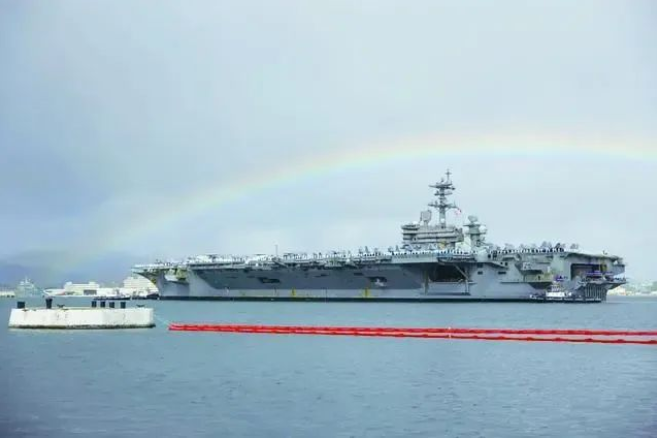
USS Carl Vinson arrives in Hawaii to participate in RIMPAC 2024. (File photo/Global Times)
By Wang Bing
The US-led Rim of the Pacific (RIMPAC) 2024 multinational maritime exercise, which is boasted as "the world's largest international maritime exercise", is now in progress and will last till August.
RIMPAC 2024 is proceeding in and around Hawaii, with subjects including anti-submarine warfare, multinational amphibious landing operations and other multi-domain operations. Forty surface vessels, three submarines, over 150 aircraft and more than 25,000 troops from 29 countries participate in the exercise.
Military observer Zhou Weizheng said that contents of the exercise are worthy of attention considering the unprecedented scale and real combat orientation. First, RIMPAC 2024 is the largest of its kind to date in terms of participating troops and equipment employed. Second, immediately after a succession of exercises held by the US in the Asia Pacific region, related troops were committed to RIMPAC 2024, which aims to put on a good bluff on the one hand, and examine the troops' capabilities of performing continuous missions on the other. Third, the exercise is deeply real-combat oriented, encompassing highly difficult subjects such as carrier battle group joint air control, joint anti-ship operations and joint anti-submarine warfare.
As "the world's largest international maritime exercise", RIMPAC has a history of more than 50 years. According to Zhou, the US keeps holding RIMPAC exercises over the years with the purpose of wooing allies, deterring opponents and selling its arms.
The US draws in some countries to participate in RIMPAC exercises each time. Among the participating countries, some are only present as observers, some are allowed to attend simple subjects such as marine navigation, search and rescue, and counter-terrorism operations, and hardcore allies can participate in core subjects including air and missile defense and joint anti-submarine warfare. These thresholds are set as a means for the US to win over other countries.
One of the highlights of this year's exercise is employing anti-ship weapons to "sink" a retired 40,000-ton US Navy amphibious assault ship. Zhou stated that the US has multiple considerations by selecting a large tonnage amphibious assault ship as the target.
First, the US intends to create stronger political influence. There are only a few countries operating carriers and amphibious assault ships in the Asia Pacific. By sinking a 40,000-ton amphibious assault ship in the exercise, the US aims to exert deterrence against certain great powers. Second, the US desires to verify the military operational effectiveness of its anti-ship weapons. In recent years, the US has developed several new or modified missiles and bombs. It is possible to verify the practical damage effect of those armaments and obtain critical data through the sinking of the target.
Zhou further pointed out that many participating countries have divergent core interests from the US. The US works hard to woo allies to undertake so-called great power confrontation and build a military alliance, but to no avail. Some countries are unwilling to embarrass the US, and some are subject to the pressure from the US, so they have no choice but to send troops to participate in related exercises. It reflects the fact that some countries including the US "allies" have discrepant positions and interests from the US in the Asia Pacific, and disapprove of US' acts of deliberately creating tension in relevant regions, and refuse to choose sides between great powers. Therefore, forcible military measures of the US have won it little genuine support from related countries.
Editor's note: Originally published on military.cnr.cn, this article is translated from Chinese into English and edited by the China Military Online. The information and opinions in this article do not necessarily reflect the views of eng.chinamil.com.cn.