By Ji Cheng and Du Jiahua
Following the release of the new Defense Space Strategy in June this year and the setup of the basic organizational structure for its space force, the US Department of Defense (DoD) has recently taken a swirl of moves to build up the space force, reported foreign media. Pentagon has not only accelerated selecting military service members responsible for space combat, but also made substantial progress in improving the defense space system by launching reconnaissance satellites and developing mini space stations. These measures obviously steering the space force toward real combat are bound to invoke strong dissatisfaction and policy response from other countries, aggravate the international space arms race while endangering global strategic stability.
US space force development advances in depth.
The US has taken multiple steps recently to push its space force buildup toward combat operations on all fronts and dimensions.
The US Space Force announced that it had just completed the selection of the first batch of 2,410 soldiers, who, picked out of 8,500 active-duty airmen, will officially join the space force in September and are tasked with space operation missions. Previously about 16,000 military and civilians have been assigned to serve in the space force.
On July 15, a Northrop Grumman Minotaur IV carrier rocket was launched at the Wallops Flight Facility in California, sending four reconnaissance satellites to orbit. The US National Reconnaissance Office (NRO) said the launch was aimed at providing intelligence support for the DoD and intelligence agencies. US media reported that the NRO would launch Minotaur IV again in due time next year carrying space reconnaissance satellite.
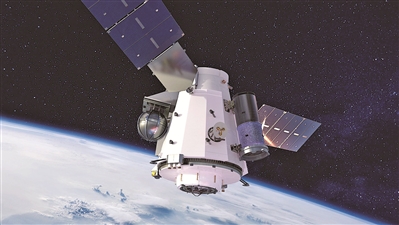
At the same time, the DoD has begun explorations to build mini space stations. Sierra Nevada Corporation, an American aerospace technology company, recently signed a contract with Pentagon’s Defense Innovation Unit to build experimental mini space stations, which, when renovated and upgraded, will be able to support “space assembly, microgravity experimentation, logistics and storage and other functions” and be equipped with sensors serving intelligence, monitoring and reconnaissance purposes as well as offensive or defensive weapons.
US space force building is more real-combat-oriented.
In America’s military strategy, space has evolved from a “propellant” that assists on the ground battlefield to a potential and important new battle domain. Guided by this concept, the US space force is increasingly oriented toward real combat, taking organizational perfection and inter-service combined operations as main breakthroughs.
Pentagon has taken faster steps to improve the space force’s organizational structure. At the end of June, Lt. Gen. David Thompson, vice commander of Space Force Headquarters , announced for the first time that the space force would consist of the Space Operations Command, Space Training and Readiness Command, and Space Systems Command. Space Operations Command will be responsible for the operation of military satellites, missile warning constellations and satellite communication systems.
A space satellite warning system targeting Russia’s strategic missiles and other weapons is being established. Although the US military has been secretive about the satellite carried by Minotaur IV, media reports revealed that it might be the NROL-129 reconnaissance satellite aimed to track the trajectory of Russian strategic missiles. In addition, hypersonic weapons with stronger penetration and attack capability are also a key focus for the US side.
The US military is accelerating the integration of space force with the modernization of conventional services. Take the US Army for example. Gen. Mike Murray, head of Army Futures Command, said they had successfully applied space technologies to improve the remote precise assault capability of artilleries. Developing long-range precision fires is considered the No.1 priority of US Army’s modernization and a core element in the theory of future multi-domain operations.
Closer attention should be paid to US hegemonic thinking.
The US military is moving more quickly to enhance the real combat capabilities of its space force for the following considerations.
On the one hand, Pentagon believes space supremacy is the prerequisite for precise attacks. During the Gulf War, the US military used spy satellites to monitor the trend of warfare, spy on targets, and navigate weapons. Soon after the Space Force was formed, reconnaissance satellites were used to successfully issue early warnings against incoming missiles from Iran, which was taken as the service’s first operation after its formation.
On the other hand, building a real-combat-ready space force is an important approach for the US to seek space hegemony. Washington believes that the ever faster development of science and technology has obviously increased the number of state actors capable of space competition, which is likely to escalate inter-state conflicts to a higher level, even triggering small-scale space conflicts. That’s why the US has been hyping up the space threats from other countries as an excuse for its own space development, in the attempt to jointly dominate the formulation of space code of conduct with its partners and seek space supremacy. Such hegemonic moves in the name of “America first” will seriously undermine global strategic stability and trigger a space arms race.