By Wang Shuo
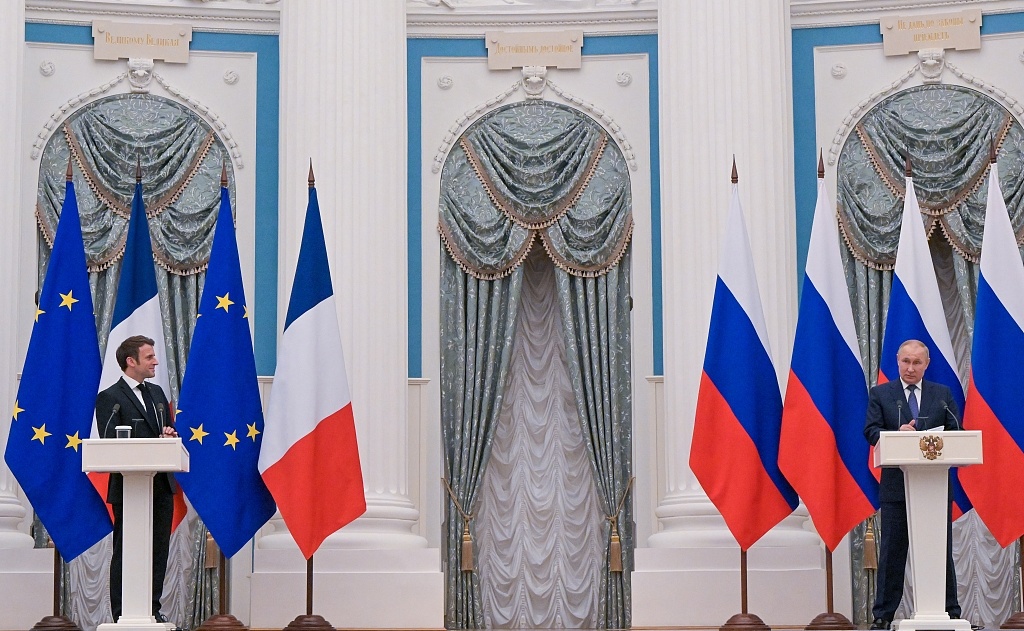
The tension in Ukraine continues to rise. While the US increased its troops to Eastern Europe, European countries launched intensive diplomatic mediation. Among them, France is particularly active. President Emmanuel Macron visited Russia on February 7 to hold talks with Russian President Vladimir Putin and became the first Western head of state to visit Moscow since the end of last year. Then, Macron visited Kyiv. As the current presidency of the Council of the EU, can France resolve the military confrontation crisis between Russia and Ukraine?
Europe and the US have some differences on the Ukraine issue. As a part of the Western camp, although Europe mostly follows the US, they have different fundamental interests. Although Europe hopes to maintain some pressure on Russia, it hopes to restart the "Normandy format " and ease the situation in a peaceful way for its own security. Of course, Macron has many considerations for being so proactive on this issue.
France will have a new presidential election in April this year. Although Macron is generally favored by the outside world, he still faces pressures. Macron came to power in the name of reform that is both the goal of his governance and the foundation of legitimacy. However, both strong social inertia and the sudden COVID-19 pandemic have seriously hindered and put on hold Macron's reform. The biggest challenge in Macron's re-election is not the challenge from the right, especially the far right, but how to persuade the people who have high expectations to vote for him again.
Charles de Gaulle's insistence on independence, maintaining France's status as a major power, and resisting American control has been deeply affecting France's foreign policy. Therefore, although France is a member of the alliance system under the leadership of the US, it has always maintained a certain degree of independence and advocated the formulation of foreign policies based on its own interests. The French people with a major power complex, have a high degree of acceptance of their president's diplomatic achievements. Macron, who regards "rejuvenating France's status as a great power" as his mission, will not miss such an opportunity.
It is because of the difficulty in advancing internal reforms that Macron is more eager to show his diplomatic capability and win the support of the public. Of course, Macron's strategic direction is right, and he hopes to use the diplomatic mediation on the Ukraine issue to show his image. However, it is hard to say what kind of results can be achieved.
First, neither France nor Europe is the decisive factor in the Ukraine crisis, nor do they have the key to solving the problem.
Second, Europe is not united. Although Macron is hailed as the "last European president" by the outside world, there are doubts about him within the EU as they believe that he represents French-style "selfishness" and "adventurous progress". In particular, some Central and Eastern European countries expect the US-led NATO to provide security guarantees, and they are not optimistic about the strategic autonomy advocated by Macron. The new German government's support for Macron will also be very limited.
Third, whether Macron can be re-elected is still in suspense. The latest polls show that Macron's approval rate is around 24%, and the Economist magazine estimates his chance of re-election is 79% on a model. But Macron is not without worries. He faces a highly divided French society with a modest edge over other candidates. Therefore, whether it is public or private, Macron needs to make a difference in the short term and deliver significant results. Although he cannot convince the US and Russia, at least he is trying to help solve the issue.
(The author is a professor at the School of International Relations and Diplomacy, Beijing Foreign Studies University)
Editor's note: This article is originally published on huanqiu.com, and is translated from Chinese into English and edited by the China Military Online. The information, ideas or opinions appearing in this article do not necessarily reflect the views of eng.chinamil.com.cn.